


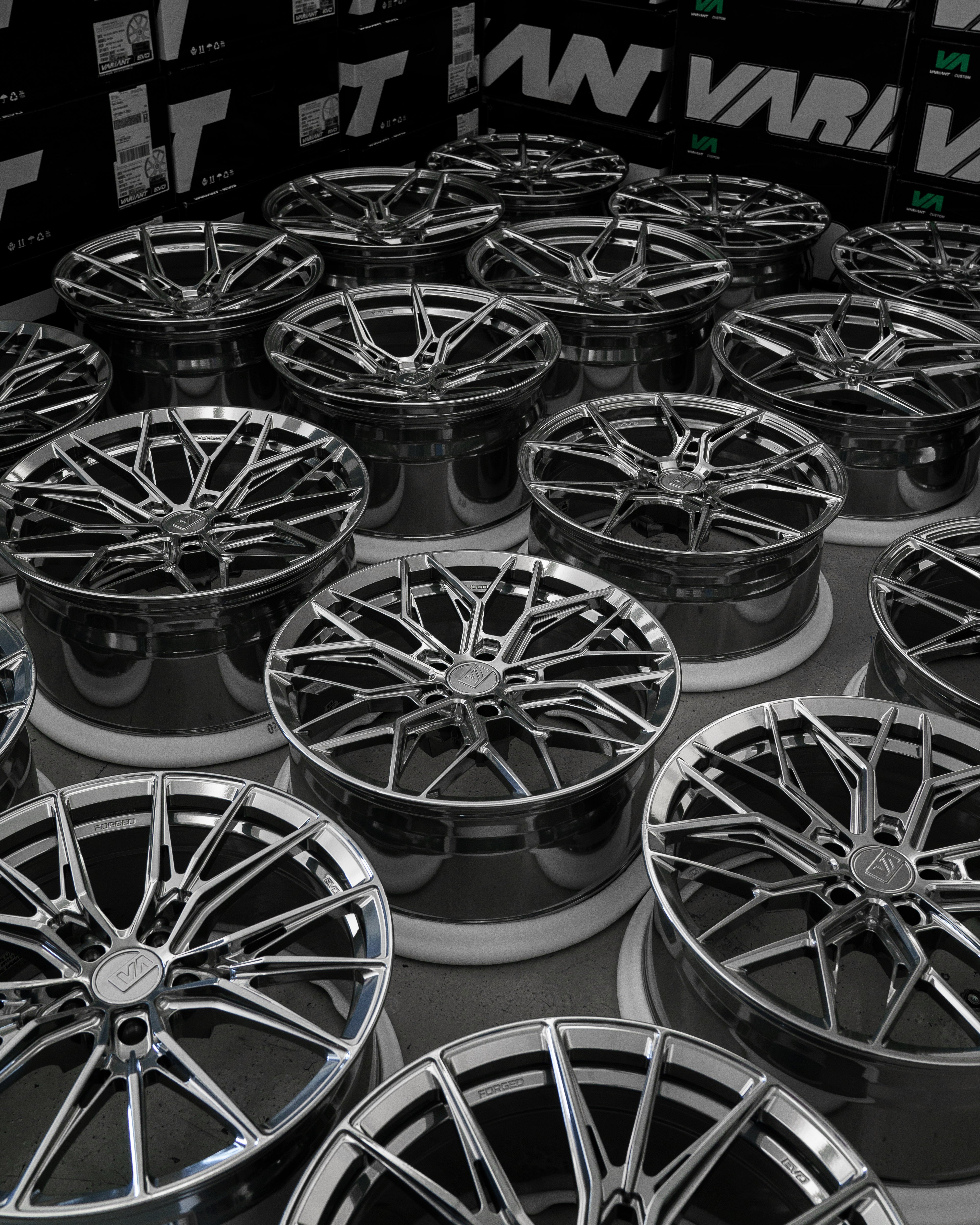

Key takeaways: The best wheels for the Audi RS6 Avant (C8) are lightweight forged monoblock or two-piece wheels in 21x10.5 or 22x10.5, run square at all four corners with a 5x112 bolt pattern and a 66.5 mm center bore. Square fitment is not a style choice on this car — quattro dislikes mismatched rolling diameters between axles. Because the RS6 weighs close to 5,000 pounds and carries very large brakes, load rating and caliper clearance matter more here than on almost any other wagon.
What are the best wheels for the Audi RS6, and what actually makes one better?
When people ask what the best wheels for the Audi RS6 are, they usually mean which size looks right. The more useful question is which wheel meets the RS6's specific engineering demands, because this car punishes a wheel in ways a lighter sedan does not.
The C8-generation RS6 Avant, sold in the U.S. from the 2021 model year, pairs a 4.0-liter twin-turbocharged V8 with a quattro all-wheel-drive system and a curb weight in the neighborhood of 5,000 pounds. Audi quotes around 591 horsepower for the standard car and 621 for the RS6 Performance. That combination — mass, torque, and all-wheel drive — means a wheel on this car sees loads that would be marginal on a 3,500-pound coupe.
So the shortlist is narrow: forged construction for strength-to-weight, a verified load rating, and a fitment that respects the drivetrain. Everything else is preference.
What is the RS6 C8 bolt pattern, center bore, and OEM wheel size?
The C8 RS6 uses a 5x112 mm bolt pattern and a 66.5 mm center bore, the same hub specification shared across most of the modern Audi range. Like other Audis, it uses lug bolts that thread into the hub rather than studs with nuts, which changes how you hang a wheel during installation.
Factory fitment is square. The common U.S. configuration is 21x10.5 with roughly a +19 mm offset wearing 275/35R21, with a 22-inch package available on some trims and option groups running 285/30R22. Sizes and offsets vary by model year, region, and option code, so confirm against your own wheels before ordering anything.
If you are unclear on how these numbers interact, our guides to bolt pattern and PCD and center bore and hub-centric rings cover the fundamentals. A 66.5 mm bore is small enough that many universal-bore wheels will require hub-centric rings, and on a vehicle this heavy, hub-centricity is not optional.
Should the RS6 run a staggered or square setup?
Run square. This is the single most important fitment decision on the car, and it is a mechanical constraint rather than an aesthetic one.
The RS6's quattro system continuously distributes torque between axles. When front and rear tires have meaningfully different rolling diameters, the center differential and clutch packs are forced to accommodate a permanent speed difference, which generates heat and wear. Staggered offsets front to rear are fine. Staggered tire sizes are not.
This is different from a rear-drive car, where a staggered setup is standard practice. Our breakdown of staggered vs. square setups explains why the drivetrain layout drives the answer.
Should you run 21-inch or 22-inch wheels on an RS6?
| 21-inch (21x10.5) | 22-inch (22x10.5) | |
|---|---|---|
| Typical tire | 275/35R21 or 285/30R21 | 285/30R22 |
| Sidewall height | Taller — more impact protection | Shorter — more rim exposure |
| Ride quality | Noticeably better on broken pavement | Firmer, more impact harshness |
| Tire cost and availability | Broader, generally less expensive | Narrower selection, higher cost |
| Unsprung weight | Lower | Higher at equal construction |
| Visual proportion | Balanced for a wagon body | Fills the arches, more presence |
| Winter viability | Workable with a dedicated set | Poor — too little sidewall |
Twenty-one is the more complete answer for a car that gets driven. Twenty-two is the right call if the RS6 is primarily a statement and you accept the ride penalty. What you should not do is go to 20 inches to save money on tires: the RS6's front brake discs are roughly 420 mm (16.5 in) on the steel setup and around 440 mm (17.3 in) with the carbon-ceramic option, so 21-inch is effectively the floor. Verify before you order using our guide to checking brake clearance.
How much does wheel weight matter on a car this heavy?
It matters more, not less. Unsprung weight is mass not supported by the springs, and reducing it improves how quickly a wheel can follow the road surface, how much work the dampers have to do, and how the car changes direction. On a 5,000-pound wagon with a stiff air-suspension calibration, the suspension is fighting a lot of inertia at every corner.
Factory 21- and 22-inch wheels on heavy German performance cars tend to be substantial — frequently 30 pounds or more per corner in the larger sizes. A well-designed forged monoblock in the same diameter and width will typically come in meaningfully lighter, because forging produces a denser, directionally aligned grain structure that lets you remove material without giving up strength. The exact figure depends entirely on design, width, and the load rating the wheel is engineered to.
We explain the mechanism in what is unsprung weight, and the material science in what is 6061-T6 aluminum.
Why does load rating matter so much on the RS6?
Because the RS6 is heavier than most of the cars a given wheel design was originally drawn for. Every wheel carries a maximum load rating per corner, and that figure must meet or exceed the load your vehicle actually places on it. The gross axle weight ratings on your driver's door placard are the reference — NHTSA's tire and loading guidance explains how to read them.
This is where a lot of RS6 owners get into trouble shopping on looks alone. A beautiful, extremely light wheel engineered for a 3,200-pound track car is the wrong part for a 5,000-pound wagon carrying a family at 90 mph on the interstate. Ask for the load rating in writing before you buy, and read what is a wheel load rating if you are not sure what number you need.
Which Variant wheels work on the RS6?
Variant builds true forged wheels only — no cast, no flow-formed — so every option below starts from the same construction baseline and differs in how the wheel is assembled and finished.
- Forged monoblock from the EVO Collection: one-piece, the lightest and most structurally efficient layout, and the simplest to keep clean. The default recommendation for an RS6 that gets driven hard.
- Two-piece from the EX2 Collection: a forged face joined to a forged barrel, which opens up more precise width and offset control — useful when you want a specific face profile at the RS6's +19 to +25 offset window.
- Multi-piece from the Corsa Collection: maximum control over concavity, lip depth, and finish combinations, at the cost of more assembly and more maintenance.
Start from your exact model year and trim in vehicle-specific fitments, or browse the full forged wheel catalog. If you want a finish that is not in the standard menu, the additional finishes option covers custom work. For a closely related platform, our Audi RS3 wheel guide covers the smaller end of the RS lineup.
Frequently asked questions
What is the bolt pattern on an Audi RS6 C8?
The C8 RS6 Avant uses a 5x112 mm bolt pattern with a 66.5 mm center bore and lug bolts rather than studs. This is shared across most of the modern Audi lineup, which makes the aftermarket selection unusually broad.
Can you run a staggered wheel setup on an RS6?
You can run staggered offsets, but you should not run staggered tire sizes. The quattro all-wheel-drive system is sensitive to differing rolling diameters between the front and rear axles, and a persistent mismatch adds heat and wear to the center differential. Keep all four tires the same size.
Will 20-inch wheels fit an Audi RS6?
Generally no. The RS6's front brake discs are roughly 420 mm on the steel setup and about 440 mm with carbon ceramics, which makes 21 inches the practical minimum diameter. Always verify caliper clearance against a specific wheel's inner barrel profile before ordering.
Are forged wheels worth it on an RS6?
On a vehicle of this weight and power, the strength-to-weight advantage of forging is doing real work rather than just adding cost. A forged wheel lets you cut unsprung mass while retaining the load rating a nearly 5,000-pound car requires, which is difficult to achieve with cast construction at the same weight.
What offset should you run on an RS6?
Factory offset is around +19 mm on the 21x10.5 setup. Most aftermarket fitments land in the +15 to +30 range at that width, depending on how flush you want the wheel to sit and whether the car is lowered. Lower offset pushes the wheel outward and increases rub risk at full compression.
Written by Taylor Smith, co-founder of Variant Alloy Wheels, who has spent nearly two decades in the automotive aftermarket.
Share:
Do Wider Wheels Give You More Grip?
How Do You Clean Forged Wheels Without Damaging the Finish?