


Key takeaways: Unsprung weight is the mass your suspension springs cannot control, mainly your wheels, tires, brakes, and hubs. Because that mass follows every bump in the road instead of being cushioned by the springs, reducing it improves grip, ride quality, braking, and acceleration more than removing the same weight from the body. For most drivers, fitting a set of lightweight forged wheels is the single easiest way to cut unsprung weight.
What is unsprung weight?
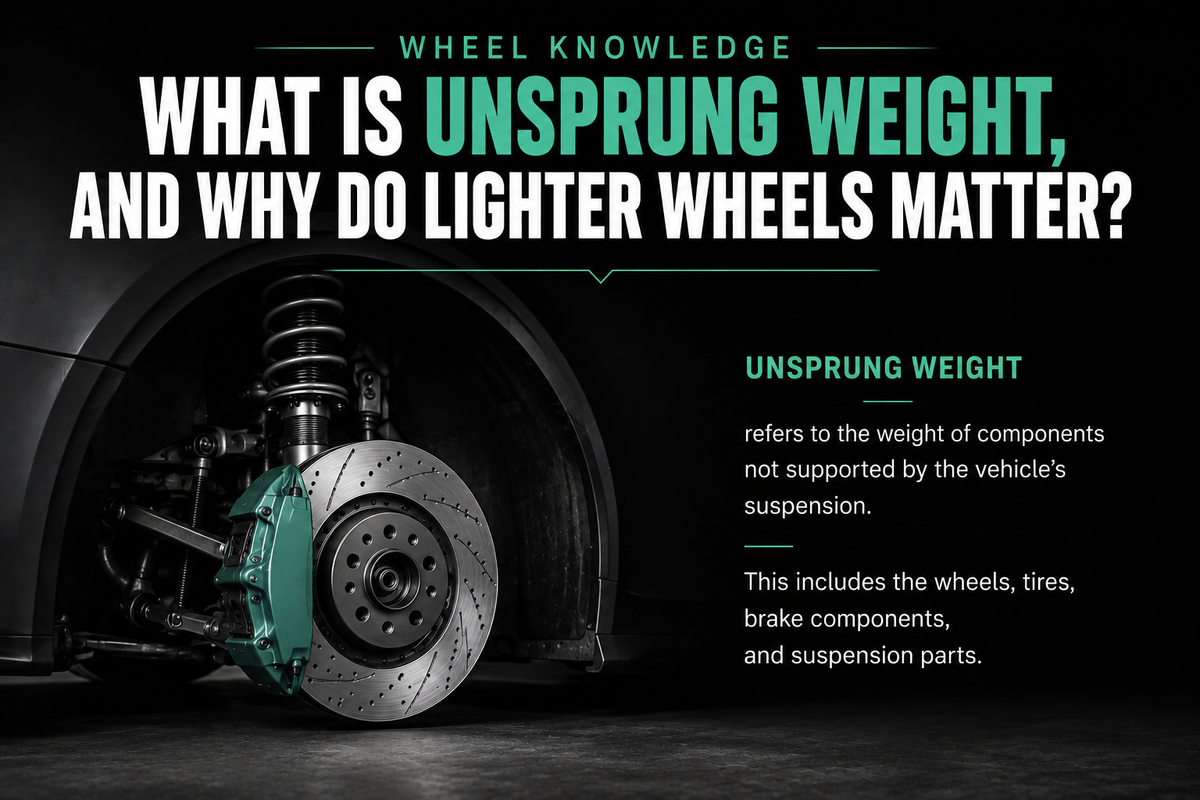
Unsprung weight (also called unsprung mass) is every part of the car that is not held up by the suspension springs. It includes the wheels, tires, brake rotors, a large share of the brake calipers and hubs, the wheel bearings, and roughly half the weight of the suspension arms and the springs themselves. Everything the spring supports, the chassis, body, engine, battery pack, seats, and passengers, is called sprung weight.
The distinction matters because the two masses behave very differently. Sprung weight rides on a cushion of springs and dampers, so it moves relatively slowly and smoothly. Unsprung weight is connected almost directly to the road, so it has to accelerate up and down rapidly every time a tire meets a bump, a pothole, or a dip. The heavier that unsprung mass is, the harder it is for the suspension to keep the tire planted.
Why does unsprung weight matter?
Unsprung weight matters because your suspension has one core job: keep the tire in firm, consistent contact with the road. Lighter unsprung mass is easier for the spring and damper to control, so the tire recovers from bumps faster and stays loaded more consistently. That improves grip, braking, ride comfort, and steering response all at once, which is why engineers and racers obsess over it.
You will often hear the rule of thumb that one pound of unsprung weight is worth roughly two pounds of sprung weight. Treat that as a directional guide rather than a hard law of physics. The real multiplier depends on the car, the suspension, and how the weight is distributed, and publications like Car and Driver have pointed out that the effect is often smaller than enthusiasts assume. What is not in dispute is the direction: less unsprung weight is better for handling, all else equal.
How does unsprung weight affect grip and ride quality?
Lighter unsprung mass tracks bumps more faithfully. When a wheel is light, the damper can push it back down onto the pavement quickly after a bump, so the contact patch stays loaded and grip stays steady. A heavy wheel carries more momentum, skips over ruts, and unloads the tire for a fraction longer, which shows up as a busier ride and less predictable grip on rough roads.
How does unsprung weight affect braking and acceleration?
Wheels and tires are not just unsprung, they are also rotating mass. Every pound at the rim has to be spun up under acceleration and slowed under braking, so it works against you twice: once as ordinary mass and once as rotational inertia. Cutting weight at the wheel therefore has an outsized effect on how quickly the car gathers speed and how short it stops compared with removing weight from, say, the trunk.
How does unsprung weight affect steering feel?
Lighter wheels reduce the gyroscopic resistance the front axle fights when you turn the wheel, so steering feels quicker and less inert off-center. It is a subtle change, but it is one of the first things drivers notice after moving from heavy cast wheels to a lighter forged set.
How much of your unsprung weight is the wheel?
The wheel is the biggest single piece of unsprung mass you can realistically change. Tires, rotors, and hubs are largely fixed by your car and your grip needs, but wheel weight varies enormously with how the wheel is made. Here is roughly how a typical 19-inch performance wheel compares across construction methods:
| Construction | Typical 19" weight | Relative strength-to-weight |
|---|---|---|
| Cast (gravity/low-pressure) | ~26–30 lb | Lowest |
| Flow-formed | ~23–27 lb | Moderate |
| Forged (6061-T6) | ~19–23 lb | Highest |
Those numbers vary with diameter, width, and design, but the pattern holds: a forged wheel is usually the lightest option at a given size and strength. Shaving four to six pounds per corner off a heavy factory cast wheel removes 16 to 24 pounds of unsprung, rotating mass from the car, and you feel it. For more on how construction drives weight, see our guide on whether forged wheels are lighter than cast wheels.
How do you reduce unsprung weight?
The most effective levers, in rough order of impact for a street car, are:
- Fit lighter wheels. This is the biggest and easiest gain, and forged wheels give the most weight savings without sacrificing strength.
- Choose sensible tire sizes. A lighter tire in the right size trims rotating mass, though never below the load rating your car needs.
- Avoid unnecessary hardware. Thick steel spacers and heavy accessory components add unsprung weight at the worst possible place, the outer edge of the assembly.
- Mind wheel diameter. Going up in diameter usually adds weight and rotating inertia, so weigh the looks of a bigger wheel against the performance cost. Our post on whether bigger wheels affect ride quality digs into that trade-off.
Do forged wheels reduce unsprung weight?
Yes. Forging compresses a solid billet of aluminum under enormous pressure, which aligns the metal's grain structure and makes it far stronger per gram than cast aluminum. Because the material is stronger, less of it is needed to hit the same strength target, so a well-designed forged wheel can be meaningfully lighter than a cast or flow-formed equivalent while being more resistant to bending and cracking. That combination, lower weight plus higher strength, is exactly what you want in unsprung mass.
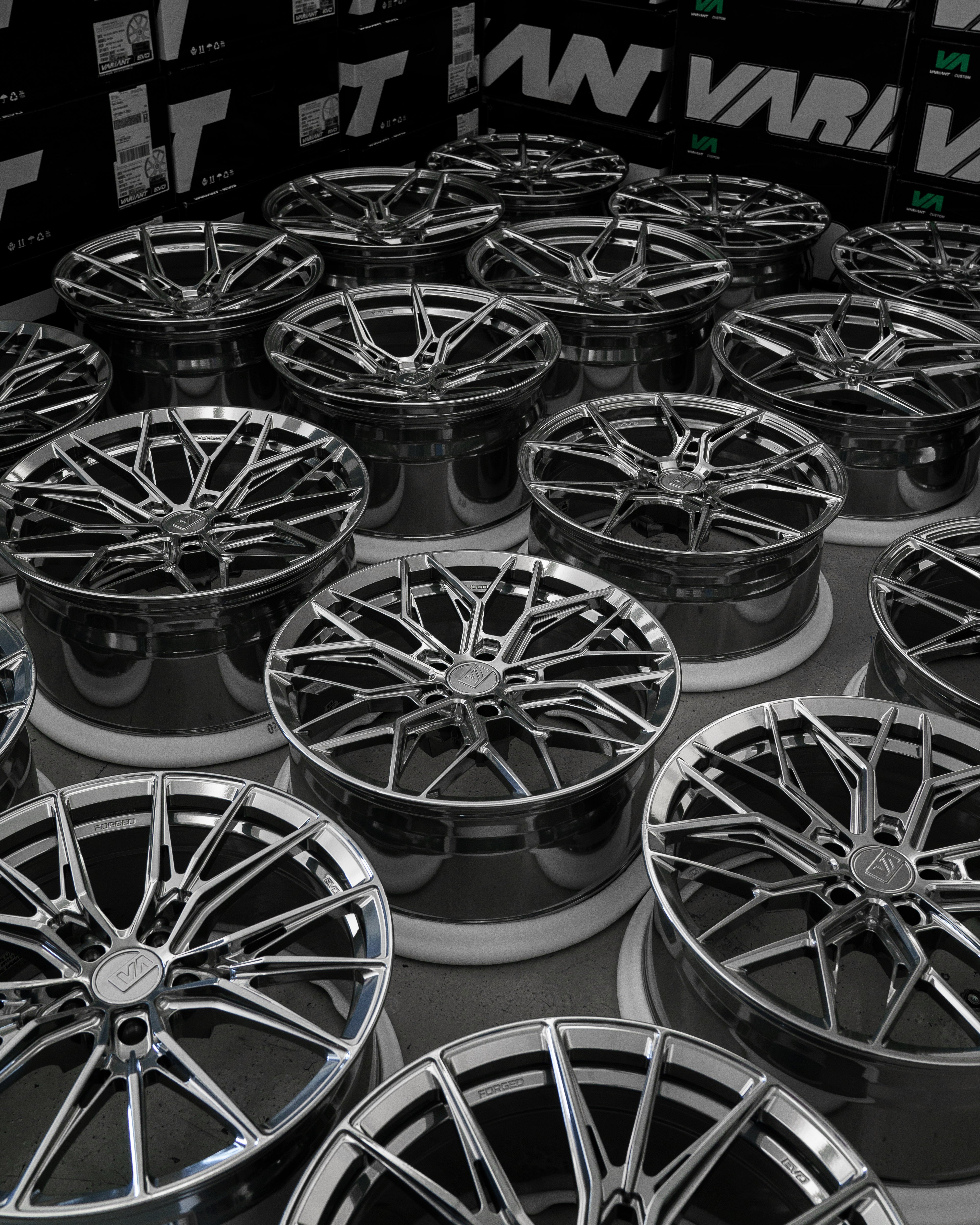
Variant builds every wheel as a true forged wheel from 6061-T6 aluminum, which is why weight is one of the first things we optimize. If you are shopping for a lighter setup, our Corsa, EVO, and Strada forged lines are built around exactly this priority, and you can browse the full forged wheel range or see the lightest forged wheels for your car. If you want the underlying physics, Wikipedia's overview of unsprung mass is a solid primer.
Frequently asked questions
Does unsprung weight really make a difference you can feel?
Yes, though the size of the effect depends on the car and the road. On a smooth highway you may notice little, but on a rough back road or a track, lighter wheels produce a calmer ride, steadier grip, and quicker steering that most drivers pick up on immediately.
Is one pound of unsprung weight really equal to two pounds of sprung weight?
It is a rule of thumb, not a precise ratio. The true multiplier varies with the vehicle and suspension design, and it is often less than 2:1. The reliable takeaway is directional: reducing unsprung weight helps handling more than removing the same weight from the body.
Do bigger wheels increase unsprung weight?
Usually, yes. A larger-diameter wheel typically weighs more and carries its mass farther from the center, which increases both unsprung and rotating mass. A lighter forged wheel can offset some of that penalty, but going up in size still tends to add weight overall.
Are forged wheels the best way to reduce unsprung weight?
For most street and performance cars, yes. The wheel is the largest piece of unsprung mass you can change, and forged construction gives the best strength-to-weight ratio, so a forged set is typically the most effective single upgrade for cutting unsprung weight.
Written by Taylor Smith, co-founder of Variant Alloy Wheels, who has spent nearly two decades in the automotive aftermarket.
Share:
What Are the Best Wheels for the Tesla Model S Plaid?
What Are the Best Wheels for the Chevrolet Corvette C8 Stingray?