


Key takeaways: Wheel brake clearance is not a single number, and it is not just wheel diameter. A wheel clears a brake kit only if three things work together: the wheel is large enough in diameter, the inner profile of the spokes and barrel sits outboard of the caliper, and there is enough margin left for flex and heat. The two measurements a wheel manufacturer actually needs are the radial distance from the hub center to the caliper's outermost point, and the axial distance from the hub mounting face to the caliper's tallest point. Aim for at least 3mm of clearance everywhere, and 4-5mm if you drive the car hard.
Getting wheel brake clearance wrong is one of the more expensive mistakes in this hobby, because you usually discover it with a set of wheels already in your garage and a caliper that will not let the wheel seat flat against the hub. It's also completely avoidable. The measurement takes about ten minutes with a straightedge and a ruler.
Why isn't wheel diameter enough to know if a wheel clears?
Because a brake caliper occupies three-dimensional space and a wheel is not a smooth cylinder on the inside.
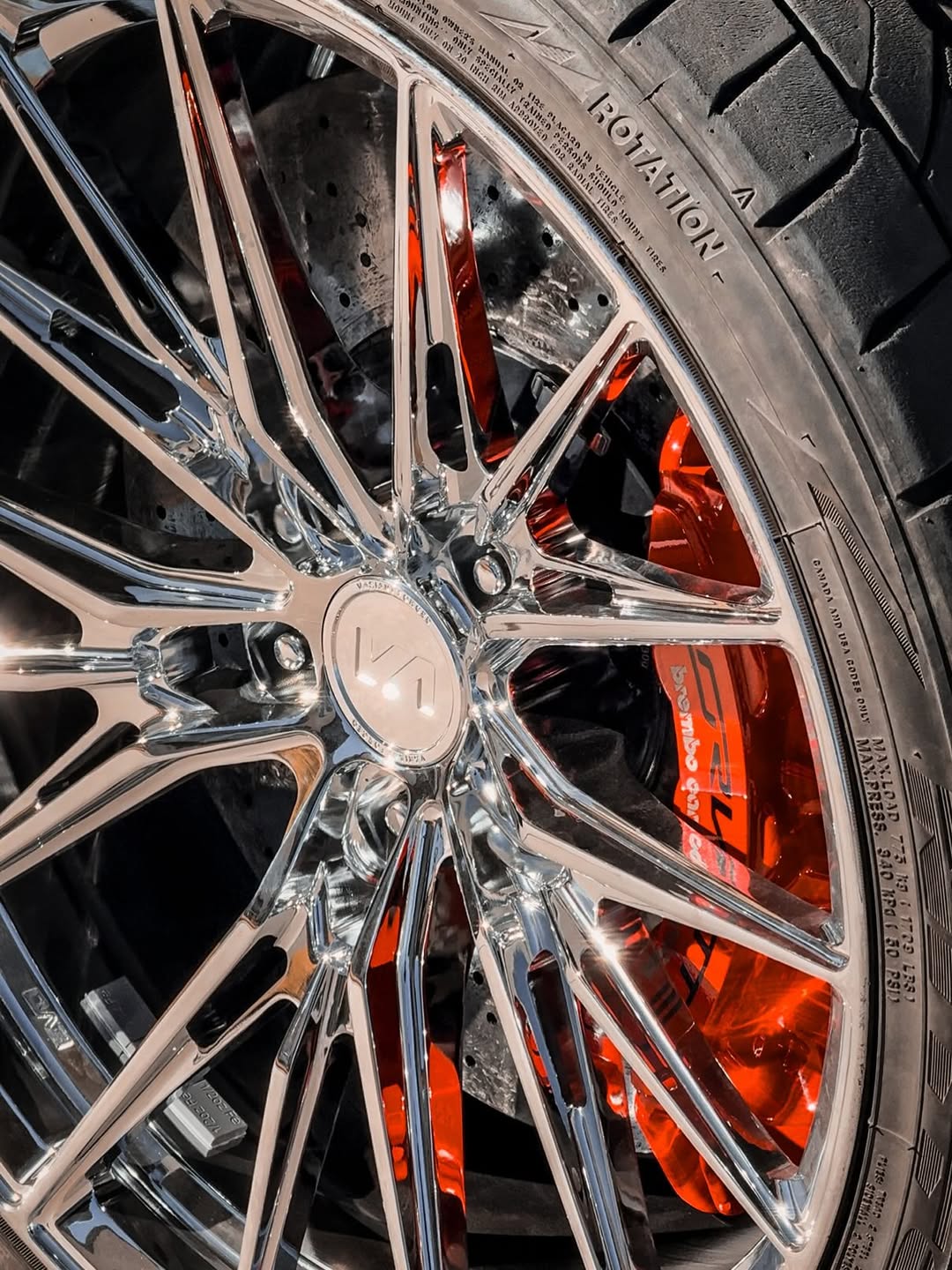
Two 20-inch wheels can have wildly different inner geometry. One might have spokes that arc gently outward from a flat hub face, leaving a deep pocket for a caliper. Another might have spokes that sit nearly flush with the mounting pad, leaving almost nothing. The barrel shape matters too: the transition from the hub face into the barrel is often where a tall caliper actually makes contact, not at the spoke face.
So "20-inch wheels clear this brake kit" is a statement about a specific wheel model in a specific offset, not about 20-inch wheels generally. This is the same reason two wheels with identical published specs can look and fit differently, a point we cover in how to read a wheel spec sheet.
What measurements do you actually need?
Wheel manufacturers work from two numbers, usually called X and Y. Take them with the wheel off and the caliper in place:
- X, the radial dimension. Measure from the center of the wheel hub to the furthest outboard point of the caliper, measured along a radius. This tells you the minimum wheel diameter you need. Double it, add clearance, and compare to the wheel's inner barrel diameter.
- Y, the axial dimension. Lay a straightedge flat across the hub mounting face (the flat surface the wheel bolts against), then measure from that straightedge back toward the caliper's tallest point. This tells you how much depth the wheel's spokes need before they can start curving inward.
A third measurement is worth taking if you run a big brake kit with a wide caliper body: the width of the caliper at its widest, and where that width sits relative to the barrel. Some multi-piston calipers are tall but narrow, others are short and fat, and each fights a different part of the wheel.
Record all measurements in millimeters. Wheel specs are metric, and converting mid-process is how errors creep in.
How much clearance is enough?
| Clearance | Verdict | Why |
|---|---|---|
| Under 2mm | Do not run it | Wheel and caliper flex under cornering load will make contact |
| 2-3mm | Marginal | May work on a gently driven street car, but leaves no margin for debris or a wheel weight |
| 3-5mm | Good | Standard target for street and spirited driving |
| 5mm+ | Ideal | Track use, heavy cars, and aggressive camber settings |
The reason you can't run a paper-thin gap is that nothing in this system is rigid. Under hard cornering the wheel deflects, the hub deflects, and the caliper bracket deflects, all in slightly different directions. Brake components also grow as they heat: a rotor and caliper coming off a track session are dimensionally larger than they were cold. Add a stick-on wheel weight or a piece of road debris and a 2mm gap becomes a scraping noise and a scored caliper.
Do wheel spacers fix a brake clearance problem?
Partly, and only for one of the two dimensions.
A spacer moves the wheel outboard, which increases the axial (Y) clearance between the caliper and the wheel's spokes. That genuinely helps when a wheel is otherwise correct but sits a few millimeters too close. What a spacer cannot do is make the wheel bigger. If the caliper is too tall radially and would hit the inner barrel, no amount of spacing helps, because the barrel is a fixed diameter.
Spacers also change effective offset, which changes scrub radius, fender clearance, and load on the wheel bearing. If you're considering them, read whether wheel spacers are safe first, and understand what you're doing to wheel offset in the process. Ordering the correct offset from the start is always better than correcting a mistake with hardware.
How do you check clearance before the wheels arrive?
Three approaches, in order of reliability:
- Ask the wheel manufacturer with your X and Y numbers. A manufacturer that machines from billet has the CAD data for every wheel and can tell you definitively whether a given model, size, and offset clears. This is the correct first step.
- Use a brake clearance template. Many big brake kit makers supply a printable or plastic template that shows the caliper's profile. You hold it against the back of a wheel to check the fit. Useful, but only as accurate as the print scaling.
- Test fit a known wheel. If a friend runs the same brake kit and a similar wheel, borrow one. Nothing beats physically bolting a wheel to the hub and looking through the spokes.
What doesn't work: assuming that because the wheel is the same diameter as your OE wheel, it will clear. OE wheels are usually designed around a specific caliper with minimal margin, and aftermarket wheels of the same diameter frequently have shallower spoke pockets.
Does wheel design affect brake clearance?
Significantly. Deeper concave faces generally create more caliper room, because the spokes sweep outward from the hub before turning back toward the lip. That's one of the practical benefits of forging: because the material is stronger, a designer can machine thinner, more sculpted spokes without dropping below the required load rating. We explain the limits of that in what decides how deep a wheel can go.
Split-spoke and mesh designs also tend to behave differently around a caliper than a five-spoke, simply because the spoke count changes where the material sits relative to the caliper's arc. Two wheels with identical X and Y clearance on paper can still differ in whether a specific spoke lands on top of the caliper bridge.
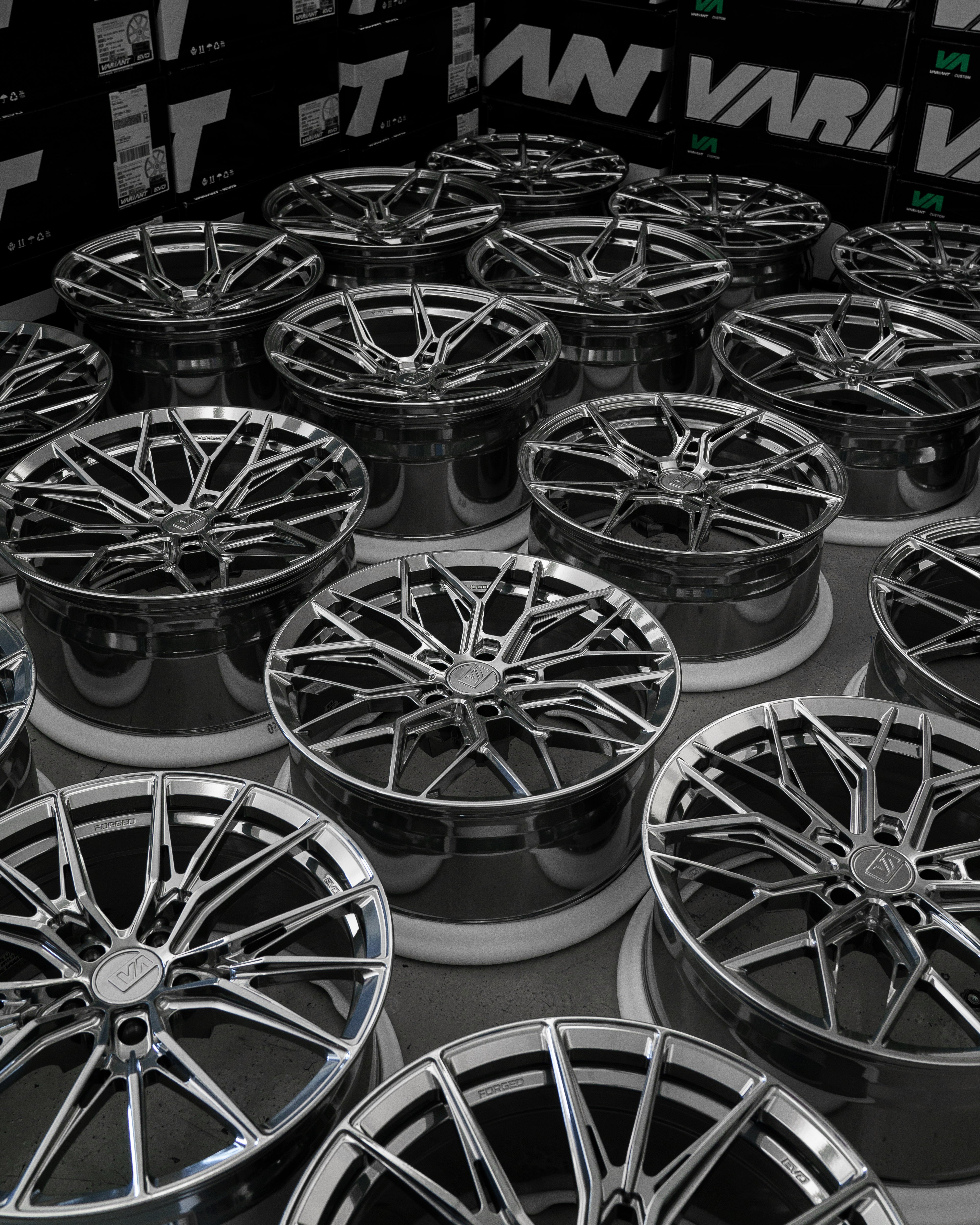
Every Variant wheel is true forged and machined from billet, which means we hold CAD models for every profile and can confirm clearance against your measurements before you order. Browse Corsa and EVO, or start from vehicle-specific fitments for your car. For general background on wheel and brake geometry, Tire Rack's wheel tech resources and the Wikipedia entry on disc brakes are useful independent references.
Frequently asked questions
How do you measure brake caliper clearance for wheels?
Remove the wheel and take two measurements in millimeters. First, the radial distance from the center of the hub to the caliper's furthest outboard point, which sets your minimum wheel diameter. Second, lay a straightedge across the hub mounting face and measure back to the caliper's tallest point, which sets how much spoke depth the wheel needs. Give both numbers to your wheel manufacturer.
How much clearance should there be between a wheel and a brake caliper?
At least 3mm at every point, and 4-5mm if the car sees track use, aggressive camber, or heavy braking. Anything under 2mm risks contact, because the wheel, hub, and caliper all flex under cornering load and brake components expand as they heat.
Will wheel spacers fix brake caliper clearance?
Only for axial clearance. A spacer pushes the wheel outboard and adds room between the caliper and the spokes, but it cannot make the wheel's inner barrel any larger. If the caliper is too tall radially, a spacer will not help. Spacers also change effective offset, scrub radius, and bearing load.
Do bigger wheels always clear bigger brakes?
No. Diameter is only one of the three dimensions that matter. A 20-inch wheel with shallow spokes can fail to clear a caliper that a well-designed 19-inch wheel clears easily, because the caliper contacts the spoke face rather than the barrel. Always check both the radial and axial measurements.
Can you machine a wheel to clear a caliper?
It is sometimes done, but we don't recommend it. Removing material from the back of a spoke removes structural section exactly where bending loads are highest, and it voids any manufacturer warranty. Specify a wheel that clears from the start instead.
Written by Taylor Smith, co-founder of Variant Alloy Wheels, who has spent nearly two decades in the automotive aftermarket.
Share:
What Are the Best Wheels for the Dodge Challenger and Charger Hellcat?
What Are the Best Wheels for the BMW 4 Series (G22)?