


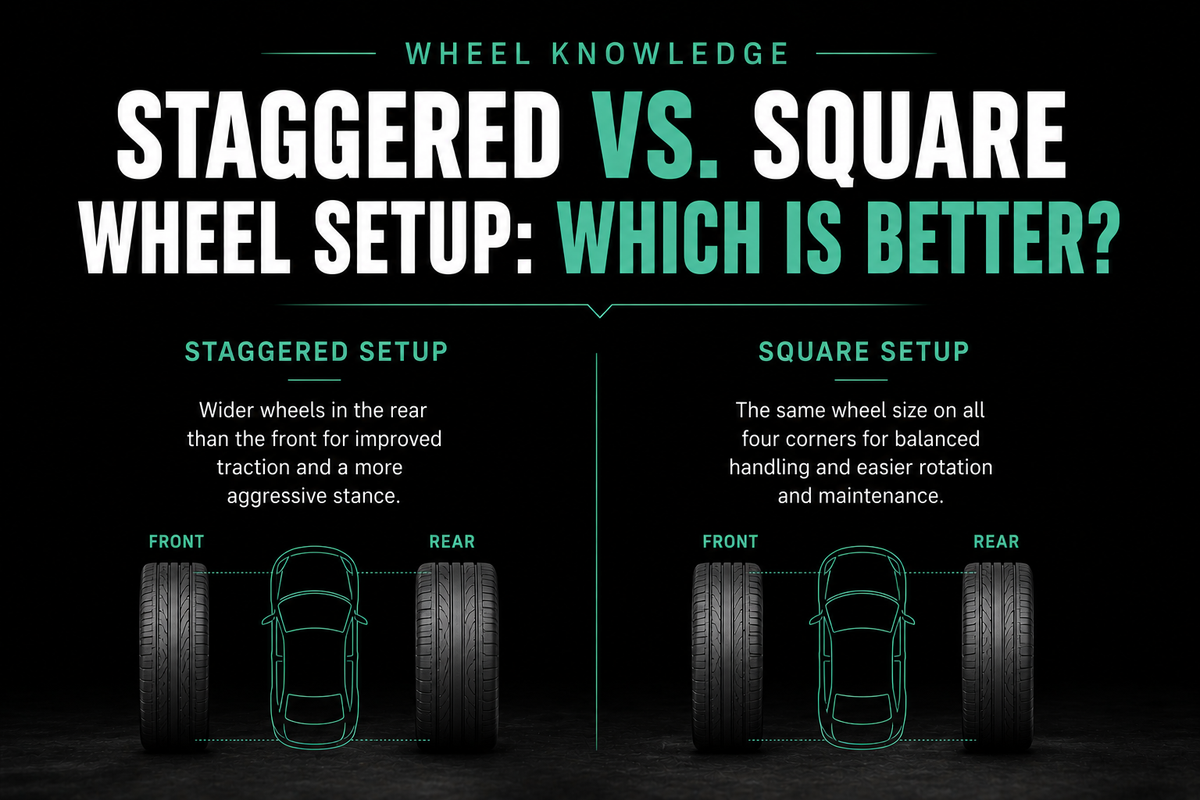
Key takeaways: A staggered wheel setup runs wider wheels and tires on the rear axle than on the front. A square setup runs the same width, diameter, and tire size at all four corners. Staggered fitment adds rear traction and gives most rear-wheel-drive cars a stability-biased balance, but it kills front-to-rear tire rotation. Square fitment usually wins on track balance, tire life, and simplicity, as long as the wider front wheel clears your suspension and fenders.
The staggered vs. square wheel setup question comes up the moment you start speccing a set of forged wheels. It is not a style choice dressed up as engineering. Front and rear width changes how the car puts power down, how it rotates in a corner, how long your tires last, and how much you spend every time you replace them. Here is what each setup actually does.
What is a staggered wheel setup?
A staggered setup uses a wider wheel and tire on one axle than the other, almost always wider at the rear. A common example on a modern sports car is a 19x9 front with a 255-section tire paired to a 19x10.5 rear with a 295-section tire. The wheels are not interchangeable between axles because the widths and often the offsets differ.
Staggered fitment exists because rear-wheel-drive cars ask more of the rear tires. The rear axle handles all of the acceleration load plus a share of cornering load, so more rear contact patch means less wheelspin and a more planted feel under throttle. Manufacturers also use stagger deliberately to bias the car toward mild understeer at the limit, which is the safer, more predictable failure mode for most drivers.
What is a square wheel setup?
A square setup runs identical wheels and tires on all four corners, for example 18x9.5 +35 with 265/35R18 at every position. Every wheel is the same part number. Every tire is the same size, compound, and tread pattern.
That uniformity is the whole advantage. You can rotate tires front to back, carry one spare size, and change the car's balance with alignment and tire pressure rather than being locked into the width the factory chose.
Staggered vs. square: how do they compare?
| Factor | Staggered | Square |
|---|---|---|
| Rear traction on throttle | Better, wider rear contact patch | Good, limited by matched width |
| Front grip and turn-in | Limited by narrower front tire | Higher, front matches rear width |
| Handling balance at the limit | Biased toward understeer | More neutral, more adjustable |
| Front-to-rear tire rotation | Not possible | Possible |
| Cost per replacement set | Front tires cheaper, rears pricier | Four identical tires, often lower total |
| Total unsprung weight | Lower, narrower front wheels | Slightly higher |
| Track day suitability | Workable, understeer-limited | Preferred by most track drivers |
| Stance and visual width | Aggressive rear presence | Even, subtle |
Does a staggered setup actually improve grip?
It improves rear grip specifically, not total grip. Adding 30mm of rear tire width raises the rear axle's cornering and traction limit, but it does nothing for the front. The car's overall cornering speed is usually limited by whichever end runs out of grip first, and on a heavily staggered car that end is the front.
This is why so many time-attack and club racers run square. If your goal is lap time, matching front width to rear width raises the front limit and lets you use more of the rear grip you already have. If your goal is street driving with a stability margin, or launching a 600-plus horsepower car without lighting up the rears, stagger earns its keep.
Can you rotate tires on a staggered setup?
No, not front to back. Different sizes make front-to-rear rotation physically impossible. Your remaining options depend on tread pattern, and Tire Rack's rotation guidance lays out the constraints clearly:
- Non-directional tires (symmetric or asymmetric): you can swap left-to-right on the same axle, which evens out wear between the two fronts and the two rears.
- Directional tires: the tread pattern only works in one rotational direction, so side-to-side swaps require dismounting, remounting, and rebalancing.
- Different front and rear offsets: even with non-directional tires, the wheels themselves stay put. Only the tires can move.
In practice, most staggered owners simply replace rears more often than fronts. Budget for that. On a powerful RWD car it is not unusual to go through two sets of rears for every set of fronts.
Can you run square on a car that came staggered from the factory?
Often yes, and it is one of the most common reasons people order custom-spec forged wheels. The limiting factor is the front. Going from a 9-inch front to a 10.5-inch front adds roughly 19mm of width per side at the same offset, and that width has to fit between the strut or spring perch on the inside and the fender lip on the outside.
Three things decide whether it works:
- Inner clearance. Suspension components, brake lines, and coilover bodies sit closest to the wheel barrel at full steering lock and full compression.
- Outer clearance. Fender lip contact shows up under compression and steering, not when the car is sitting still.
- Steering geometry. Wider fronts at a lower offset change scrub radius, which affects steering feel and torque steer.
Offset does the heavy lifting here, so it is worth understanding before you order. Our guides on wheel offset and wheel width and tire fitment walk through the math. If you are chasing a specific look rather than a lap time, flush fitment covers how offset and width interact with stance, and why wheels rub covers what to do when you get it slightly wrong.
Which setup is right for your car?
Choose staggered if you drive mostly on the street, your car makes serious power through the rear wheels, you want factory-style stability, or you want the wider rear stance visually.
Choose square if you do track days or autocross, you want maximum tire life through rotation, you want to tune balance with alignment and pressures, or you are running an all-wheel-drive car that does not need a rear traction bias.
One thing that does not change either way: construction. A wider wheel carries more bending load, and a true forged wheel gets its strength from a grain structure that follows the shape of the part rather than from adding material. That is why forged wheels can be both wider and lighter than the cast wheels they replace. Every Variant wheel is true forged, so you can spec an aggressive square setup without paying a weight penalty for the extra width. If you want the background, see forged vs. flow-formed wheels.
When you are ready to spec a set, start with the vehicle-specific fitments we already have validated, or browse the full forged wheel lineup. The Corsa series is a good starting point for square track-oriented setups, and the Evo series offers the concave profiles that make a staggered rear look right.
Frequently asked questions
Is a staggered setup faster than a square setup?
Usually not on a road course. Square fitment raises front grip to match the rear, which is what limits cornering speed on most staggered cars. Staggered setups do help in straight-line acceleration and launches on high-horsepower rear-wheel-drive cars.
Do staggered wheels wear tires out faster?
The tires do not wear faster per mile, but you cannot rotate front to rear, so wear concentrates unevenly and rear tires typically need replacing first. Owners of powerful RWD cars often replace rears twice as often as fronts.
Can I put square wheels on a car that came staggered?
Frequently yes, but the wider front wheel has to clear suspension components inside and the fender lip outside, and the change in scrub radius affects steering feel. Confirm width, offset, and tire size against your specific chassis and ride height before ordering.
Does staggered fitment matter on an all-wheel-drive car?
Less than on rear-wheel drive. Many AWD performance cars still come staggered to bias handling toward understeer and to add rear traction under power, but the case for square fitment is stronger because the front axle is also driven and benefits from more contact patch.
Written by Taylor Smith, co-founder of Variant Alloy Wheels, who has spent nearly two decades in the automotive aftermarket.
Share:
What Are the Best Wheels for the BMW M3 (G80)?
Do You Need Special Lug Nuts for Aftermarket Wheels?