


Key takeaways: Wheel center bore is the machined hole in the back of the wheel that slides over your car's hub. If a wheel's center bore is larger than your hub, hub-centric rings fill the gap and center the wheel while you torque it down. The rings are a centering and vibration-prevention aid, not a load-bearing part. Your lug hardware carries the clamping load. If the center bore is smaller than your hub, the wheel simply will not fit.
Wheel center bore is one of those specs buyers skip right past on a listing, then get reminded of at 70 mph when the steering wheel starts shaking. It is a simple dimension with real consequences, so it is worth ten minutes of your time before you order a set.
What is wheel center bore?
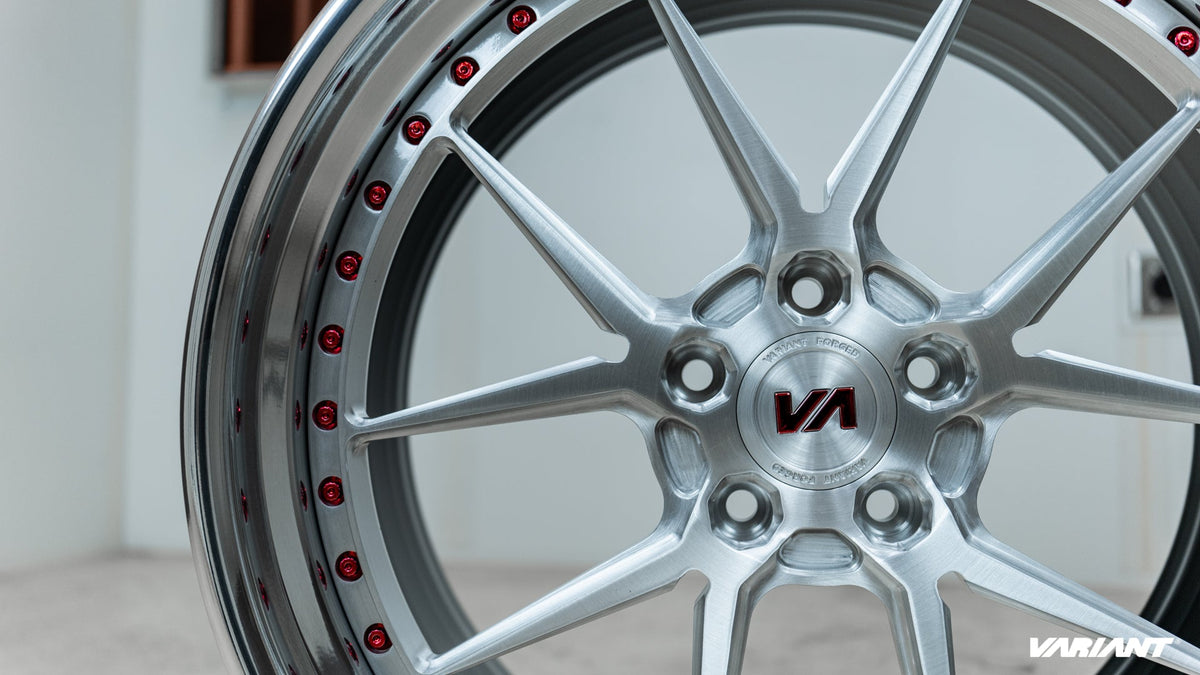
The center bore is the diameter of the machined opening on the back face of the wheel, measured in millimeters. It slides over the raised hub flange on your car's wheel hub assembly. On a BMW M3 or M4 that flange measures 66.6 mm. On most Teslas it is 64.1 mm. On a C8 Corvette it is 70.3 mm.
When the wheel's center bore matches the hub diameter within a fraction of a millimeter, the wheel drops on and self-centers. That is called a hub-centric fitment. When the bore is deliberately made oversize so one wheel can cover several vehicles, that is a lug-centric fitment, and the lug hardware does the centering instead.
What are hub-centric rings, and do you need them?
Hub-centric rings are simple sleeves that press into an oversize center bore and step it down to your hub diameter. You need them any time the wheel's center bore is larger than your hub and the wheel was not machined specifically for your car.
They do two things well: they hold the wheel concentric while you snug the lugs, and they keep the assembly from settling slightly off-center, which is the most common cause of a vibration that appears only above 55 mph and cannot be balanced out.
What they do not do is carry the car. Once the lug nuts are torqued to spec, clamping force between the wheel face and the hub face carries the load through friction. Tire Rack makes the same point in its explanation of what a wheel centerbore is: the bore positions the wheel precisely as the lug hardware is torqued down. Anyone telling you the plastic ring is holding up a corner of your car has it backwards.
That said, ring material matters for durability. Aluminum and steel rings survive pothole impacts and repeated wheel-offs far better than plastic ones, which can deform or crack over time. Given that a set costs less than a tank of fuel, there is no good argument for cheaping out.
Hub-centric vs. lug-centric: what is the difference?
| Hub-centric | Lug-centric | |
|---|---|---|
| Center bore | Machined to match the hub (or stepped down with a ring) | Deliberately oversize to cover multiple vehicles |
| What centers the wheel | The hub flange | Tapered or ball lug seats as they are torqued |
| Typical use | Performance and vehicle-specific fitments | Many truck and SUV applications |
| Vibration risk | Low | Higher if installed carelessly |
| Installation note | Wheel self-locates on the hub | Torque with the wheel off the ground so the lug seats can pull it centered |
Neither approach is inherently unsafe. A properly torqued lug-centric wheel with correct conical seats is fine (endurance racers have run them for decades). Hub-centric fitment is simply more forgiving, and on a street car with 20-inch wheels and low-profile tires, forgiving is worth having.
How do you find your car's center bore?
- Look up your vehicle's hub bore in millimeters. It is a fixed number for your chassis, listed on any reputable fitment database.
- Check the wheel's stated center bore on the spec sheet. If you are unsure how to read one, our guide to reading a wheel spec sheet before you buy walks through every line.
- Compare. Wheel bore larger than hub means you need rings. Wheel bore equal to hub means you are done. Wheel bore smaller than hub means the wheel does not fit, full stop.
That last case deserves emphasis. Do not let anyone open up a center bore on a mounted wheel with a die grinder. Center bore machining is a lathe operation done concentric to the wheel's own axis, and a freehand job will leave you with a wheel that never runs true again.
Does center bore matter on forged wheels?
It matters just as much, but it is usually less of a headache. Because a forged wheel starts life as a solid billet and is machined to final dimensions on a CNC lathe, the center bore can be cut to your exact hub with no compromise. Every Variant wheel is a true forged wheel, and our vehicle-specific fitments are specified around the chassis they are built for rather than a one-size-fits-many bore. That is one of the quiet advantages of buying to application instead of buying whatever is in stock in your bolt pattern.
If you are still deciding on sizing more broadly, center bore is the last piece of a puzzle that also includes bolt pattern and offset. Get all three right and the wheel is a bolt-on. Get any one wrong and it is a return shipping label. Browse the full forged wheel lineup or a specific design family like Corsa once you know your numbers.
What happens if you ignore center bore?
- High-speed vibration. The most common symptom, and the most commonly misdiagnosed. People chase it with rebalancing for months.
- Uneven lug loading. An off-center wheel can load studs unevenly, which over thousands of heat cycles is not something you want on a wheel stud.
- Accelerated tire wear. A wheel that runs even slightly eccentric puts a cyclic load into the tire every revolution.
None of this is dramatic on day one. It is a slow annoyance that gets worse, which is exactly why it is worth getting right at install. While you are at it, torque matters just as much. See how much you should torque aftermarket wheels.
Frequently asked questions
Are hub-centric rings safe?
Yes, when they are the correct size and made of aluminum or steel. They are a centering aid, and they do not bear the vehicle's weight in normal use. Properly torqued lug hardware does. Choose metal rings over plastic for longevity.
Can the wheel center bore be larger than the hub?
Yes. A larger center bore is common and completely workable, which is what hub-centric rings exist for. What you cannot do is fit a wheel whose center bore is smaller than your hub flange.
Do hub-centric rings need to be replaced?
Inspect them every time the wheels come off. Metal rings typically last the life of the wheel. Plastic rings can crack or deform after a hard impact or a few seasons of heat cycling and should be replaced when they do.
Do I need hub-centric rings if my wheels are made for my car?
No. If the wheel's center bore was machined to your vehicle's hub diameter, the wheel is already hub-centric and adding a ring is neither possible nor necessary.
Will hub-centric rings fix a wheel vibration?
They will fix a vibration caused by an off-center wheel. They will not fix a vibration from an out-of-balance tire, a bent wheel, a worn wheel bearing, or a warped rotor. Rule out the cheap causes first, then look at centering.
Written by Taylor Smith, co-founder of Variant Alloy Wheels, who has spent nearly two decades in the automotive aftermarket.
Share:
What Are the Best Wheels for the BMW 3 Series (G20)?
What Are the Best Wheels for the BMW 3 Series (G20)?