


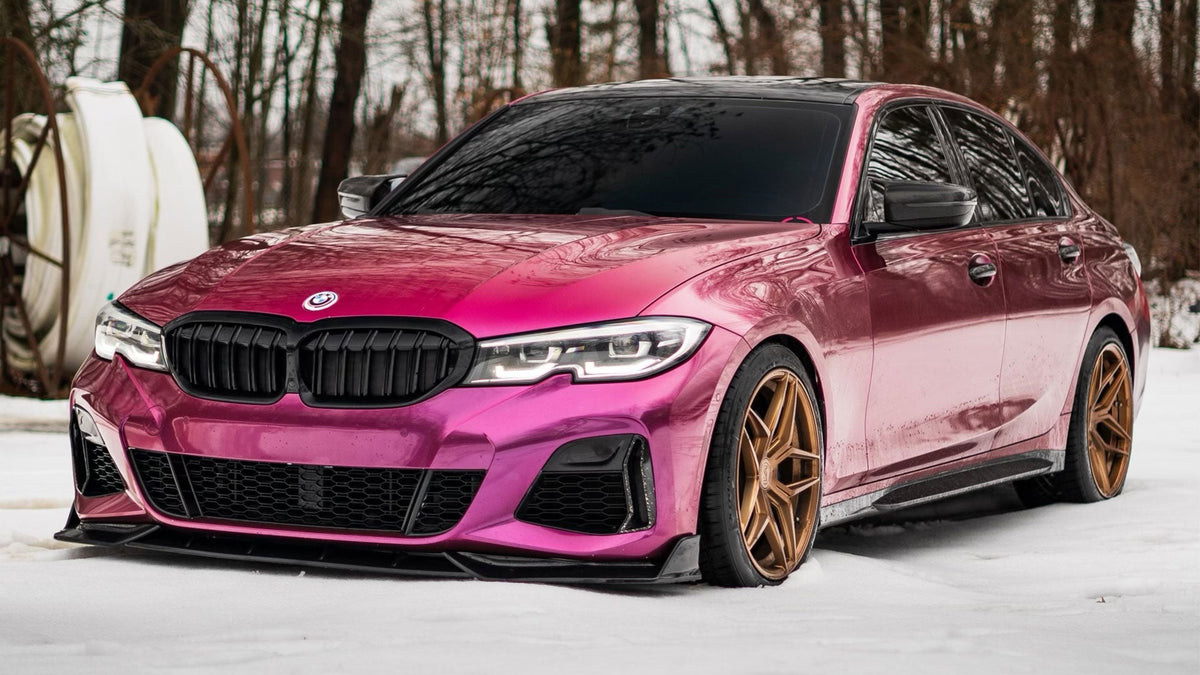
Key takeaways: The best wheels for the BMW 3 Series (G20) are true forged wheels in 19 or 20 inches, built to the G20's 5x112 bolt pattern and 66.6 mm center bore. A 19x8.5 front / 19x10 rear staggered setup is the sweet spot for drivers who still care about ride quality, while 20x9 / 20x10 delivers the most aggressive stance. Forged construction matters more than diameter here: it keeps unsprung weight down while adding strength the G20's stiff suspension will find.
What wheel specifications does the BMW 3 Series (G20) use?
Before you shop, know the four numbers that determine whether a wheel physically bolts to your car. The G20 generation, introduced for the 2019 model year and covering the 330i, 330e, M340i and their xDrive variants, uses a different pattern than the F30 that came before it.
| Specification | BMW 3 Series (G20) |
|---|---|
| Bolt pattern | 5x112 mm |
| Center bore | 66.6 mm (hub-centric) |
| Fastener | M14 x 1.25 wheel bolts (no studs) |
| Factory diameters | 17–19 in depending on trim and package |
| Common aftermarket diameters | 19 in and 20 in |
That 5x112 pattern is the important change. The previous-generation F30 used 5x120 with a 72.5 mm bore, so F30 wheels do not fit a G20 and vice versa. If you are cross-shopping used sets, verify the pattern rather than trusting a listing; Tire Rack's guide to measuring bolt pattern shows how to check a five-lug hub yourself. For background on the generation and its variants, Wikipedia's G20 entry lists the model range in full.
What size wheels fit the BMW 3 Series G20 best?
Two sizes cover almost every G20 build.
- 19x8.5 front / 19x10 rear. The best all-around choice. You get a visibly wider rear track and room for a 275-section rear tire while retaining enough sidewall that broken pavement does not ruin the car. This is the size we recommend to anyone who actually drives their 3 Series in winter or on rough roads.
- 20x9 front / 20x10 rear. The showcase setup. Deeper concavity, more face to look at, and a properly aggressive stance. The trade-off is real: less sidewall means a firmer ride and more exposure to potholes.
Offsets for these widths typically land in the ET30–ET35 range up front and ET35–ET40 out back, but the right number depends on your exact tire, ride height, and whether you have xDrive. Because our wheels are semi-custom, you specify offset rather than accepting whatever a shelf stock wheel happens to be. That matters: getting offset right in the wheel is always better than correcting it later with hardware. Read our breakdown of wheel offset if you want to understand what those ET numbers are doing.
Should you run staggered or square on a G20?
Run staggered on a rear-drive 330i or M340i if you want the look and the traction; run square if you rotate tires and drive the car hard on track. A staggered setup puts a wider tire under the driven axle, which suits the G20's rear-drive balance and looks correct on the car's proportions. A square setup lets you rotate front to rear, which meaningfully extends tire life and gives you a spare that fits any corner.
On xDrive cars, be more conservative with front width and offset. The front driveshafts and slightly different suspension geometry leave less room for error. Our full comparison of staggered vs. square setups covers the trade-offs in detail.
Why choose forged wheels for a BMW 3 Series?
Because the G20's suspension is stiff enough that wheel weight is genuinely felt, and because cast wheels in these sizes are heavy. A forged wheel starts as a solid billet of aluminum compressed under enormous pressure, which aligns the grain structure of the metal and produces a part that is stronger per unit of weight than a cast wheel. That lets a forged wheel hit the same strength target with less material.
The practical result is lower unsprung weight, the mass that the suspension has to control at every bump. Reducing it improves how quickly the damper can react, which shows up as better ride compliance and sharper turn-in. Our article on unsprung weight explains the mechanism, and forged vs. flow-formed covers where the manufacturing methods actually diverge.
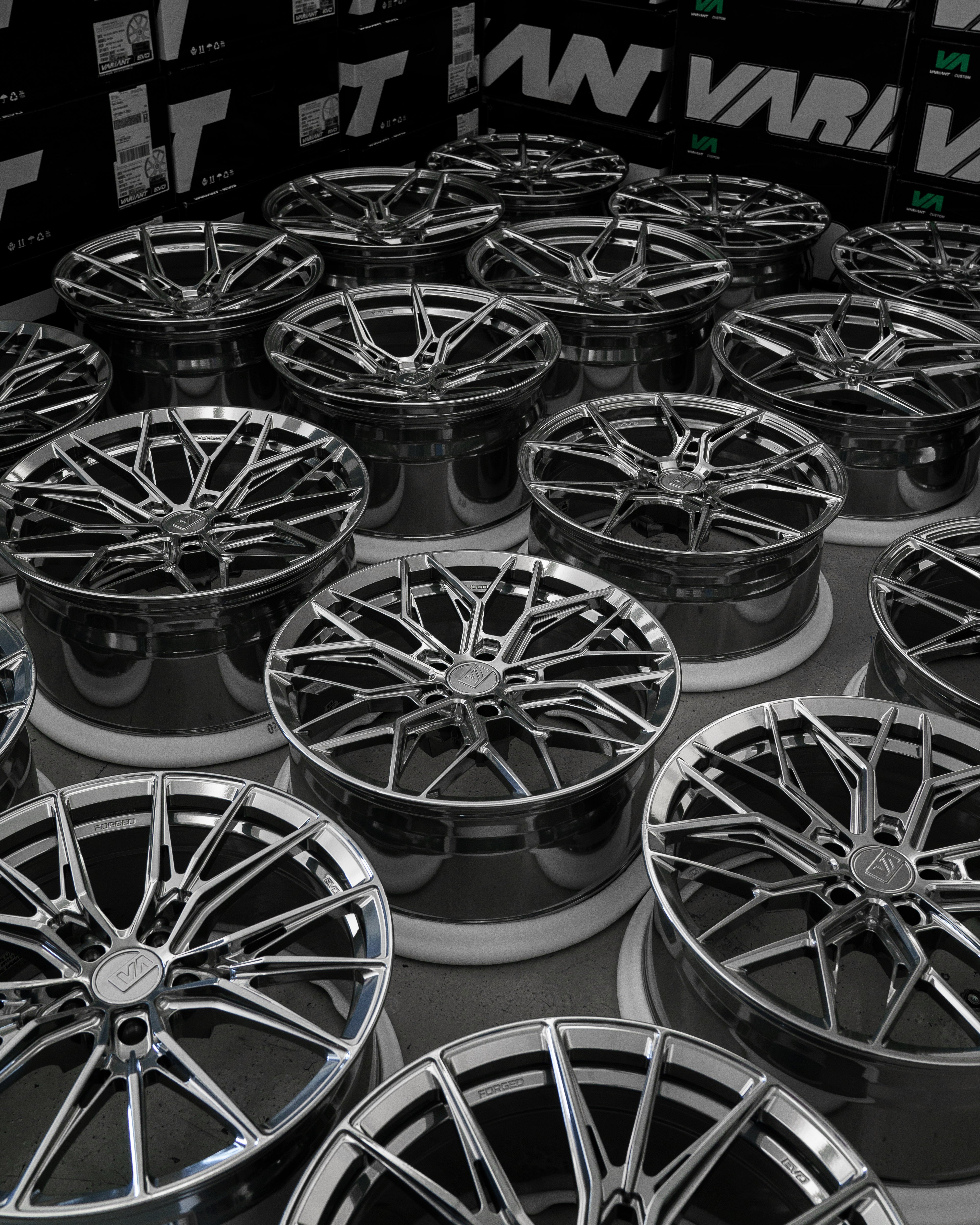
Variant builds only true forged wheels. Every wheel in the EVO Collection is forged from 6061-T6 aerospace aluminum under 10,000 tons of pressure, then machined and finished in-house on multi-axis CNC mills. The two-piece EX2 Collection applies the same forging process with a separate center disk and barrel, which opens up finish combinations you cannot get from a monoblock. If the difference between those constructions is new to you, start with monoblock vs. 2-piece vs. 3-piece.
Which wheel designs work best on the G20?
The G20's body is relatively clean and restrained, so the designs that look right on it tend to be either sharply technical or genuinely simple. Across our BMW 3 Series fitments, a few directions consistently work:
- Split five-spoke (Zeno). Evolved from our Xenon design, it reads as a modern M-car wheel without copying one. Available in three concave profiles.
- Directional multi-spoke (Sena, Rian). Adds visual motion to a sedan silhouette that can otherwise look static.
- Clean five-spoke (Aure, Maxim). If your G20 is a 330i in a conservative color, a simple face ages better than a busy one.
Concavity is worth thinking about separately from spoke count. A 20x10 rear allows significantly more dish than a 19x8.5 front, which is part of why staggered setups photograph well. Our guide to wheel concavity explains what limits how deep a given size can go.
What finish should you pick?
Finishes are a matter of taste, but a few things are objectively true. Raw milled and brushed faces hide brake dust better than gloss black. Gloss finishes are easiest to clean but show swirl marks. Satin bronze and satin gunmetal are the most forgiving of daily use on a silver, grey, or white car. Chrome powder makes a statement and demands maintenance.
All standard finishes are included at no additional cost, and center cap inserts can be color-matched. Our post on choosing a wheel finish goes deeper on durability by finish type.
What should you check before ordering?
- Confirm your exact model year and whether the car is xDrive or rear-drive.
- Note whether you have M Sport brakes or the standard brake package, since caliper clearance affects minimum diameter and spoke shape.
- Decide your tire strategy first. Tire size drives wheel width, not the other way around.
- Check ride height. Lowered cars need more conservative offsets to avoid fender contact at full compression.
- Order new TPMS sensors if you are building a second set for winter.
You can browse everything that fits your car under vehicle-specific fitments, or see the full forged wheel catalog. If you also own an M3, our G80 M3 wheel guide covers that chassis, and the 4 Series G22 guide covers the coupe.
Frequently asked questions
What is the bolt pattern on a BMW 3 Series G20?
The G20 uses a 5x112 mm bolt pattern with a 66.6 mm center bore and M14 x 1.25 wheel bolts. This differs from the previous F30 generation, which used 5x120 mm with a 72.5 mm bore, so the two are not interchangeable.
Will 20-inch wheels fit a BMW 330i?
Yes. A 20x9 front and 20x10 rear staggered setup fits a 330i with appropriate offsets and tire sizing. Expect a firmer ride than the factory 18s or 19s because of the reduced sidewall height.
How much lighter are forged wheels on a G20?
It depends on the size and design, but a forged wheel is typically meaningfully lighter than a cast wheel of the same diameter and width because the forging process allows less material to carry the same load. The gain is felt as improved suspension response rather than as raw acceleration.
Do I need new TPMS sensors for aftermarket wheels on a G20?
If you are moving your existing wheels' sensors over, no. If you are building a second set, you will need a second set of sensors programmed to the car. See our guide to TPMS sensors and aftermarket wheels.
Can you run a square setup on a rear-drive 330i?
Yes, and it is the better choice if you track the car or want to rotate tires. A common square configuration is 19x9 at all four corners with a matched tire size, which trades some rear traction and stance for longer tire life.
Written by Taylor Smith, co-founder of Variant Alloy Wheels, who has spent nearly two decades in the automotive aftermarket.
Share:
What Is Wheel Center Bore, and Do You Need Hub-Centric Rings?
What Is Wheel Center Bore, and Do You Need Hub-Centric Rings?