


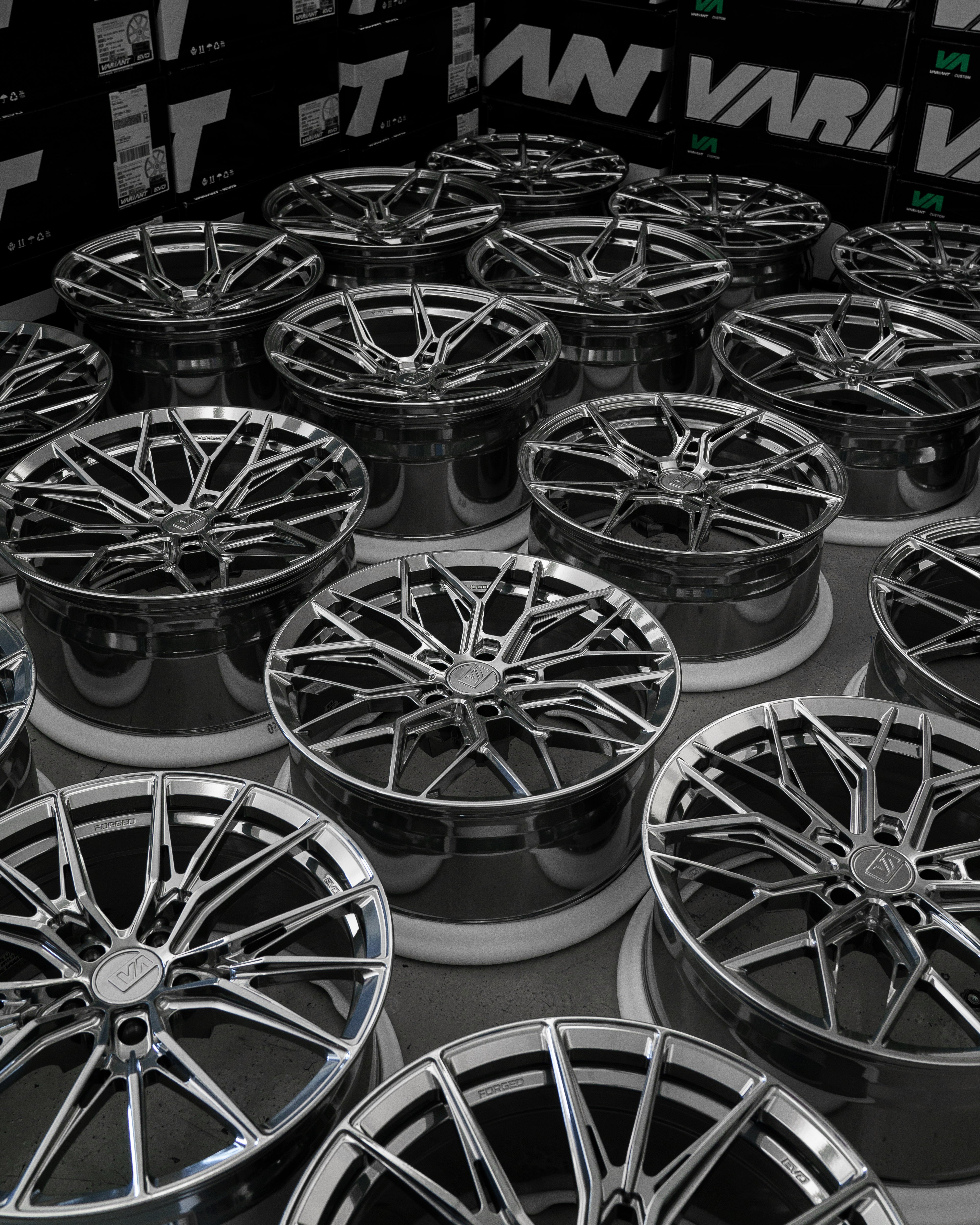
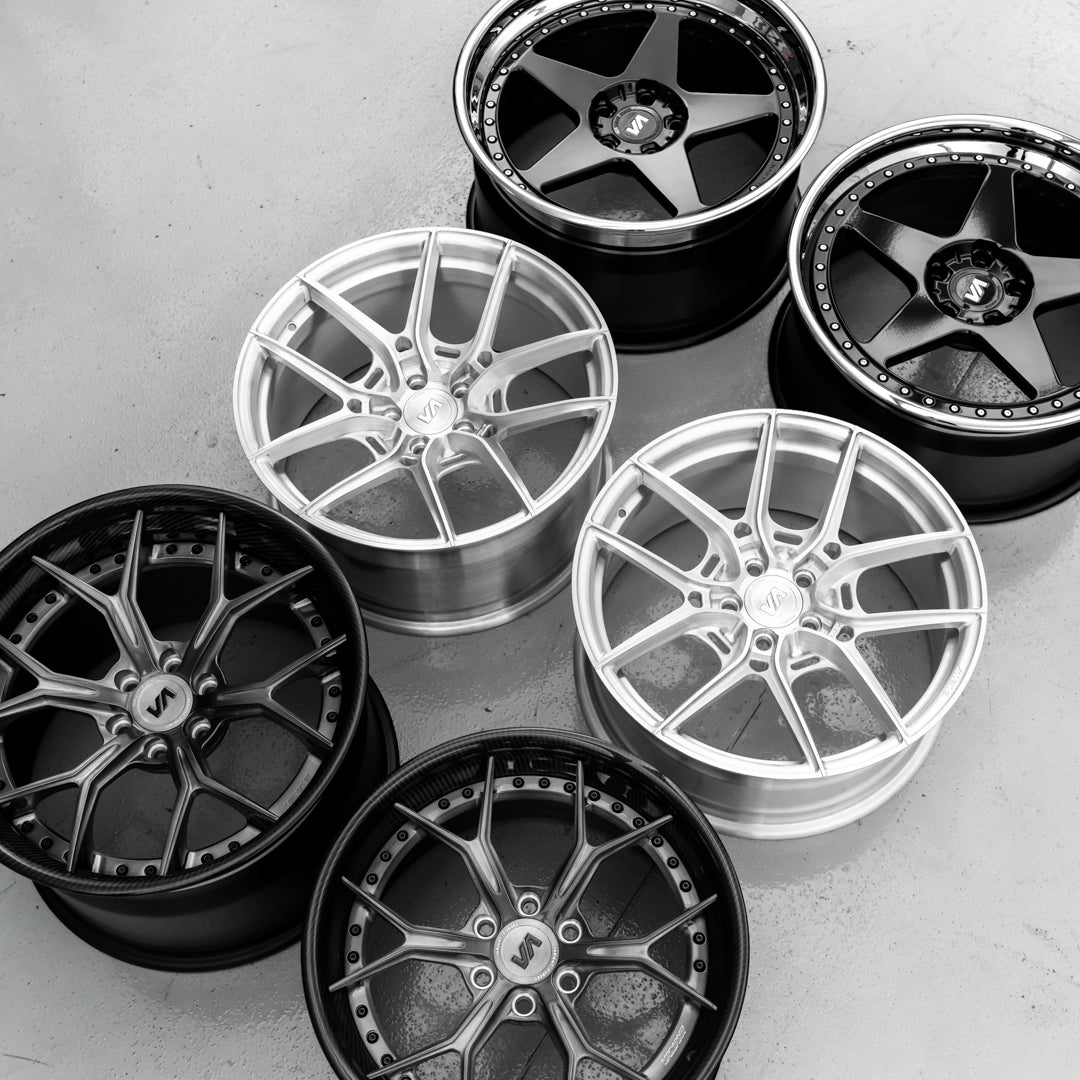
Key takeaways: The difference between forged vs. flow-formed wheels comes down to how the metal is shaped. A forged wheel is pressed from one solid billet of aluminum under thousands of tons of pressure, which aligns the grain and makes it the strongest, lightest option. A flow-formed wheel (also called rotary forged) starts life as a cast blank, then has only its barrel spun and stretched by rollers, so it is stronger and lighter than a plain cast wheel but not a true forging. Forged wins on strength-to-weight and impact behavior; flow-formed wins on price. Variant builds only true forged wheels.
What is the difference between forged and flow-formed wheels?
Forged and flow-formed wheels are made by two different manufacturing processes, and that process is the whole story. Forging takes a solid slug of aluminum (a billet) and squeezes it into shape under enormous hydraulic pressure. Flow forming (the industry also calls it rotary forging or flow forging) starts with a cast wheel blank and then uses spinning steel rollers to stretch and compress only the barrel, the cylindrical section where the tire mounts. So a flow-formed wheel is a cast wheel with a work-hardened barrel, while a forged wheel is worked metal from the center cap to the lip.
That distinction matters because the grain structure of the aluminum, essentially how tightly the metal is packed, is what determines strength and weight. Forging refines the grain throughout the entire wheel. Flow forming only refines it in the barrel.
How are forged wheels made?
A forged wheel begins as a cylindrical billet of aircraft-grade aluminum, most often 6061-T6. The billet is heated and pressed between dies under thousands of tons of force, which compacts the aluminum and aligns its grain flow to follow the shape of the wheel. The rough forging is then CNC-machined into its final spoke design, heat-treated to a T6 temper for hardness, and finished. Because the grain runs continuously through the whole part with no voids or porosity, a forged wheel can use less material to hit the same strength target, which is why it ends up both strong and light. If you want the full walkthrough, see our step-by-step guide on how forged wheels are made.
How are flow-formed (rotary forged) wheels made?
A flow-formed wheel starts as a low-pressure cast blank, the same basic process used for ordinary cast wheels. The face (the spokes and center) stays cast. The blank is then mounted on a spinning mandrel, heated, and pressed by hydraulic rollers that stretch the barrel thinner and longer while the wheel rotates. This flow-forming step work-hardens and aligns the grain in the barrel only, which is why the marketing names, flow formed, flow forged, and rotary forged, all point at the same thing: a hybrid that is cast where it is complex and rolled where it is simple. It is a genuine step up from plain casting, but the face still has the granular structure of a cast part.
Which is stronger, forged or flow-formed?
Forged is stronger. A true forging has no porosity and continuous grain flow, so its yield strength is higher than a flow-formed wheel of the same size. Industry testing generally puts a flow-formed barrel at roughly 80% of the strength of a comparable forged wheel, and a big part of the difference is how each fails. A cast or flow-formed face has granular aluminum, so a hard enough pothole hit tends to crack or shatter it, a sudden, catastrophic failure. A forged wheel is far more likely to bend and hold air, giving you warning and a chance to limp home. For a safety-critical part that is a meaningful difference. We cover this in more depth in do forged wheels bend or crack.
Which is lighter, forged or flow-formed?
Forged is lighter. Because forging lets the engineer remove material without giving up strength, a forged wheel is typically the lightest way to build a given size and load rating. Flow forming reduces weight compared with a plain cast wheel, mostly in the barrel, but the cast face limits how far it can go. Lower wheel weight is unsprung weight, and reducing it improves ride, steering response, braking, and acceleration more than shedding the same weight elsewhere on the car.
Forged vs. flow-formed: a side-by-side comparison
| Attribute | Forged | Flow-formed (rotary forged) |
|---|---|---|
| Starting material | Solid billet | Cast blank |
| Grain structure | Refined throughout | Refined in barrel only |
| Relative strength | Highest | ~80% of forged |
| Relative weight | Lightest | Heavier than forged, lighter than cast |
| Failure mode on impact | Tends to bend | Can crack or shatter |
| Design flexibility | Fully custom sizes, offsets, finishes | Limited to available molds |
| Relative cost | Highest | Mid-range |
Which should you buy?
Choose based on how you use the car and what you value. If you want the lowest possible unsprung weight, the highest strength-to-weight, custom sizing and offset for a precise fit, and the more forgiving failure mode, a true forged wheel is the better tool, and it is the only kind Variant makes. Our forged lineups, from Corsa and EVO to Strada and Designer, are all monoblock forgings built to spec. If your priority is a strength bump over stock cast wheels at a lower price, and you are fine with off-the-shelf sizing, flow-formed is a reasonable value option, just know it is not a forging. For the bigger picture on where forged fits, read are forged wheels worth it or browse the full forged wheel lineup. You can also compare the flow-forming family against plain casting in this overview of wheel construction from Tire Rack, or read the metallurgy behind forging on Wikipedia.
Frequently asked questions
Are flow-formed wheels the same as forged wheels?
No. Flow-formed wheels (also called rotary forged) start as cast blanks and only have the barrel rolled and stretched. Forged wheels are pressed from a solid billet, so the whole wheel has refined grain. The names sound similar, but only one is a true forging.
Are forged wheels worth the extra money over flow-formed?
If you care about the lowest unsprung weight, maximum strength-to-weight, custom fitment, and a bend-instead-of-shatter failure mode, forged is worth it. If you just want a strength upgrade over cast wheels on a budget, flow-formed can make sense.
Is a flow-formed wheel stronger than a cast wheel?
Yes. Flow forming work-hardens and aligns the grain in the barrel, making a flow-formed wheel meaningfully stronger and a bit lighter than a plain cast wheel of the same design. It still is not as strong as a full forging.
Do forged and flow-formed wheels weigh the same?
No. A forged wheel is typically lighter for the same size and load rating because forging removes material without sacrificing strength. Flow-formed wheels save weight over cast but carry a cast face that limits how light they can get.
Written by Taylor Smith, co-founder of Variant Alloy Wheels, who has spent nearly two decades in the automotive aftermarket.
Share:
What Is Wheel Offset? Positive, Negative, and Zero Offset Explained
Do Forged Wheels Hold Their Value?