



Key takeaways: The difference between monoblock, 2-piece, and 3-piece wheels is how many separate forged parts make up the finished wheel. A monoblock wheel is forged and machined from one piece, which makes it the lightest and simplest design. A 2-piece wheel bolts or welds a forged center into a separately forged barrel, and a 3-piece wheel splits that barrel into inner and outer halves. Multi-piece construction buys you width, offset, and lip options a one-piece wheel cannot produce, at the cost of a little weight and some extra hardware to look after.
If you have started shopping for forged wheels, you have run into the terms monoblock, 2-piece, and 3-piece. They describe wheel construction, not quality tier, and the right answer depends on what you are trying to accomplish. Here is how each one is built, what it actually changes on the car, and how to decide.
What does monoblock mean?
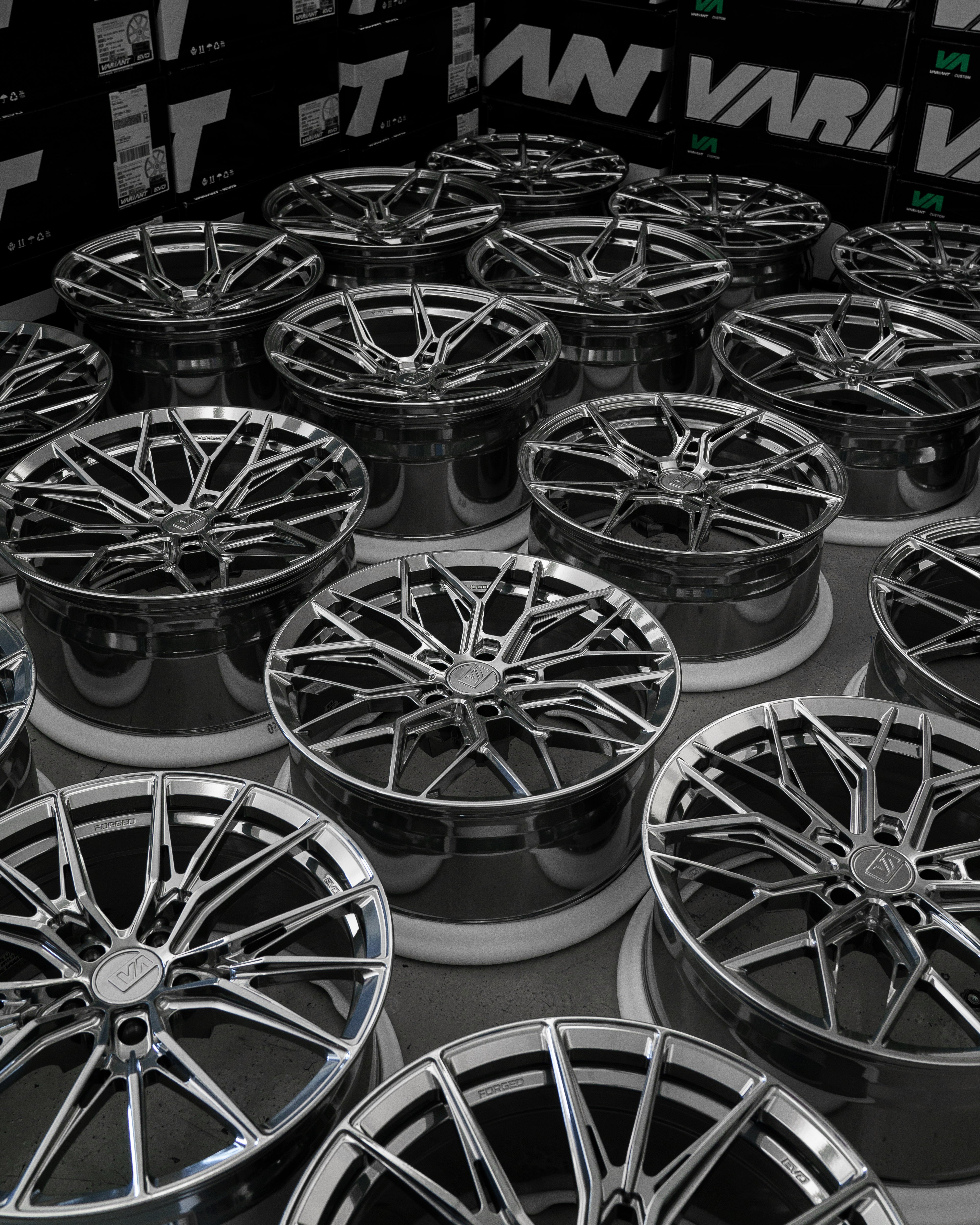
A monoblock wheel (also called one-piece) is forged from a single billet of aluminum and then CNC-machined into its final shape. Center, spokes, and barrel are all the same continuous piece of metal, with no seams and no fasteners holding structural parts together.
Because the grain structure runs uninterrupted from the hub face out to the lip, a monoblock has no joints to engineer around. It is also the simplest wheel to manufacture, inspect, and mount. Most modern performance wheels, including the majority of what we build at Variant, are monoblock forgings. If you want to see what happens between billet and finished wheel, we walked through it in how forged wheels are made.
What is a 2-piece wheel?
A 2-piece wheel uses a forged center (the hub face and spokes) mated to a separately forged barrel (the rim section that holds the tire). The two parts are joined either by welding or by a ring of structural bolts.
The advantage is manufacturing flexibility. Because the barrel is made independently, the same center design can be paired with a wide range of widths and offsets without cutting a new forging die for every combination. That is how you get a 20x12 rear in a design that also exists as a 20x9 front. Our EX2 2-piece line exists for exactly that reason: fitments and lip depths that a one-piece die cannot economically produce.
What is a 3-piece wheel?
A 3-piece wheel adds one more split. The barrel is divided into an inner half and an outer half, and those two halves are bolted together with the center sandwiched between them, then sealed so the assembly holds air.
This is the most configurable construction available. Width, offset, lip height, and the finish of each individual component can be specified more or less independently, which is why 3-piece wheels dominate the show and stance world and why they were the standard in motorsport before modern forging made monoblocks so capable. The trade-off is more hardware, more mass, and a sealed joint that has to be maintained correctly.
Monoblock vs. 2-piece vs. 3-piece: side-by-side comparison
| Attribute | Monoblock (1-piece) | 2-piece | 3-piece |
|---|---|---|---|
| Structural parts | One forging | Forged center + forged barrel | Forged center + outer barrel + inner barrel |
| Typical weight at same size | Lightest | Slightly heavier | Heaviest |
| Fitment flexibility | Limited by the forging die | Wide range of widths and offsets | Widest range, near-custom |
| Repairability | Whole wheel must be repaired or replaced | Barrel can often be replaced | Individual barrel half can be replaced |
| Maintenance | None beyond normal care | Check bolt torque if bolted | Check bolt torque and sealant integrity |
| Best for | Street and track builds prioritizing weight | Aggressive fitment with forged strength | Show builds and fully bespoke specs |
Which construction is lightest?
At the same diameter, width, and spoke design, a monoblock is normally the lightest of the three. The reason is simple: multi-piece designs have to duplicate material where the parts overlap, and bolted assemblies add a ring of steel or titanium fasteners that a one-piece wheel does not carry at all. A well-optimized 2-piece can get close, but it starts from a small penalty.
That penalty matters more than its raw number suggests because wheels are unsprung mass, the portion of the vehicle not supported by the springs. Reducing unsprung mass lets the dampers control wheel movement more effectively over bumps, and because a wheel also has to be spun up and slowed down, its weight carries a rotational penalty on top of the static one. Tire Rack's testing on lightweight wheels covers the mechanism in detail, and we broke it down for wheels specifically in our guide to unsprung weight.
Worth keeping in perspective: a few pounds per corner between a monoblock and a comparable 2-piece is a real but modest difference. Going from a heavy cast OEM wheel to any true forged wheel is a far bigger jump.
Which construction is strongest?
Piece count does not determine strength. Load rating does, and that comes from the engineering and the validation testing behind a specific wheel, not from how many parts it has. A properly designed 3-piece forged wheel can carry more load than a poorly designed monoblock.
What piece count changes is where the engineering effort goes. A monoblock has no joints, so the designer only has to manage the spoke-to-barrel transition and the hub face. Multi-piece designs add bolted or welded interfaces that have to be sized, torqued, and validated properly. Done right, they pass the same fatigue and impact standards. Done cheaply, the joint becomes the weak point. Always buy on the published load rating for your specific fitment rather than on construction type. We covered how to read those numbers in our wheel load rating guide.
Do multi-piece wheels leak air or need more maintenance?
Bolted multi-piece wheels rely on a sealant at the barrel joint to hold air, so yes, they need a bit more attention than a monoblock. Two practical items:
- Assembly bolts. Check torque periodically, especially after the first few hundred miles and after any tire change. Loose hardware is the most common cause of a slow leak on a 3-piece wheel.
- Sealant. The bead sealant has a service life. Wheels that are disassembled for refinishing must be resealed correctly on reassembly, which is a shop job, not a driveway job.
A monoblock has none of this. Mount the tire, torque the lug nuts to spec, and drive.
Which one should you buy?
Work backwards from the fitment you need:
- Choose monoblock if a one-piece design exists in the size and offset your car needs. It is lighter, simpler, and there is nothing to service. This covers the large majority of street and track builds.
- Choose 2-piece when you need a width, offset, or lip depth that no monoblock in that design offers, and you still want forged strength with reasonable weight.
- Choose 3-piece when the build calls for genuinely bespoke specs or a deep stepped lip, and you accept the added weight and maintenance.
One thing that is not a variable here: the base material. Every Variant wheel across every construction type is true forged 6061-T6 aluminum. We do not make cast or flow-formed wheels, so choosing between monoblock and multi-piece is a choice about geometry and fitment, not about whether you are getting a forging. You can browse the full range in our forged wheel collection, or start with the Corsa and Designer monoblock series.
Frequently asked questions
Are 3-piece wheels stronger than monoblock wheels?
Not inherently. Strength is set by the wheel's design, material, and validated load rating rather than by how many pieces it has. A monoblock has fewer structural interfaces to engineer, but a well-designed 3-piece forged wheel meets the same standards. Compare published load ratings for your exact size, not construction types in the abstract.
Why are 2-piece and 3-piece wheels usually more expensive?
They require multiple separate forgings, additional machining operations, structural hardware, sealing, and hand assembly. A monoblock is one forging and one machining program. The extra cost buys fitment flexibility and component-level repairability, not extra strength. We break down the full pricing picture in our guide to forged wheel cost.
Can you repair a curbed multi-piece wheel more easily?
Usually yes. On a 3-piece wheel, a badly damaged outer barrel half can be unbolted and replaced while keeping the original center, which is often cheaper than replacing a whole monoblock. Light cosmetic curb rash is repairable on either construction.
Is a monoblock wheel the same as a cast wheel?
No, and this is a common mix-up. Monoblock describes piece count (one piece), while cast, flow-formed, and forged describe the manufacturing process. A wheel can be a cast monoblock or a forged monoblock, and they are not remotely comparable. Variant builds forged monoblocks only.
Do multi-piece wheels need different lug nuts or torque?
Lug nut selection depends on the wheel's seat type (conical, ball, or flat) and the hub face design, not on piece count. The assembly bolts that hold a multi-piece wheel together are entirely separate from your lug hardware and have their own torque spec from the manufacturer. See our guide on torquing aftermarket wheels for the lug side of it.
Written by Taylor Smith, co-founder of Variant Alloy Wheels, who has spent nearly two decades in the automotive aftermarket.
Share:
What Are the Best Wheels for the BMW M3 (G80)?
Do You Need Special Lug Nuts for Aftermarket Wheels?