


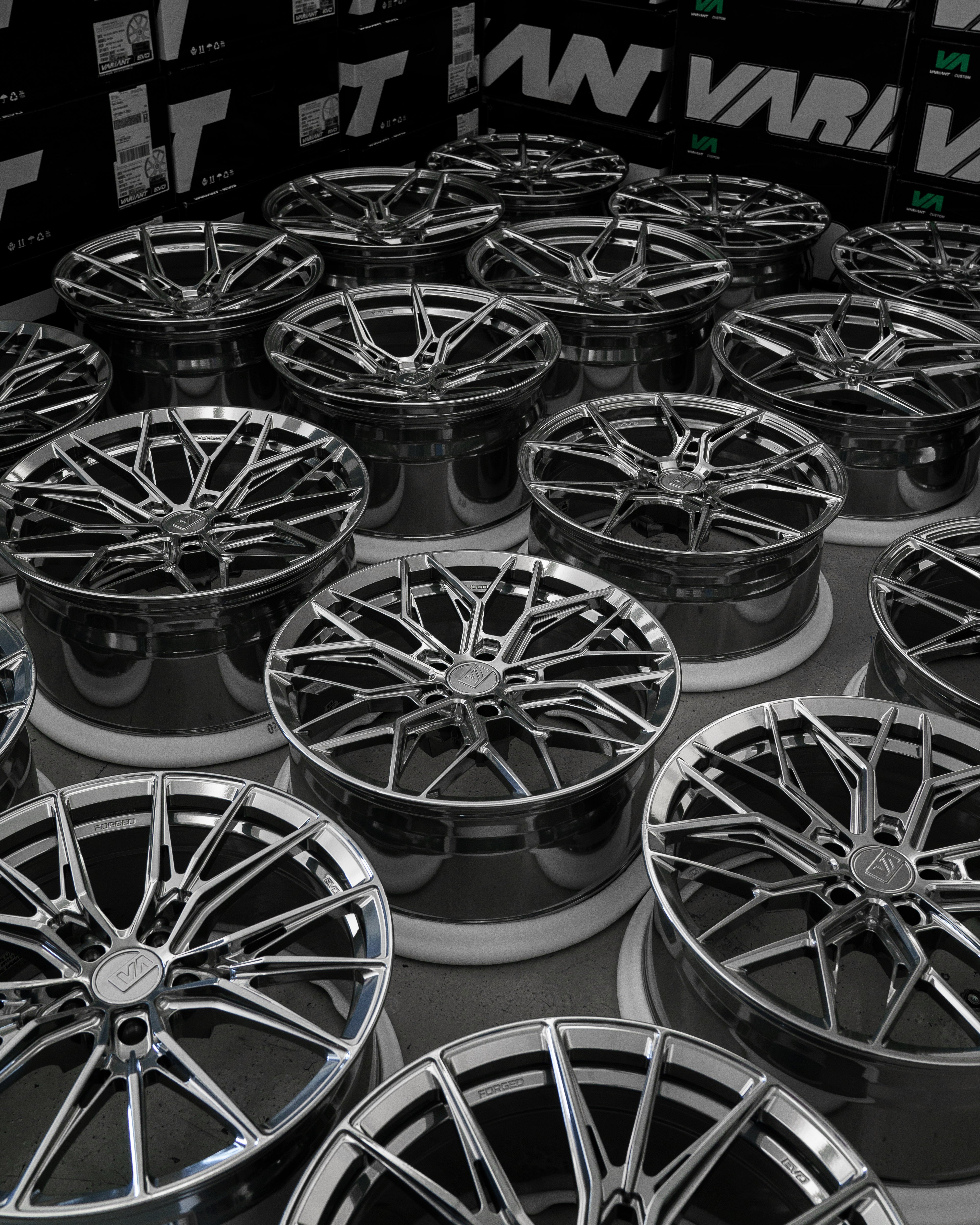

Key takeaways: The best wheels for the BMW M3 (G80) are true forged wheels in the factory 5x112 bolt pattern with a 66.6 mm center bore, and the most popular aggressive setup is 20x10 front with 20x11 rear. Forged construction is the right call on this car because the G80 is heavy for a sport sedan, and unsprung weight is where you feel a wheel change most. A 19-inch front paired with a 20-inch rear is the better choice if you track the car and want more sidewall.
What wheels does the G80 M3 come with from the factory?
It depends on the trim. The base BMW M3 with the six-speed manual ships on a staggered 18-inch front and 19-inch rear setup. The M3 Competition and Competition xDrive move up to a 19-inch front and 20-inch rear stagger, typically 19x9.5 up front and 20x10.5 out back, wrapped in 275/35R19 and 285/30R20 rubber. BMW's own M3 Sedan model page lists the current trim-by-trim configurations.
The factory wheels are good. They are also cast, heavy, and on every other G80 at the meet. That is usually what starts the search.
What bolt pattern and specs does the G80 M3 use?
Every G80 M3 uses the same core hub specs, which makes shopping straightforward once you know them:
- Bolt pattern: 5x112. This is the modern BMW pattern, shared with the G82 M4 and the A90 Toyota Supra. It is not the 5x120 used on older E and F chassis BMWs, so older-generation wheels do not carry over. If those numbers are unfamiliar, start with our guide to wheel bolt patterns and PCD.
- Center bore: 66.6 mm. Wheels built to this bore seat directly on the hub with no rings needed.
- Lug type: BMW uses bolts rather than studs from the factory. Many owners fit a stud conversion kit, which makes mounting a set of wheels dramatically easier when you are doing it alone in a garage.
- Brake clearance: the M Compound brakes are large, and the optional M Carbon Ceramic package is larger still. Spoke profile matters here, not just diameter.
What size aftermarket wheels fit the G80 M3?
Two setups cover most of what people actually run.
| Setup | Sizes | Best for | Trade-off |
|---|---|---|---|
| Square-ish 20-inch | 20x10 front / 20x11 rear | Street cars, the most aggressive stance, widest tire options | Less sidewall, firmer ride over broken pavement |
| Staggered 19/20 | 19x10 front / 20x11 rear | Track days, autocross, cold-weather setups | Front and rear wheels are not interchangeable |
The 20x10 and 20x11 combination is the volume seller for a reason: it fills the arches the way the G80's bodywork was clearly drawn for, and it opens up a much wider tire catalog than the odd factory sizes. The 19-inch front is the enthusiast's pick. More sidewall means more compliance on curbing and a cheaper front tire when you are burning through sets at track days.
Whichever you choose, confirm the exact offsets against your car. Offset determines whether the wheel tucks or pokes, and on a car with this much fender flare there is real room to get it wrong in both directions. Our offset guide walks through what the ET number is actually telling you.
Which Variant wheels fit the BMW M3 (G80)?
Every wheel we build is true forged. We do not make cast or flow-formed wheels, so there is no lower tier to talk you out of. The BMW M3 collection covers the 2021 and newer G80 in four designs:
- Zeno: the widest finish range in the lineup for this car, from gloss black to raw milled to satin bronze. A directional, split-spoke face that reads modern without shouting.
- Sena: a cleaner multi-spoke design. This is the one to look at if you want the wheel to complement the M3's already-busy front end rather than compete with it.
- Rian: a more structural, defined-spoke look. Raw milled on a Brooklyn Grey or Isle of Man Green car is a particularly good combination.
- Maxim: available in both the 20x10 / 20x11 setup and a 19x10 / 20x11 staggered setup for owners who want the taller front sidewall.
All of them are built to the G80's native 5x112 and 66.6 mm specs, so no adapters and no hub rings. If you are cross-shopping across the M lineup, the vehicle-specific fitments hub lists everything we spec by chassis.
Should you go square or staggered on a G80?
Staggered, in almost every case. The G80 is rear-biased in its power delivery even in xDrive form, and it puts down 473 to 523 horsepower depending on trim, per the model's published specifications. A wider rear tire is doing real work there, not just filling the arch.
The argument for square is tire rotation and a single spare size, which matters if you are running a dedicated track setup and burning tires fast. It is a legitimate choice, just a narrower one. We compared both approaches in staggered vs. square wheel setups.
Does forged construction actually matter on this car?
Yes, and the reason is weight in the right place. A G80 M3 weighs roughly 3,800 to 3,900 pounds depending on trim and drivetrain. That mass is already a lot for the suspension to control, and every pound you remove from the wheel is unsprung and rotating, meaning the damper has less inertia to fight over bumps and the car changes direction with less lag.
Forging aligns the aluminum's grain structure along the load paths in the wheel rather than leaving it randomly oriented as casting does. The practical result is a higher strength-to-weight ratio, which is what lets a forged wheel be both lighter and more resistant to bending than a cast wheel of the same size. That is the whole argument, and it is covered in more depth in forged vs. flow-formed wheels.
The honest counterpoint: going from a 19-inch factory wheel to a 20-inch aftermarket wheel with a wider tire can erase some of the weight you saved. If minimum weight is the goal, stay closer to the factory diameter. If the goal is a lighter wheel that also looks the way you want, forged in 20 inches is still meaningfully better than cast in 20 inches.
Frequently asked questions
What is the bolt pattern on a BMW M3 G80?
5x112 with a 66.6 mm center bore. This is shared with the G82 M4 and other current-generation BMWs, but not with older E or F chassis cars, which use 5x120.
Will G80 M3 wheels fit a G82 M4?
Generally yes. The M4 shares the M3's platform, bolt pattern, center bore, and track widths, so a wheel specced for one typically fits the other. Confirm the exact size and offset before ordering, since fender clearance can differ slightly between body styles.
Do you need spacers with aftermarket wheels on a G80 M3?
Not if the wheel is specced correctly for the car. Spacers are a way to correct an offset that is too conservative. Buying the right offset in the first place is the cleaner solution, because it keeps the hardware count in the load path down.
Can you run 20-inch wheels on an M3 with carbon-ceramic brakes?
Usually yes, but spoke profile is the deciding factor rather than diameter. The M Carbon Ceramic calipers are physically larger, so confirm caliper clearance for the specific wheel design before ordering. Diameter alone does not answer the question.
How much lighter are forged wheels than the factory M3 wheels?
It depends entirely on the size you choose. A forged wheel in the same diameter and width as the factory wheel will typically save meaningful weight per corner, but stepping up in diameter and width can offset some of that. Compare the actual published weight of the specific size you are ordering rather than assuming forged automatically means lighter than what you have.
Written by Taylor Smith, co-founder of Variant Alloy Wheels, who has spent nearly two decades in the automotive aftermarket.
Share:
What Is a Wheel Bolt Pattern? PCD and Lug Patterns Explained
Do You Need Special Lug Nuts for Aftermarket Wheels?