


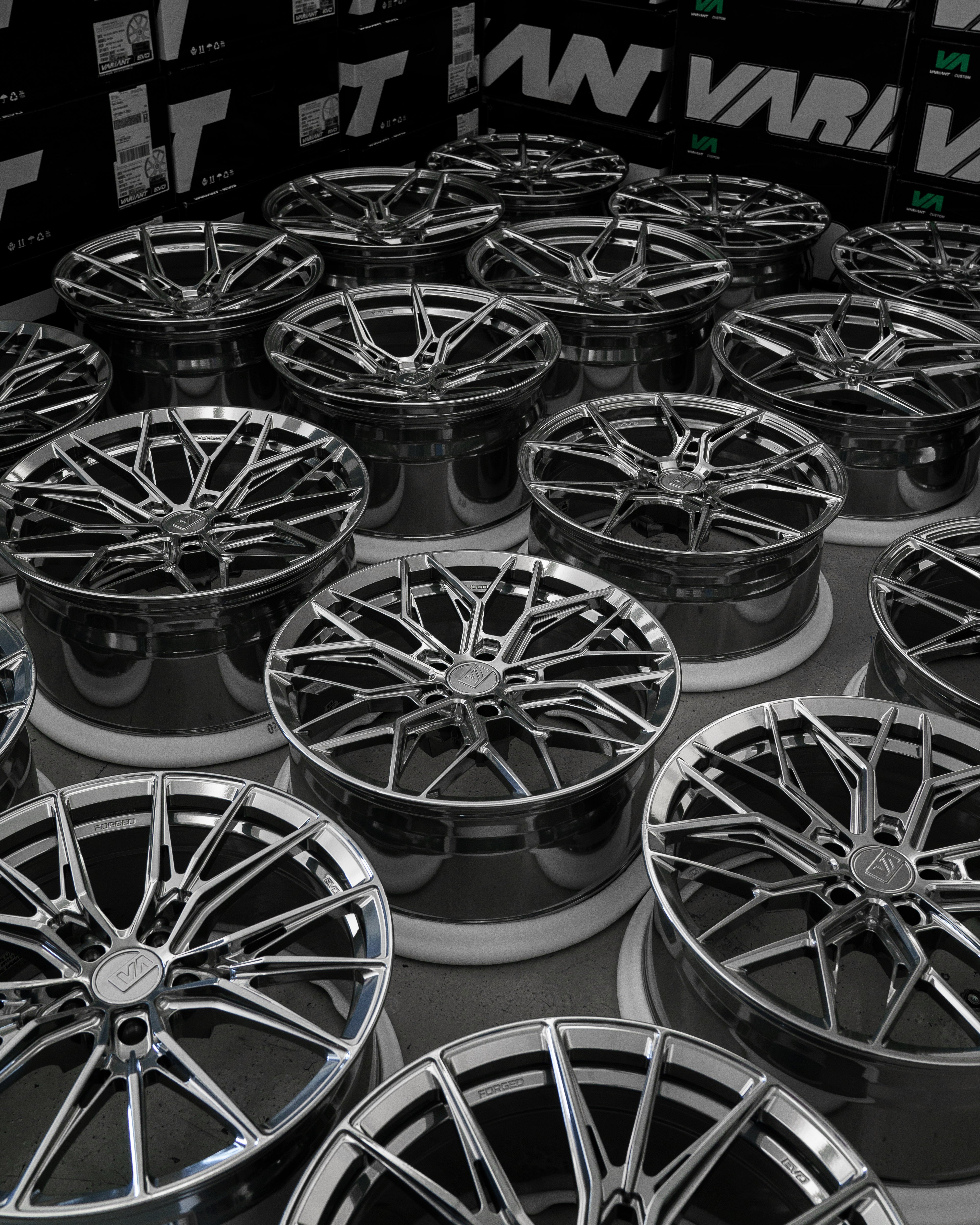

Key takeaways: Wheel concavity describes how far a wheel's spoke face curves inward from the outer lip toward the mounting hub. It is a byproduct of geometry, not a style option you simply order: wheel width, offset, and brake caliper clearance together determine how much concavity is physically available on your car. Because deep concavity forces spokes to carry load through a curved path instead of a straight one, the deepest profiles are almost always forged, where the aluminum's grain structure follows the shape of the part.
What is wheel concavity, exactly?
Wheel concavity is the depth of the dish formed between the outer lip of the wheel and the face of the spokes. Look at a wheel from directly in front. If the spokes sit flush with the outer lip, the face is flat. If they sweep back toward the center, curving away from you, that curve is concavity, and the distance between the plane of the lip and the deepest point of the spoke is how it gets measured.
People often talk about concavity as though it were a finish or a model choice, like brushed bronze or gloss black. It is not. Concavity is the consequence of where the wheel's mounting pad ends up inside the barrel. Move that pad, and the concavity changes, whether you wanted it to or not.
Flat, shallow, deep, and dish: what are the levels?
The terms are informal across the industry, but they describe points along one continuous scale:
- Flat face: spokes sit level with or very near the outer lip. Common on high-offset factory wheels and on square track setups.
- Shallow concave: a gentle sweep, typically a fraction of an inch of depth. This is what most OEM-plus fitments end up with.
- Deep concave: a pronounced curve where the spoke drops well behind the lip. Usually requires a wide wheel, a low offset, or both.
- Deep dish: a tall, near-vertical outer lip with a flat or shallow face behind it. This is a different look from deep concave, and the two are frequently confused.
Deep concave and deep dish are not the same thing. Concavity is about the curve of the spokes; dish is about the height of the lip in front of them. A wheel can have both, one, or neither.
What determines how concave a wheel can be?
Three variables set the ceiling, and you cannot cheat any of them.
1. Wheel width
Width creates room. A 10.5-inch-wide wheel simply has more barrel depth to work with than an 8.5-inch wheel at the same offset. This is why staggered setups so often look dramatically more concave at the rear than the front: the rear wheel is wider, so the face has further to travel. If you want serious concavity on a narrow wheel, you are usually out of luck.
2. Offset
Offset is the distance from the wheel's mounting pad to its centerline. Positive offset pushes the pad toward the street-facing side of the wheel, which drags the spoke face outward and flattens it. Negative or low offset moves the pad inboard, leaving more barrel in front of the spokes, which is where concavity comes from. If you take nothing else from this section: lower offset generally means more concavity, higher offset generally means less. For the full explanation of how offset works and how to choose it, see our guide to wheel offset and fitment, and the technical overview of wheel sizing conventions.
3. Brake clearance
This is the constraint that ends most concavity dreams. The spokes have to clear the brake caliper, and the caliper does not move. On cars with large front brake packages, like a Corvette C8 with the Z51 package, a BMW M3 with M Compound brakes, or anything running carbon ceramics, the caliper occupies exactly the space the spoke would need to sweep into. The wheel designer has to pull the spoke forward to clear it, which flattens the face. You can have aggressive concavity or you can have a big brake kit, and on many cars you cannot have the maximum of both.
Concavity constraints at a glance
| Variable | Change | Effect on concavity |
|---|---|---|
| Wheel width | Wider | More concavity possible |
| Offset | Lower / more negative | More concavity |
| Offset | Higher / more positive | Less concavity, flatter face |
| Caliper size | Larger brakes | Less concavity available |
| Diameter | Larger | Slightly more room, but a secondary effect |
Why are deep concave wheels usually forged?
Concavity has a structural cost. In a flat-faced wheel, load travels from the hub to the rim in something close to a straight line. In a deep concave wheel, that same load has to travel through a curved spoke, which introduces bending stress the straight path never sees. The deeper the curve, the more the material is being asked to do.
That is the case for forging. Forging compresses a solid billet of aluminum under enormous pressure, and the metal's grain structure flows to follow the shape of the finished part rather than being randomly oriented as it is in a casting. The result is higher density, better fatigue resistance, and greater strength per unit of weight. A cast wheel chasing the same concave profile has to add material to compensate, which adds unsprung weight and gives back the handling benefit you were after. Every wheel Variant builds is true forged for exactly this reason, which is what makes the aggressive profiles across the EVO monoblock collection and the multi-piece Corsa collection workable in the first place. If you want to understand how one-piece and multi-piece construction differ, our breakdown of monoblock vs. 2-piece vs. 3-piece wheels covers it.
Should you chase maximum concavity?
Honestly, no, not as a goal in itself. Chasing depth usually means dropping offset, and dropping offset changes scrub radius, loads the wheel bearings differently, and increases the odds of fender rub at full lock or full compression. A wheel that looks perfect parked and rubs on every driveway is a bad wheel.
The better approach is to start from a correct fitment for your car and see what concavity that fitment allows. On most applications there is a satisfying amount of it available inside a safe offset range. Our vehicle-specific fitments are built around that logic, and the Designer collection shows how spoke design itself, not just depth, drives how a face reads on the car.
Frequently asked questions
Is concave the same as dish?
No. Concavity is how far the spoke face curves inward from the lip. Dish is the height of the outer lip standing in front of the face. A wheel can be deeply concave with almost no lip, or deeply dished with a flat face.
Can I make my existing wheels more concave?
No. Concavity is machined into the wheel face during manufacturing and is fixed. Spacers push the whole wheel outward, which changes how it sits in the fender but does not change the shape of the face. In fact, a spacer moves the spokes further from the caliper without altering the spoke curve at all.
Does a more concave wheel weigh more?
Not necessarily, but it can. A deeper spoke path carries more bending load, so the design may need thicker sections to hold the same safety margin. Forged construction limits how much extra material that requires, which is why deep concave forged wheels can stay competitive on weight while cast equivalents typically cannot.
Do big brake kits rule out concave wheels?
They do not rule them out, but they reduce how much concavity is available. The spoke has to clear the caliper, so a larger caliper forces the face forward. Confirm caliper clearance before committing to a profile, particularly on cars running carbon ceramic brakes.
Is there a downside to running low offset for more concavity?
Yes. Lower offset moves the wheel outboard, which alters scrub radius, changes bearing load, and raises the risk of tire rub against the fender or liner. Concavity is worth having, but not worth compromising fitment for.
Written by Taylor Smith, co-founder of Variant Alloy Wheels, who has spent nearly two decades in the automotive aftermarket.
Share:
What Are the Lightest Forged Wheels for Your Car?
What Are the Best Wheels for the BMW 3 Series (G20)?