


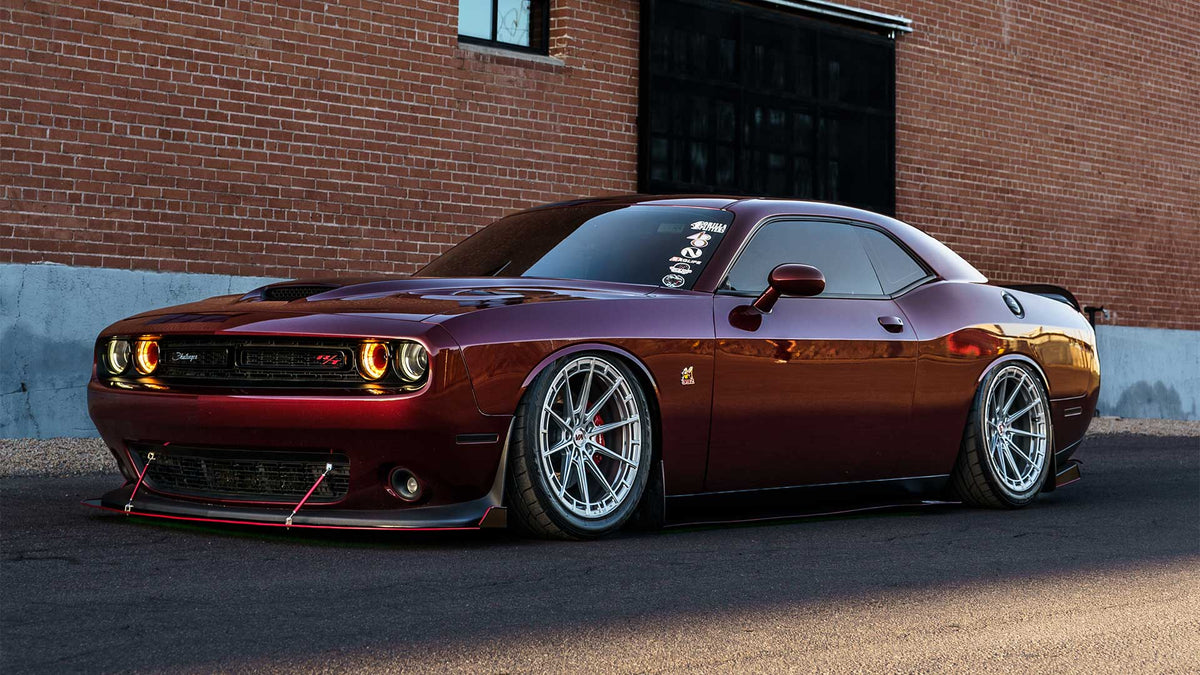
Key takeaways: The best wheels for the Dodge Challenger and Charger Hellcat are lightweight true-forged sets in 5x115 with a 71.5mm center bore, sized to your body style. Widebody cars run a square 20x11 setup with 305/35ZR20 tires at roughly ET-2, while narrowbody Hellcats run 20x9.5 with 275/40ZR20. These are 4,400 to 4,600 pound cars making 707 to 807 horsepower, so reducing unsprung weight and getting the right width under the fender matters more here than on almost anything else.
Hellcat owners have a specific problem: the car has enormous power and enormous mass, and the factory wheels are neither light nor especially wide relative to what the chassis can use. That's a good starting point for a wheel upgrade, but only if you understand which body style you have, because Dodge sold two very different fitments under similar badges.
What are the factory wheel specs on a Hellcat?
All modern Challengers and Chargers share the same mounting hardware:
- Bolt pattern: 5x115 (five lugs on a 115mm pitch circle diameter)
- Center bore: 71.5mm, hub-centric
- Fastener type: lug nuts on studs
From there the two body styles diverge sharply:
| Body style | Factory wheel | Factory tire | Setup |
|---|---|---|---|
| Widebody (Hellcat, Redeye, Super Stock, Scat Pack Widebody) | 20x11, approx. ET-2 | 305/35ZR20 | Square, all four corners |
| Narrowbody (Hellcat, Scat Pack, R/T) | 20x9.5, approx. ET+18 | 275/40ZR20 | Square |
Note the offset gap. Twenty millimeters of offset difference plus an inch and a half of width means a widebody wheel will sit dramatically outside the fender on a narrowbody car, and a narrowbody wheel will look badly tucked under widebody arches. Confirm which car you have before you order anything. If offset is unfamiliar territory, start with our wheel offset guide.
What wheel size is best for a widebody Hellcat?
Widebody cars have real room to work with. The common upgrades are:
- 20x11 square, ET0 to ET-5. Factory-equivalent sizing on a lighter forged wheel. Keeps the 305/35ZR20 tire and the factory alignment behavior. The safest choice.
- 20x11 front, 20x11.5 or 20x12 rear. A mild stagger for owners who want a wider rear contact patch for traction. Requires care with rear fender clearance and often a slight fender roll.
- 21-inch. Fills the arches impressively and suits the widebody's proportions, but the shorter sidewall firms up an already firm car and increases pothole risk. See how bigger wheels affect ride quality.
A wider rear is genuinely useful on a rear-wheel-drive Challenger Hellcat making 707 to 807 horsepower, where traction is the actual limiting factor. On an all-wheel-drive Charger the case is weaker, and staying square keeps rolling circumference matched. Our breakdown of staggered vs. square setups covers when each makes sense.
What wheel size is best for a narrowbody Hellcat?
Narrowbody cars are more constrained, and this is where people get into trouble. Common working sizes:
- 20x9.5 square, ET+15 to ET+20. Direct replacement territory. Straightforward.
- 20x9.5 front, 20x10.5 rear, ET+18 front and ET+20 to ET+25 rear. A modest stagger on a 275 front and 295 rear. Usually the most aggressive setup that works without fender work.
- Anything wider than 10.5 rear. Expect fender rolling, and on a lowered car, expect rubbing. Read why wheels rub and how to fix it before committing.
If you're unsure how width translates to tire fitment, our guide to wheel width and tire fitment shows how to match a tire size to a rim width without stretching or ballooning the sidewall.
Why does wheel weight matter so much on a Hellcat?
Because these cars are heavy and the factory 20x11 wheels are not light. A Challenger SRT Hellcat Widebody weighs roughly 4,500 pounds, and a Charger Hellcat Widebody is in the same neighborhood.
Every pound removed from a wheel is unsprung and rotating, which is the most valuable place on the car to lose mass. Less unsprung weight gives the dampers less inertia to control over broken pavement, which usually shows up as better body control and a more settled ride rather than as a lap time. Less rotating inertia also helps a car that spends its life accelerating and braking hard. The mechanism is explained in what unsprung weight actually does.
There's a second reason construction matters here, and it's the more important one. A 20x11 wheel carrying a 4,500-pound car with 650-plus lb-ft of torque needs a serious load rating. A cast wheel reaches that rating by adding material, which is why big cast wheels get heavy fast. A forged wheel reaches it with less metal, because forging aligns the aluminum's grain structure and eliminates the porosity casting leaves behind. That's the whole argument for forged on a car like this: same strength, less weight. See forged vs. flow-formed for the full comparison.
What about drag-strip and street/strip setups?
Plenty of Hellcats see a strip. A few practical notes:
- Skinnies up front, wide rear. A common drag setup runs a narrow lightweight front wheel and a wide rear on a drag radial. This is a dedicated-use configuration, not a street setup, and it changes steering feel significantly.
- Wheel strength is not optional. Launching a supercharged V8 puts enormous torsional load through the rear wheels. This is exactly the scenario where a wheel's failure mode matters, and where a forged wheel's tendency to bend rather than crack is a meaningful safety margin.
- Check your load rating against actual corner weights, not the manufacturer's curb weight, especially if you've added a cage or heavy audio.
Which Variant wheels fit the Hellcat?
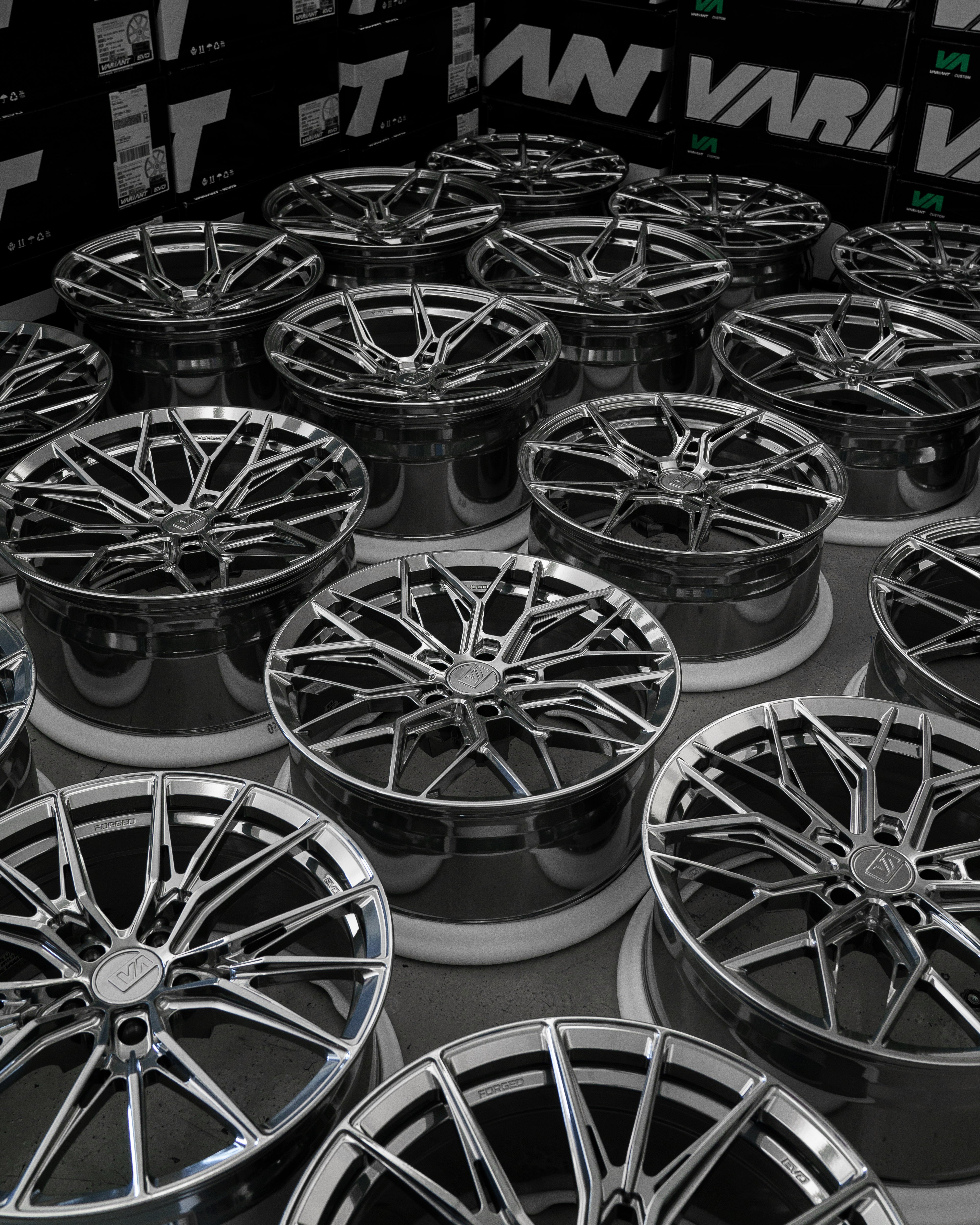
Variant builds only true forged wheels, machined from billet rather than cast. We list confirmed Hellcat fitments by body style so you don't have to guess:
- Challenger OEM Widebody (Hellcat, Demon, Scat Pack)
- Charger Hellcat and Redeye
- Challenger RWD (narrowbody)
- Charger OEM Widebody
For designs, the Corsa line leans lightest and most motorsport-oriented, while EVO offers split-spoke and mesh faces that suit the Challenger's broad shoulders. You can also browse all vehicle-specific fitments. For independent instrumented test data and factory specifications, Car and Driver's Challenger SRT Hellcat coverage is a good reference, and the Wikipedia entry on the third-generation Challenger lays out the trim and body-style history clearly.
Frequently asked questions
What is the bolt pattern on a Dodge Challenger Hellcat?
The Dodge Challenger and Charger Hellcat use a 5x115 bolt pattern with a 71.5mm hub-centric center bore, shared across the whole modern Challenger and Charger range including R/T, Scat Pack, Hellcat, and Redeye. They use lug nuts on studs rather than lug bolts.
What size wheels come on a widebody Hellcat?
Factory widebody Challengers and Chargers run a square 20x11 setup at approximately ET-2 with 305/35ZR20 tires on all four corners. Narrowbody cars run 20x9.5 at roughly ET+18 with 275/40ZR20 tires, so the two are not interchangeable.
Can you put widebody wheels on a narrowbody Challenger?
Not without consequences. A 20x11 wheel at ET-2 is both wider and considerably further outboard than the narrowbody's 20x9.5 at ET+18, so it will poke well past the fender and almost certainly rub. If you want that width, the widebody fender kit has to come with it.
How much weight can you save with forged wheels on a Hellcat?
A true forged wheel is typically 15-25% lighter than a comparable cast wheel at the same size, which on a 20x11 can mean several pounds per corner. On a 4,500-pound car that repeatedly accelerates and brakes hard, that reduction in unsprung, rotating mass is one of the more noticeable chassis changes available.
Do you need a staggered setup on a Hellcat?
No, and the factory doesn't use one. Both widebody and narrowbody Hellcats ship square. A mild rear stagger can help traction on rear-wheel-drive Challengers where grip is the limiting factor, but on all-wheel-drive Chargers staying square keeps front and rear rolling circumferences matched, which the drivetrain prefers.
Written by Taylor Smith, co-founder of Variant Alloy Wheels, who has spent nearly two decades in the automotive aftermarket.
Share:
Will Aftermarket Wheels Clear My Big Brake Kit? How to Check Brake Clearance
What Are the Best Wheels for the BMW 4 Series (G22)?