



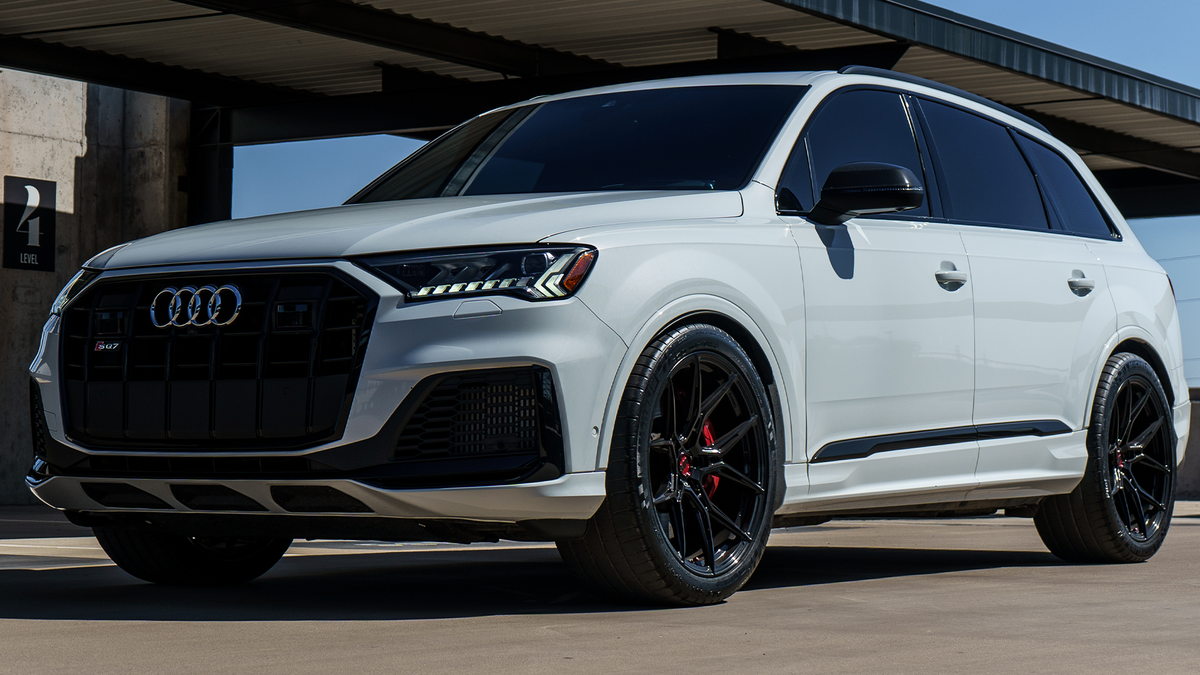
Yes, custom forged wheels can usually be ordered in a specific offset, and often a specific width, because a forged wheel is machined to its final dimensions after forging, within the range the forging allows. "Any" width and offset is an overstatement, though. Your real limits are brake caliper clearance on the inboard side, strut and control arm clearance, fender line on the outboard side, and the engineering envelope the wheel was designed and load-rated around. Tell our fitment experts your car, tires and ride height and we'll spec the width and offset. Our EVO monoblocks are listed in proven fitments for popular cars, and when your numbers fall outside them, EVO Custom builds the same designs to your car in diameters from 17 to 24 inches.
Can you order custom forged wheels in any width and offset?
Within limits, yes. This is the single biggest practical advantage of custom forged wheels over off-the-shelf cast or flow-formed sets. A cast wheel is poured into a mold, so the mold defines the width and offset, and changing either means tooling a new mold. That is why cast catalogs offer a handful of fixed sizes per design.
Forging works the other way around. A forged monoblock wheel begins as a solid aluminum billet that is pressed under enormous force into a forging, heat-treated, and then machined. The forging sets the design and the size range; the machining stage cuts the mounting pad, hub bore and bolt pattern, and the mounting pad is where offset is set. Moving the offset a few millimeters inside that range is a machining change, not a new mold. That is how our EVO Custom program works: you pick an EVO design, and our team specs the diameter, width and offset for your car, checking them against your brakes and tires. Our step-by-step look at how forged wheels are made covers the full process.
Why does forging allow custom specs when casting does not?
The difference comes down to where the shape is created.
| Construction | How the shape is made | Custom width and offset? |
|---|---|---|
| Cast | Molten aluminum poured into a fixed mold | No. Limited to whatever sizes the mold set covers. |
| Flow-formed | Cast center, then the barrel is spun and stretched over a fixed mandrel | Limited. Barrel width has some flexibility, the center does not. |
| Forged monoblock | Solid forged blank, machined to the car's hub, bolt pattern and offset | Yes, within the design's range. The forging sets the width; the offset is machined in. |
| Forged 2-piece | Forged center bolted or welded to a separate barrel | Yes. The barrel sets the width and where the center sits in it sets the offset. |
Two-piece construction is the most flexible of the four, because the barrel and the center are separate parts. Swap barrel dimensions and you change width; change where the center sits in the barrel and you change offset, without touching the face design at all. Our EX2 two-piece collection exists for exactly this kind of fitment work, and the monoblock vs. 2-piece vs. 3-piece comparison explains where each makes sense.
What actually limits your custom offset and width?
Four physical constraints, and one engineering one. None of them care what you want the car to look like.
- Brake caliper clearance. The inner barrel and spoke backside have to clear the caliper body. Cars with large factory brakes, and anything with a carbon-ceramic or big brake kit, set a hard floor on how much you can raise offset or how deep the spokes can sit. Our guide to checking brake clearance covers how to measure it.
- Suspension clearance. On the front axle, the strut body, spring perch, or upper control arm often sits closer to the inner barrel than the caliper does. Add width inboard and this is usually what you hit first.
- Fender and arch line. The outboard limit. Too little offset and the tire pokes past the fender, rubs at full compression, or both.
- Tire availability. A 12.5-inch-wide wheel is useless if no tire you want is made in a size that fits it properly. Check the tire first on unusual widths.
- The engineering envelope. Forged wheels for road use are designed and validated at specific dimensions. Aftermarket wheel testing under standards like SAE J2530 covers radial fatigue, cornering fatigue, and impact, and the load rating depends on the geometry that was tested. A width or offset far outside the validated range is not a cosmetic request, it is a different wheel that needs different validation.
That last one is why a responsible manufacturer will sometimes tell you no. It is not upselling; it is that the numbers you asked for fall outside what the design supports at your vehicle's corner weight.
How do you decide what width and offset to order?
Work outward from the tire, not inward from the look.
- Pick the tire size first. Decide what you want at each corner, for example 275/35R20 front and 305/30R20 rear on a rear-drive coupe.
- Match wheel width to that tire. Every tire has a recommended rim width range. Our guide on choosing wheel width covers how to read it.
- Start from the factory offset and adjust. Adding width without adjusting offset splits the extra width evenly inboard and outboard. Tire Rack's explanation of wheel offset covers this well. Usually you want most of the added width going inboard, which means raising offset as width goes up.
- Check your ride height. A lowered car has less fender clearance and hits the arch sooner. Specify offset for the height you will actually run, not the height it sits at now.
- Confirm against a known platform. A proven fitment for a BMW M3 or Corvette C8 beats a guess every time. Start with the EVO fitments listed for your car in our vehicle-specific fitments and treat custom numbers as a deliberate deviation from a known-good baseline.
What are the trade-offs of going custom?
Custom is the right call more often than not on a modified car, but it is not free.
- Timing. Custom numbers are machined after you order, so plan the wheels into your build schedule, not the week before an event.
- The spec has to be right first. Wheels machined to your numbers are built for your car alone, so the real work happens before anything gets cut. That is the part our fitment experts handle with you.
- Resale. A set in an unusual offset fits fewer cars, so the buyer pool is smaller when you sell. Our piece on whether forged wheels hold their value gets into this.
- Going past a proven fitment is a trade. Numbers outside a known-good baseline can rub at full lock or full compression, so treat every millimeter past it as a deliberate choice, made with someone who has fit that car before.
When should you skip custom and buy a standard fitment?
If your car is stock or close to it, running factory-size tires, and you mainly want a lighter, better-looking wheel, a proven off-the-shelf forged fitment is the better buy. It is easier to resell, and the specs are already proven on your platform. Custom earns its keep when you have a modified ride height, non-standard tire sizes, a big brake kit, or a specific stance target that standard offsets cannot reach. The EVO monoblock collection and the broader forged wheel lineup cover most stock and mildly modified cars without any custom work at all, and finish options like additional finishes let you personalize the set without touching the fitment. Not sure which side of the line your car is on? Tell our fitment experts what you drive and how it sits, and we'll spec the set.
Frequently asked questions
Can you change the offset of a wheel you already own?
On a monoblock wheel, no. The offset is machined into a single piece of aluminum and cannot be safely altered. On a two-piece or three-piece wheel, sometimes: depending on the design, the manufacturer may be able to rebuild it with different barrel parts. Spacers effectively reduce offset but do not change the wheel itself.
How much offset change is too much?
There is no universal number, because it depends on the platform's suspension geometry and how much fender clearance it started with. As a practical guide, changes within about 10 mm of a proven fitment are usually straightforward, 10 to 20 mm needs careful checking against brakes and fenders, and beyond that you should expect to address rubbing, scrub radius change, or both.
Are custom forged wheels weaker than standard sizes?
Not inherently. A forged wheel built to custom dimensions from the same alloy, inside the range the design was engineered for, has the same material properties. The risk is not the customization itself, it is specifying dimensions outside what the design was engineered and load-rated for.
Can you get a custom bolt pattern and center bore too?
Bolt pattern and center bore are normally machined to match your vehicle exactly, which is standard practice rather than a custom request. A hub-specific center bore is preferable to running hub-centric rings. See our explainer on center bore and hub-centric rings.
How do you specify a custom wheel order correctly?
Provide the vehicle year, make, model, and trim; current ride height and any suspension modifications; brake setup including any big brake kit; the exact tire sizes you plan to run front and rear; and, if you have them, your target diameter, width, and offset per axle. If you don't, our fitment experts can work out the numbers from the rest. Our guide on reading a wheel spec sheet shows what each number means before you commit to it.
Written by Taylor Smith, co-founder of Variant Alloy Wheels, who has spent nearly two decades in the automotive aftermarket.
Share:
How Do You Measure Your Car for New Wheels? Clearance Checks Before You Order
Should You Buy Used Forged Wheels?