


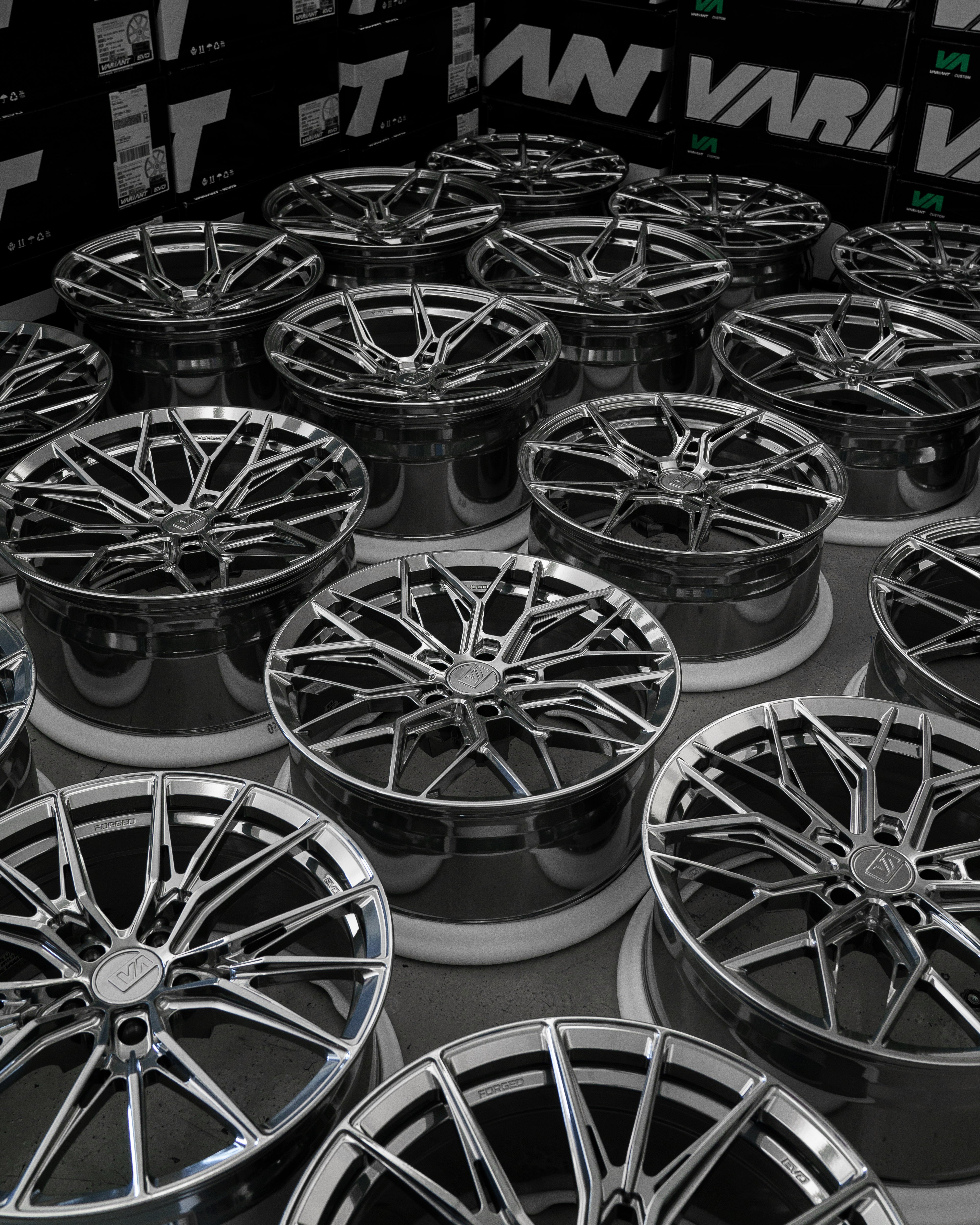
Key takeaways: Forged wheels are made by taking a solid billet of aluminum alloy (usually 6061-T6), heating it until it is soft but still solid, and squeezing it under thousands of tons of pressure in a forging press. That pressure packs the metal's internal grain structure tight and eliminates the air pockets you get in casting, so the wheel ends up stronger for its weight. The rough forged blank is then CNC-machined into its final spoke design, heat-treated, and finished. The result is a lighter, denser, more fatigue-resistant wheel than a cast or flow-formed equivalent.
What does "forged" actually mean?
Forging is shaping solid metal with compressive force rather than melting and pouring it. This is the core answer to how forged wheels are made: instead of pouring liquid aluminum into a mold (casting), a forged wheel starts life as a solid cylinder of aluminum called a billet. That billet is pressed into shape while it is hot but never liquid. Because the metal stays solid the whole time, its grain flow follows the shape of the wheel instead of freezing in place at random, which is what gives a true forged wheel its strength-to-weight advantage. If you want the wider comparison, see our guide to forged vs. flow-formed vs. cast wheels.
At Variant we only build true forged wheels, so every wheel we sell goes through the process described below.
What material do forged wheels start as?
Most forged wheels start as a billet of 6061-T6 aluminum alloy. 6061 is an aluminum alloy blended mainly with magnesium and silicon; the "T6" describes its temper, meaning it has been solution heat-treated and then artificially aged for high strength. It is the same family of alloy used in aircraft and structural parts because it balances strength, fatigue resistance, and machinability. We break the metal down in more detail in what forged wheels are made of. A single round billet, often 100 to 150 mm thick and weighing far more than the finished wheel, becomes one wheel.
How are forged wheels made, step by step?
A one-piece (monoblock) forged wheel is made in roughly six stages: billet prep, heating, forging, spin-forming the barrel, heat treatment, and CNC machining. Here is what happens at each step.
- Billet preparation. A solid cylinder of 6061-T6 aluminum is cut to size and inspected. This is the raw slug that will become the wheel.
- Heating. The billet is heated to a forging temperature (roughly 400 to 500 degrees C for aluminum) so it becomes malleable while staying solid.
- Forging under pressure. The hot billet is placed in a forging press and squeezed into a rough wheel blank. Industrial wheel presses commonly apply several thousand tons of force, and some of the largest exceed 10,000 tons. This is the step that compresses and aligns the grain structure.
- Spin-forming the barrel. The forged blank is spun and rolled to form the barrel (the drum the tire mounts to) and set the width and profile.
- Heat treatment. The wheel is solution-treated and aged (the T6 temper) to reach its final hardness and fatigue strength.
- CNC machining. A computer-controlled cutter carves the spoke design, faces the wheel, and drills the exact bolt pattern and center bore for a specific fitment.
Only after all of that does the wheel move to finishing: brushing, polishing, painting, or powder coating. You can see the finished results of this process across our monoblock lineup in the EVO Collection and our multi-piece work in the Corsa Collection.
Why does forging make a wheel stronger?
Forging strengthens a wheel by refining its grain structure and removing porosity. When aluminum is cast, it can trap tiny air pockets as it solidifies, and those voids are weak points. Forging squeezes the solid metal so tightly that there is nowhere for porosity to form, and it stretches the internal grain flow to follow the wheel's contours. The Hagerty explainer on how forged wheels are made describes the same principle: the pressure condenses the metal into a finer, denser grain. For the underlying metallurgy, the general concept of forging is well documented. In practice this means engineers can hit the same strength target with less material, which is why a forged wheel is usually lighter than a cast one of the same size. Lighter wheels reduce unsprung weight, which improves ride and handling.
How is a forged wheel different from cast or flow-formed?
The difference is how the metal is shaped and how dense it ends up. The table below summarizes the three main construction methods.
| Method | How it is made | Relative strength & weight |
|---|---|---|
| Cast | Molten aluminum poured into a mold | Heaviest, most porous, lowest cost |
| Flow-formed (rotary-forged) | Cast center, then the barrel is spun and stretched under rollers | Middle ground; only the barrel is worked |
| True forged | Solid billet pressed under thousands of tons, then machined | Strongest for its weight, densest, highest cost |
It is worth being precise here: flow-formed wheels are sometimes marketed as "forged," but only the barrel is worked and the center is still cast. A true forged wheel is worked as one solid piece. If you want a monoblock, 2-piece, or 3-piece breakdown, read monoblock vs. 2-piece vs. 3-piece wheels. Ready to shop by construction? Start with the full forged wheel lineup.
Frequently asked questions
Are all forged wheels made from a single piece of metal?
No. A monoblock forged wheel is machined from one forged billet, but 2-piece and 3-piece forged wheels forge the center and barrel(s) separately and then bolt or weld them together. All of them start from forged material rather than castings.
Why are forged wheels more expensive to make?
Forging requires a large billet, a multi-thousand-ton press, heat treatment, and extensive CNC machining, and a lot of the starting material is cut away. That equipment and material cost is why forged wheels sit at the top of the price range compared with cast wheels.
Does forging make a wheel lighter automatically?
Not automatically, but it allows it. Because forged metal is denser and stronger, a designer can remove material and still meet load requirements, so a well-designed forged wheel is typically lighter than a cast wheel of the same size and strength.
Is "billet" the same as "forged"?
They are related but not identical. A billet is the solid slug of metal you start with. A fully forged wheel is pressed under high force, whereas a "billet" wheel is sometimes only CNC-cut from the billet without the forging press step. Ask whether the wheel is actually press-forged.
Written by Taylor Smith, co-founder of Variant Alloy Wheels, who has spent nearly two decades in the automotive aftermarket.
Share:
What Are the Lightest Forged Wheels for Your Car?
What Are the Best Wheels for the BMW 3 Series (G20)?