



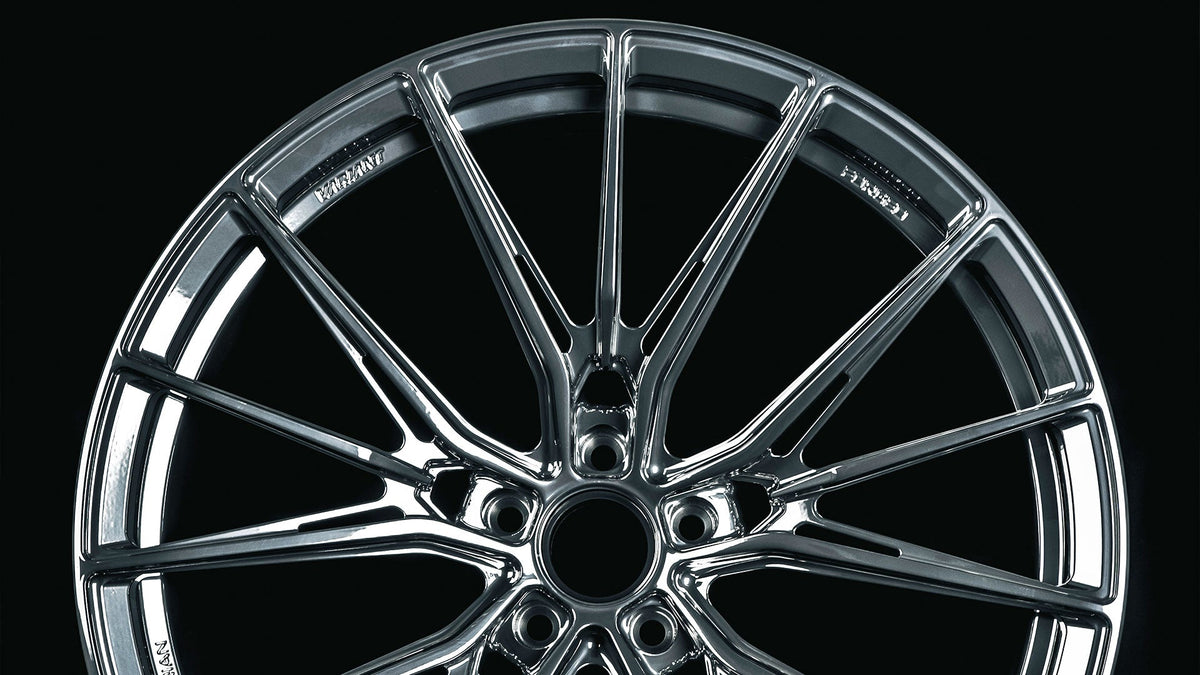
Buying used forged wheels can save you real money against new, and a forged wheel that has led an easy life is genuinely a good used purchase. The risk is not cosmetic. It is the repaired crack and the straightened bend, both of which can be hidden under fresh paint and both of which compromise a safety-critical part. Verify the specs yourself, inspect the inner barrel and mounting pad, and get a runout check on a balancer before money changes hands. If the right used set never turns up, tell our fitment experts what you drive and we'll spec a new set for it, whether that's one of our EVO monoblocks or an EX2 or three-piece build.
Are used forged wheels safe to buy?
Usually, with a real caveat. Forged aluminum starts life stronger than cast because the forging process compresses the grain structure of the billet along the shape of the wheel rather than leaving it randomly oriented as casting does. A forged wheel that has spent 30,000 street miles on a well-maintained car has usually been through nothing it wasn't built for.
The caveat is that aluminum alloys have no true fatigue limit. Unlike steel, which can cycle indefinitely below a threshold stress, aluminum accumulates fatigue damage with every load cycle no matter how small. In practice this is a non-issue for street wheels, because they are engineered with large margins against loads far above what a road car generates. It becomes relevant when a wheel has been through repeated track abuse, a hard impact, or a repair that disturbed the heat treatment.
So the question is not "is forged aluminum durable." It is "what has this specific wheel been through, and can I see the evidence." Our guide to whether forged wheels bend or crack covers what normal failure modes actually look like.
What should you inspect on a used forged wheel?
Work through this in order. Items one through five you can do in a parking lot. Items six through ten need the tire off or a balancer, and any seller who refuses that is telling you something.
- Mounting pad. The flat annular surface that meets the hub. It should be clean and even. Gouging, corrosion pitting, or a wavy surface means the wheel will not sit true no matter what else is right.
- Bolt holes and seats. Look for elongation, flattened cone seats, or bright galling. These indicate the wheel was run loose or torqued with the wrong hardware, which work-hardens the material around every hole.
- Curb rash depth. Rash that stays in the paint and the outer few thousandths of the lip is cosmetic. Rash that has gouged material out of the rim flange, or that reaches the bead seat, is structural and affects how the tire seals. See repairing curb rash on forged wheels for where that line sits.
- Inner barrel, all the way around. Bring a light. Cracks almost always start on the inside, most often where the spokes meet the barrel or at the radius where the barrel meets the outer lip.
- Hardware on multi-piece wheels. On a two- or three-piece wheel, check the bolt heads for rounding, look for sealant weeping at the joint, and ask whether the wheel has ever been disassembled and re-sealed.
- Evidence of straightening. A bent wheel that has been pressed back can look perfect from the face. Look for paint or clear coat cracking on the inner lip, a faint ripple in the barrel when you sight along it, or a section of lip that is visibly thinner than the rest.
- Evidence of weld repair. Mismatched surface texture, grinding marks, heat discoloration on the inside, or a patch of paint that is glossier than the rest. Welding a cracked wheel disturbs the heat treatment that gives forged aluminum its strength, and most wheel manufacturers do not consider a welded wheel safe to return to service.
- Runout on a balancer. This is the one people skip and the one that matters most. Radial and lateral runout should generally be under about 0.030 inch. A wheel that reads well above that will never balance out, which is a common cause of the vibration at highway speed people blame on tires.
- Measured specs, not claimed specs. Measure the bolt pattern, the center bore, and the offset yourself. Sellers get these wrong constantly, and an offset that is 10 mm off from what was advertised turns a bargain into a set of wheels that rub.
- Markings. Look for the manufacturer stamp, part number, and size on the inner barrel or the back of the spokes. A wheel with no traceable markings is a wheel you cannot verify. Our explainer on reading a wheel spec sheet covers what those numbers mean.
What are the red flags that should end the deal?
- Any crack, anywhere, repaired or not.
- Any admission or evidence that a wheel has been straightened after an impact.
- A seller who will not let you inspect with the tires off or run a balancer check.
- Fresh powder coat or paint on a wheel being sold as "never damaged." Refinishing is legitimate, but it also hides everything in items six and seven above, so a refinished wheel needs more inspection, not less.
- No markings, no part number, no traceable manufacturer.
- A price far below the going rate for that model and size. In this market, that gap is usually explained by something the listing does not mention.
How much should used forged wheels cost?
Prices vary a lot by brand, size and demand, so treat these as a rough guide to how condition moves the price, not a quote.
| Condition | Typical share of new price | What you are accepting |
|---|---|---|
| Mint, low mileage, original finish | 65 to 80 percent | No warranty, previous owner's fitment choices |
| Light rash, straight, verified runout | 45 to 60 percent | Cosmetic work or living with the marks |
| Professionally refinished | 50 to 65 percent | Refinishing may be hiding prior damage |
| Repaired, welded, or straightened | Not worth buying | Compromised structure on a safety part |
Two costs people forget to add. First, refinishing a forged wheel properly costs real money per wheel, and a set of four rashed wheels bought at a 55 percent discount can end up close to new-price territory once you make them look right. Second, most manufacturer warranties do not transfer to a second owner, so you are self-insuring. Forged wheels do hold their value comparatively well, which is a double-edged fact when you are the buyer, as we cover in do forged wheels hold their value.
When does buying new make more sense?
Used makes sense when you find the exact model, size, and offset you would have specified anyway, from a documented owner, in verifiable condition. That is a narrower window than it sounds.
New makes more sense in these cases:
- You need a specific fitment. Used inventory is whatever someone else ordered. If your car needs a particular offset to clear a big brake kit or to sit right, waiting for that combination to appear secondhand can take a very long time. New can be specced to it, and if the size isn't in our listed EVO fitments for your car, our EVO Custom program builds EVO designs in diameters from 17 to 24 inches.
- You want a finish that matches the build. A used set commits you to someone else's color. Our custom finish options let you specify from the start.
- You want a known history. On a heavy car or a track car, knowing a wheel has never been hit, repaired, or refinished is worth more than the discount.
- You want a current design. Wheel design has moved on. Our EVO monoblocks and Corsa three-piece wheels are designed around today's cars, brakes and tire sizes.
If you go new, browse the full range under forged wheels or see the EVO fitments for your car under vehicle-specific fitments. Or skip the searching: tell our fitment experts your car and how you drive it, and we'll spec the fitment.
Frequently asked questions
How can you tell if a used wheel has been repaired?
Look for mismatched surface texture, grinding marks, heat discoloration on the inner barrel, clear coat cracking on the inner lip, or a section of lip that is thinner than the rest. Fresh paint on a wheel sold as undamaged is a reason to inspect harder, not a reassurance.
Is a welded forged wheel safe to use?
No. Welding disturbs the heat treatment and grain structure that give forged aluminum its strength, and it creates a heat-affected zone around the repair that is weaker than the surrounding material. Most wheel manufacturers do not consider a welded wheel fit to return to service at road speed.
How much runout is acceptable on a used wheel?
As a general guide, both radial and lateral runout should measure under about 0.030 inch, and tighter is better. A wheel measuring meaningfully above that will be difficult or impossible to balance and will produce vibration that no amount of tire work will fix.
Do forged wheels wear out over time?
Not in the way brake pads or tires do. Aluminum accumulates fatigue damage with load cycles rather than having an indefinite threshold, but street-driven forged wheels operate far below the loads they were designed for. Impacts, repairs, and repeated track use shorten service life far more than mileage does.
Does a wheel warranty transfer to a second owner?
In most cases, no. Manufacturer wheel warranties are typically extended to the original purchaser and do not transfer with a private sale. Factor that into what you are willing to pay, since you are taking on the risk yourself.
Written by Taylor Smith, co-founder of Variant Alloy Wheels, who has spent nearly two decades in the automotive aftermarket.
Share:
Can You Order Custom Forged Wheels in Any Width and Offset?
Are Forged Wheels Good for Track Days? Heat, Impacts, and What to Check