


Key takeaways: Wheel spacers are safe when they are hub-centric, correctly sized to your hub and wheel, and installed with full thread engagement at the factory torque spec. The failures people hear about almost always trace back to the install, not the concept: wrong center bore, bolts that are too short, or a cheap non-hub-centric part. If you are already shopping for new wheels, the better answer is ordering the correct offset from the start and skipping the spacer entirely.
What does a wheel spacer actually do?
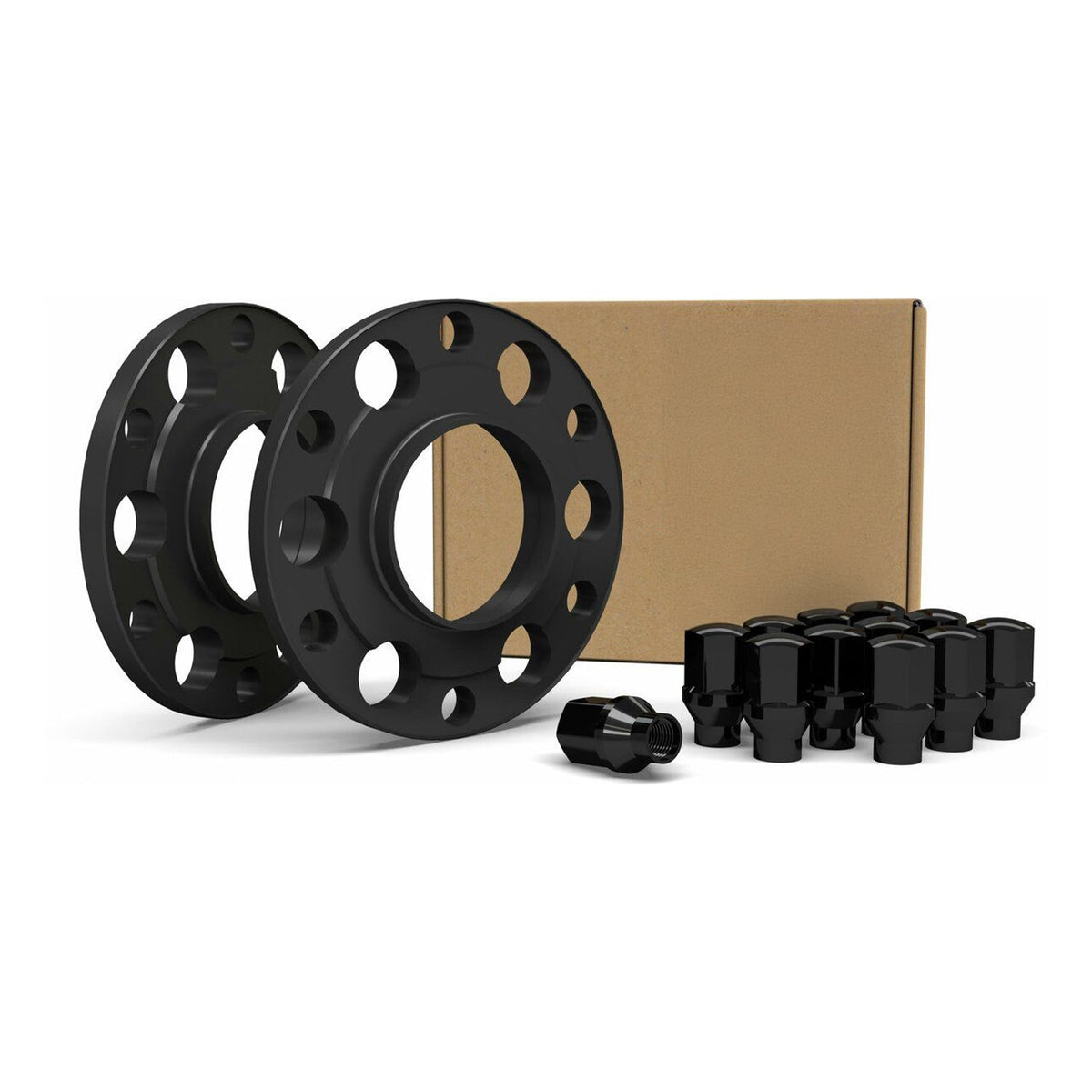
A wheel spacer is a machined aluminum or steel disc that sits between the hub and the wheel, pushing the wheel outward by the thickness of the spacer. A 15 mm spacer moves the wheel 15 mm further from the suspension and 15 mm closer to the fender.
Functionally, a spacer changes wheel offset. Offset (stamped as "ET" on most wheels) is the distance in millimeters between a wheel's mounting face and its centerline. Positive offset pulls the wheel inboard toward the strut; negative offset pushes it outboard toward the fender. Bolting a 15 mm spacer behind an ET35 wheel produces the same stance as an ET20 wheel, because you have moved the mounting face 15 mm outward. If you want the full background on how those numbers work, Wikipedia's wheel sizing entry covers the geometry in detail.
People run spacers for three common reasons: clearing a big brake caliper, correcting a wheel that sits too far inboard, or chasing flush fitment with the fender.
Are wheel spacers safe?
Yes, wheel spacers are safe when three conditions are met: the spacer is hub-centric to both the hub and the wheel, the fastener has full thread engagement, and everything is torqued to the vehicle's specification. A properly specified spacer does not meaningfully change the load path through the wheel; the clamping force of the bolts still carries the load, exactly as it does without one.
What makes spacers risky is that they add a second interface to get wrong. Without a spacer you have one joint: wheel to hub. With a spacer you have two: spacer to hub, and wheel to spacer. Both have to be centered, both have to be clean and flat, and the fasteners have to be long enough to account for the extra material.
What are the two types of wheel spacers?
| Spacer type | Typical thickness | How it mounts | Best used for |
|---|---|---|---|
| Slip-on (slip-over) | 3–15 mm | Slides over the factory studs, or sits behind the wheel on a bolt-type car and requires longer wheel bolts | Small corrections: caliper clearance, dialing in the last few millimeters of fitment |
| Bolt-on (flanged or adapter style) | 15–30 mm and up | Fastens to the hub with its own hardware, then presents a fresh set of studs for the wheel | Larger track-width changes, or adapting one bolt pattern to another |
Bolt-type vehicles (most BMW, Audi, Mercedes and Porsche models) do not have studs in the hub, so any slip-on spacer thicker than a few millimeters means buying longer wheel bolts. Stud-type vehicles (most Chevrolet, Ford, Toyota, Honda and Tesla models) usually have enough stud length for a thin slip-on spacer and nothing else.
How thick can a wheel spacer safely be?
The limit is set by thread engagement, not by a universal number. The working rule of thumb in the industry is that a bolt or stud should be engaged by at least one full thread diameter: a 14 mm bolt needs roughly 14 mm of thread engaged, a 12 mm stud needs roughly 12 mm.
In practice that means:
- Under 5 mm: usually fine on factory studs with factory lug nuts, but verify.
- 5–15 mm: generally requires longer bolts on a bolt-type car; check stud protrusion on a stud-type car.
- Over 15 mm: use a bolt-on spacer with its own studs rather than stacking a thick slip-on spacer on factory hardware.
Thicker is also not free. Every millimeter outward increases the scrub radius and the leverage the tire applies to the wheel bearing and the steering. On a street car the effect of 10–15 mm is small; at 30 mm and beyond it becomes noticeable in steering feel and bearing life.
Do wheel spacers need to be hub-centric?
Yes. A hub-centric spacer has a machined bore that fits the vehicle's hub on one side and a machined lip that centers the wheel on the other. That lip does the same job your hub does: it carries the wheel's weight and keeps it concentric while you tighten the fasteners.
Lug-centric spacers rely entirely on the taper of the lug nuts to center the wheel. That can work, but it is far less forgiving of a rushed install and it is the single most common source of "my spacers caused a vibration" complaints. If you already understand center bore and hub-centric rings, this is the same principle applied one layer further out.
What are the real downsides of running spacers?
- Added complexity. Two mating surfaces instead of one, and hardware that has to be matched to the spacer thickness.
- Increased scrub radius. Pushing the wheel outward changes steering geometry, which can add torque steer on front-drive cars and more kickback over bumps.
- Bearing load. Moving the tire's contact patch outboard increases the bending moment on the wheel bearing. Modest spacers are a non-issue; large ones shorten bearing life.
- Rubbing. Spacers frequently trade an inboard clearance problem for an outboard one. Our guide to why wheels rub covers what to check before you commit.
- Inspection and resale. Some regions and some track organizations scrutinize spacers, and stacked hardware is a common flag at tech inspection.
When is the correct offset better than a spacer?
Almost always, if you are buying wheels anyway. A spacer is a correction applied after the fact; offset is the same correction machined into the wheel. Ordering a wheel at ET20 instead of running an ET35 wheel with a 15 mm spacer gets you identical stance with one fewer joint, no extra hardware, and no thread-engagement math.
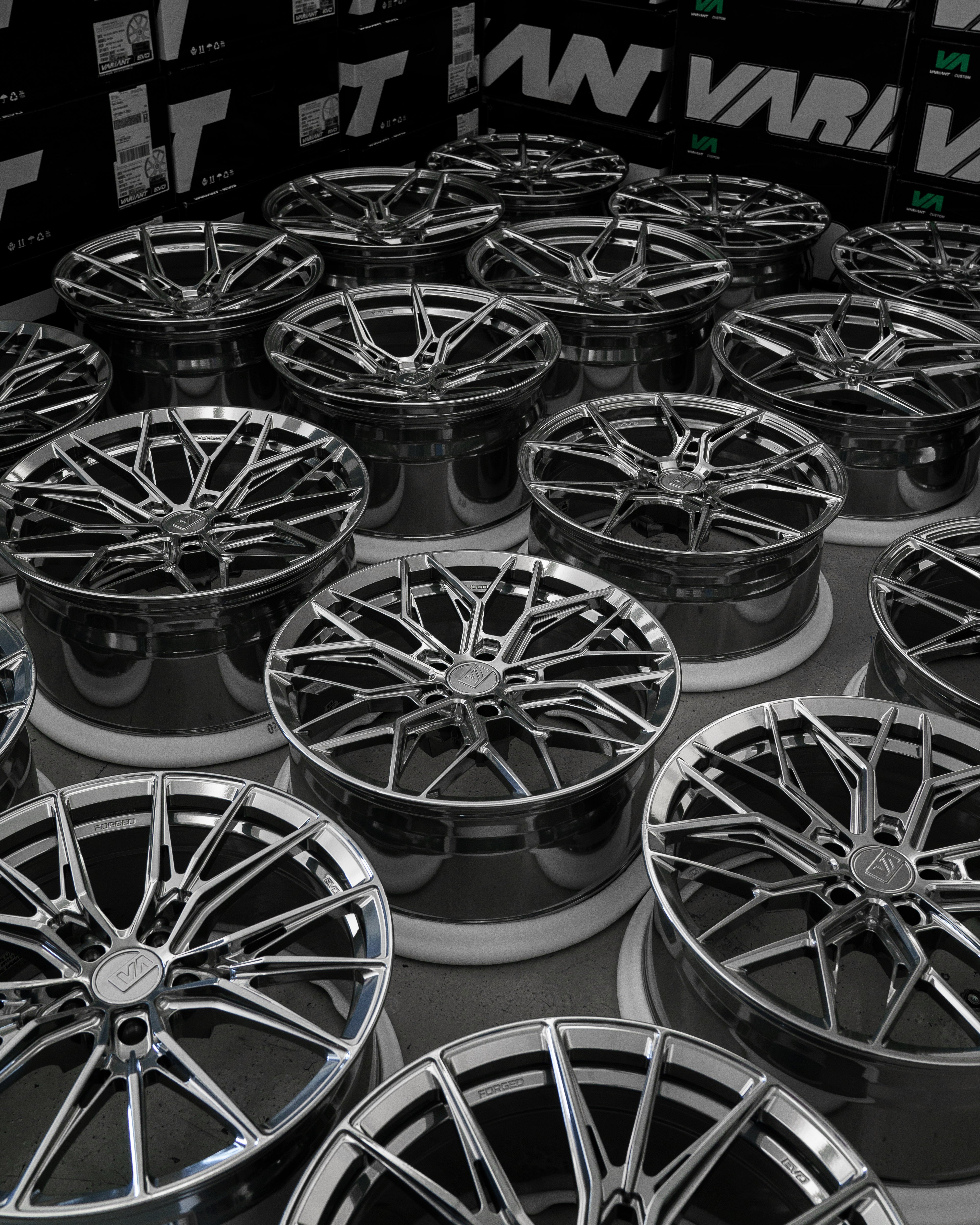
This is the main reason we build every wheel to the vehicle. Variant wheels are true forged monoblocks made from 6061-T6 aerospace aluminum, and the EVO Collection and two-piece EX2 Collection are both semi-custom: you specify diameter, width, and offset for your car rather than picking the closest thing off a shelf. Browse vehicle-specific fitments or the full forged wheel catalog to see what that looks like for your chassis.
Spacers still have legitimate uses: keeping a set of wheels you already own, clearing a big brake kit you added later, or fine-tuning a track alignment. They just should not be your first move when the correct offset is available.
How do you install wheel spacers correctly?
- Confirm the spacer's hub bore matches your hub diameter and its centering lip matches your wheel's center bore.
- Clean both mating faces. Rust, paint flakes, or old anti-seize on the hub face will cause runout and let the joint loosen.
- Verify fastener length. Thread a bolt in by hand and count turns; you want at least one bolt diameter of engagement.
- Torque the spacer's own hardware first if it is a bolt-on type, in a star pattern.
- Mount the wheel and torque to the vehicle's factory specification in a star pattern. Our wheel torque guide lists typical values by fastener size.
- Re-torque after 50–100 miles, then again after the first heat cycle at the track. Tire Rack's installation guide walks through the same star-pattern procedure for any wheel package.
Frequently asked questions
Are wheel spacers safe on a daily driver?
Yes. A hub-centric spacer in the 5–20 mm range, installed with correct-length hardware and torqued properly, is safe for daily street use. Re-torque after the first 50–100 miles and check them whenever you rotate tires.
Do wheel spacers cause vibration?
A properly specified hub-centric spacer does not. Vibration after installing spacers almost always means the spacer is lug-centric, the hub or spacer face was not clean, or the fasteners were not torqued evenly in a star pattern.
Do wheel spacers damage wheel bearings?
Thin spacers have a negligible effect. Thick spacers move the tire's contact patch outboard, which increases the bending load on the bearing and can shorten its life over time. Under roughly 15 mm, most street cars see no measurable difference.
Do I need longer bolts or studs with wheel spacers?
On a bolt-type car, yes, for anything beyond about 3–5 mm; the bolt has to reach the same depth into the hub as it did before. On a stud-type car, thin slip-on spacers can often use the factory studs, but you must verify thread engagement rather than assume it.
Are spacers or a different offset better?
A different offset, if you are buying wheels anyway. It achieves the same stance with one fewer mechanical interface and no additional hardware to specify, inspect, or re-torque.
Written by Taylor Smith, co-founder of Variant Alloy Wheels, who has spent nearly two decades in the automotive aftermarket.
Share:
Why Do My New Wheels Vibrate at Highway Speed?
Why Do My New Wheels Vibrate at Highway Speed?