


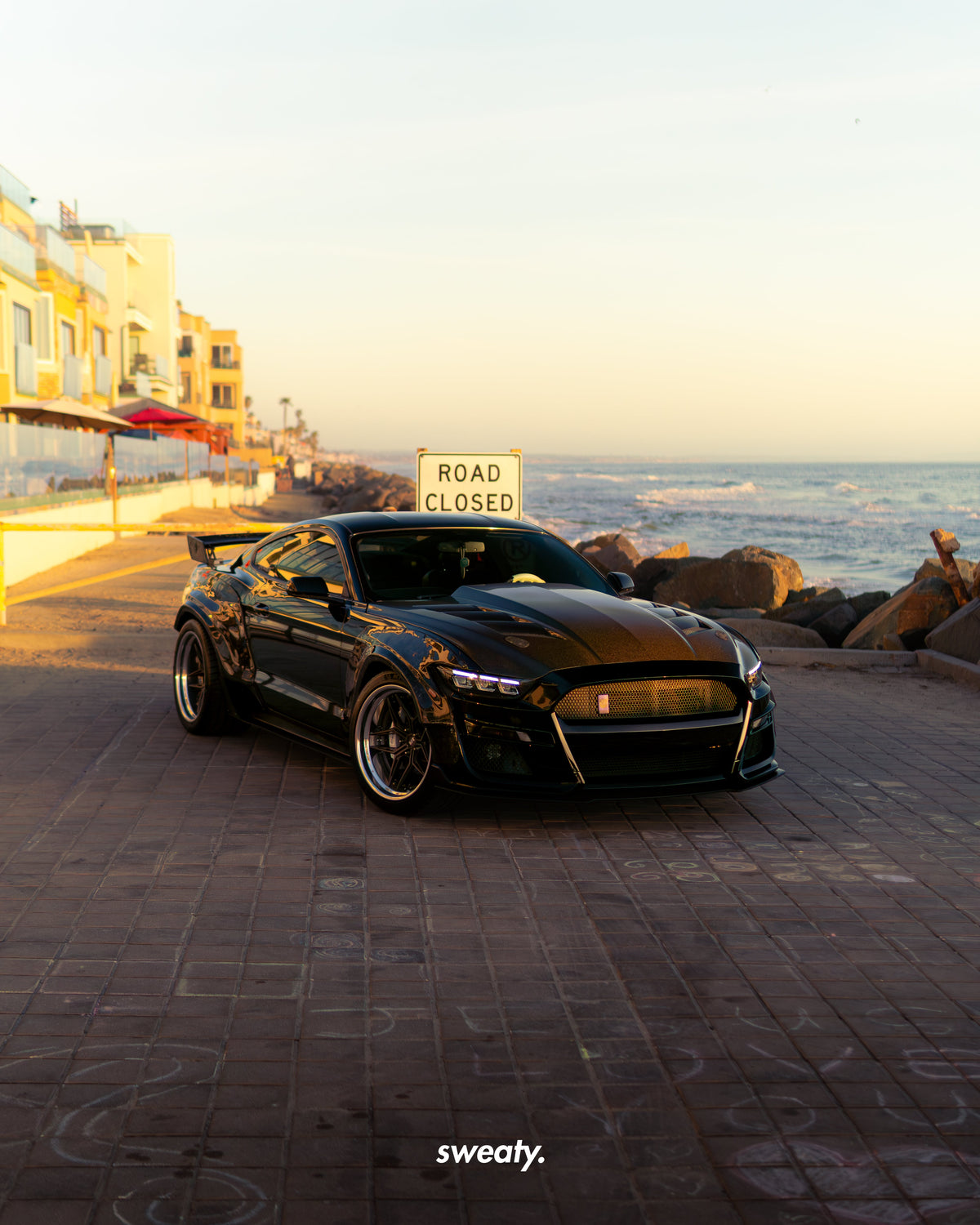
Key takeaways: The best wheels for the Ford Mustang are forged, staggered, and sized 19 or 20 inches, because that range clears the Brembo brakes on Performance Pack cars while keeping unsprung weight down. Every S550 (2015-2023) and S650 (2024+) Mustang uses a 5x114.3 bolt pattern with a 70.5mm center bore and M14x1.5 studs. Popular setups are 19x10 front with 19x11 rear for grip-focused builds, and 20x9 front with 20x10 or 20x11 rear for a longer-legged street look.
The Mustang is one of the easier cars to get wheels right on, and one of the easiest to get wrong. It's easy because the platform has been stable for a decade and the aftermarket is enormous. It's hard because Ford shipped so many brake and suspension combinations across trims that a size which fits a base EcoBoost perfectly will foul the caliper on a GT Performance Pack.
What bolt pattern and center bore does the Mustang use?
Both the S550 and S650 generations use:
- Bolt pattern: 5x114.3mm (also written 5x4.5")
- Center bore: 70.5mm
- Studs: M14x1.5, conical seat lug nuts
This is also the pattern used by the SN95 and New Edge cars from 1994 to 2004, which is why so much Mustang hardware carries across generations. The Fox Body is the exception, using a 4x10⁸ pattern. Because the Mustang is hub-centric at 70.5mm, wheels bored larger need hub-centric rings to carry the load on the hub rather than the studs. We explain why in our guide to center bore.
What size wheels come on the Mustang from the factory?
Factory sizing varies widely by trim, which is the single most important thing to understand before shopping:
| Trim | Typical factory size | Notes |
|---|---|---|
| S550 EcoBoost / base GT | 18x8 to 19x9 | Single-piston or smaller front brakes |
| S550 GT Performance Pack | 19x9 front, 19x9.5 rear | Six-piston front Brembo calipers |
| S550 GT Performance Pack 2 | 19x10.5 front, 19x11 rear | Squared-off aggressive fitment |
| Shelby GT350 | 19x10.5 front, 19x11 rear | Wide square-ish setup |
| S650 GT / Dark Horse | 19x9.5 to 19x10 front, wider rear | Brembo front on performance trims |
The takeaway: if your car has the six-piston front Brembo setup, many 18-inch wheels and some 19-inch spoke designs will not clear the caliper. Nineteen inches is the practical minimum on those cars, and clearance still depends on the specific spoke geometry rather than diameter alone.
Should you run 19-inch or 20-inch wheels on a Mustang?
Both work. The choice is about priorities, not correctness.
Choose 19-inch if you drive the car hard, autocross, or visit a track. A 19-inch wheel lets you run a taller tire sidewall, which gives you more compliance over broken pavement and a wider selection of serious performance tires. It's also the lighter option at a given width, and wheel mass is unsprung weight, so it affects how quickly the suspension can react.
Choose 20-inch if the car is primarily a street build and you want the wheel to fill the arch with a shorter sidewall. The Mustang's body lines carry a 20 well, particularly on the S650. The trade-off is a firmer ride and more exposure to pothole damage, which we covered in do bigger wheels affect ride quality.
What are the best wheel and tire sizes for a Mustang?
These are the setups that come up most often, and the tire sizes that pair sensibly with them:
| Setup | Front | Rear | Best for |
|---|---|---|---|
| Grip-focused 19 | 19x10, 275/35 or 285/35 | 19x11, 305/30 or 315/30 | Track days, maximum mechanical grip |
| Street 20 staggered | 20x9, 255/35 or 265/35 | 20x10 or 20x11, 285/30 to 305/30 | Daily driving with a wide rear stance |
| Square 20 | 20x10, 275/30 | 20x10, 275/30 | Rotatable tires, balanced handling |
A square setup is worth considering on a Mustang if you plan to track it, because you can rotate tires and the balance is more neutral. A staggered setup puts more rubber where a rear-drive car needs it for traction. There's no universal winner, and we break down the reasoning in staggered vs. square wheel setup.
What offset should you run on a Mustang?
Offset is what determines whether a given width actually fits. Higher positive offset pulls the wheel inboard toward the suspension; lower offset pushes it outward toward the fender. On a wide rear wheel, too much positive offset puts the inner barrel into the shock or the inner fender liner, while too little sends the lip past the fender.
Rather than chase a single number, work from a known-good combination for your trim and ride height. Lowered cars need different offsets than stock-height cars because the tire moves through the arch on a different arc. Our offset guide covers the math, and why wheels rub covers what to do if you've already got contact.
Why forged wheels on a Mustang?
A GT weighs comfortably north of 3,700 pounds and makes serious torque, and the S650 Dark Horse pushes that further. That combination is hard on wheels. Forging compresses the aluminum billet so its grain structure follows the shape of the wheel, which produces a denser, stronger part than casting. In practice that means a forged wheel can hit a target strength at lower weight, or hit a target weight at higher strength.
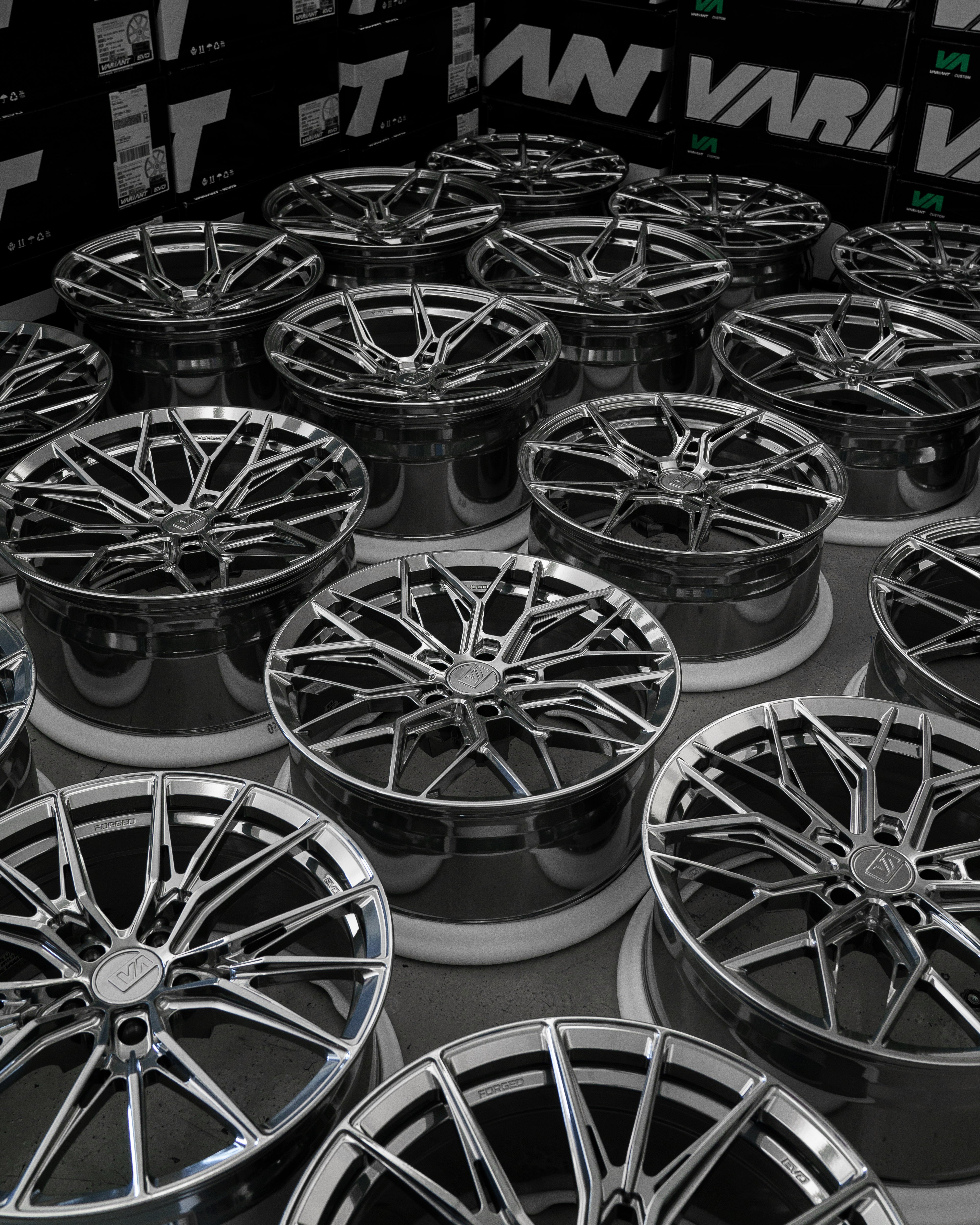
For a car that will see repeated hard launches and heat cycles, that matters more than it does on a lighter car. If you want the background, see forged vs. flow-formed vs. cast and an honest breakdown of whether forged wheels are worth it. Everything Variant builds is true forged, with no cast or flow-formed products in the lineup.
Which Variant wheels fit the Mustang?
Variant lists direct fitments across all three modern generations in the Ford Mustang collection:
- S650 (2024-2025): Maxim in 19x10 / 19x11, Nysa in 20x9 / 20x10
- S550 (2015-2023): Maxim and Aure in 19x10 / 19x11, Aure in 20x9 / 20x11, Zeno in a square 20x10 / 20x10
- SN95 and New Edge (1994-2004): Sena, Zeno, and Rian in 20x9 / 20x10
Finishes run from gloss and satin black through gunmetal, bronze, raw milled, and chrome powder. If you'd rather browse by design, start with the Designer collection or the Corsa collection, then confirm fitment through vehicle-specific fitments. For general Mustang specifications and trim history, Ford's coverage at Car and Driver and the S550 generation overview are useful references.
Frequently asked questions
What is the bolt pattern on a 2015-2025 Ford Mustang?
All S550 (2015-2023) and S650 (2024+) Mustangs use a 5x114.3mm bolt pattern with a 70.5mm center bore and M14x1.5 wheel studs. The same pattern was used on the 1994-2004 SN95 and New Edge cars.
Will 18-inch wheels fit a Mustang GT Performance Pack?
Usually not. Performance Pack cars carry six-piston front Brembo calipers that most 18-inch wheels cannot clear. Nineteen inches is the practical minimum, and even then clearance depends on the specific spoke design rather than diameter alone.
Should I run a staggered or square setup on my Mustang?
Staggered gives the rear-drive Mustang more rear traction and a wider stance. Square lets you rotate tires and produces more neutral balance, which many track drivers prefer. Both are valid; pick based on how you actually use the car.
What is the widest wheel that fits a Mustang without modification?
Many S550 and S650 owners run an 11-inch-wide rear wheel at stock ride height with the right offset and a 305 or 315 series tire. Going wider, or running a lowered car, typically requires attention to fender clearance and inner suspension clearance.
Do I need new lug nuts for aftermarket Mustang wheels?
The Mustang uses M14x1.5 studs with conical seat nuts, which matches most aftermarket wheels. Confirm the seat type on your wheel's spec sheet, and check that the lug pocket accepts your existing nut diameter and height.
Written by Taylor Smith, co-founder of Variant Alloy Wheels, who has spent nearly two decades in the automotive aftermarket.
Share:
What Are the Best Wheels for the BMW M3 (G80)?
Do You Need Special Lug Nuts for Aftermarket Wheels?