


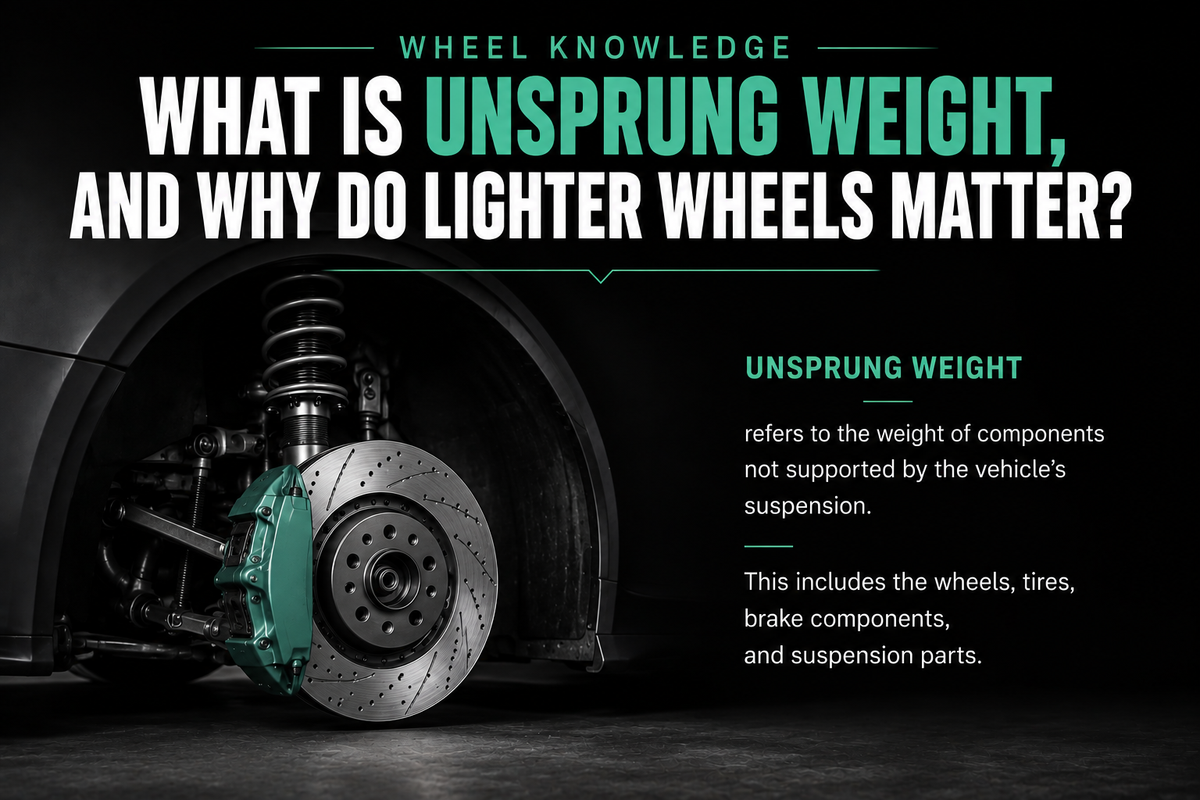
Key takeaways: Unsprung weight is the mass of everything your suspension springs have to control but don't "carry" on top of them—wheels, tires, brakes, hubs, and roughly half of each suspension link. Reducing it lets the suspension keep your tires planted on bumpy roads, which sharpens steering, shortens braking, and can smooth the ride. Because wheels are rotating, unsprung mass, swapping heavy cast wheels for lighter forged ones is the single most effective way to cut it—a rule of thumb suggests one pound off a wheel feels like removing several pounds from the body.
What is unsprung weight?
Unsprung weight is the total mass of the components that are not supported by your vehicle's springs and instead move up and down with the road. On most cars that means the wheels, tires, brake rotors and calipers, wheel hubs and bearings, and a portion (about half) of the control arms, axles, and the springs and dampers themselves. Everything resting on top of the springs—the body, engine, passengers, and cargo—is the sprung weight.
The distinction matters because the spring and damper at each corner have one job: to keep the tire pressed against the pavement while isolating the cabin from bumps. The less mass the suspension has to fling up and down to do that, the better it can do it. For a deeper definition and the engineering behind it, the Wikipedia entry on unsprung mass is a solid primer.
Why does unsprung weight matter for handling and ride?
Lower unsprung weight directly improves how quickly your suspension can react to the road. When a tire hits a bump, a lighter wheel-and-tire package accelerates upward and settles back down faster, so the contact patch spends more time on the ground. More time on the ground means more grip, more predictable steering, and shorter braking distances.
Heavy wheels do the opposite. They carry more momentum, so over a series of bumps or mid-corner ripples the tire can "skip" and lose contact—an effect enthusiasts call wheel hop. That costs grip exactly when you need it most. As Car and Driver has documented in instrumented testing, wheel and tire mass measurably affects acceleration, braking, and ride quality.
It also affects ride comfort, which surprises people. A lighter wheel lets the damper control motion with less effort, so sharp impacts are absorbed rather than transmitted into the chassis.
Why do lighter wheels matter more than other weight savings?
Wheels deliver a double benefit, which is why they're the highest-leverage place to remove weight.
- It's unsprung. A pound removed from the wheel helps the suspension far more than a pound removed from the trunk. A widely cited rule of thumb in the industry holds that one pound of unsprung weight is worth several pounds of sprung weight in handling terms.
- It's rotating. A wheel doesn't just move up and down—it spins. Spinning mass resists both acceleration and braking (rotational inertia), so a lighter wheel frees up effort the engine and brakes would otherwise spend just turning the wheel.
That's why most drivers begin to feel a difference once they shed roughly 5 pounds or more per corner, and why a meaningful drop—say 15–20 pounds across a set—can transform how a car turns in and rides.
How do you actually reduce unsprung weight?
The most practical levers, in order of bang-for-buck:
- Lighter wheels. The easiest and most cost-effective change. A forged wheel can weigh several pounds less than the cast or flow-formed wheel it replaces at the same size and strength.
- Lighter tires. Tire construction and size affect rotating mass too; a lighter tire compounds the benefit of a lighter wheel.
- Lighter brakes. Two-piece or aluminum-hat rotors trim mass, though at higher cost.
How does wheel construction change the weight?
Not all wheels of the same size weigh the same, because how they're made determines how much aluminum is needed for a given strength.
| Construction | How it's made | Relative weight at equal strength |
|---|---|---|
| Cast | Molten aluminum poured into a mold | Heaviest; porous grain needs more material |
| Flow-formed | Cast center with a spun, stretched barrel | Lighter than cast, heavier than forged |
| Forged | A solid billet of aluminum pressed under enormous pressure | Lightest; dense grain allows thinner, stronger sections |
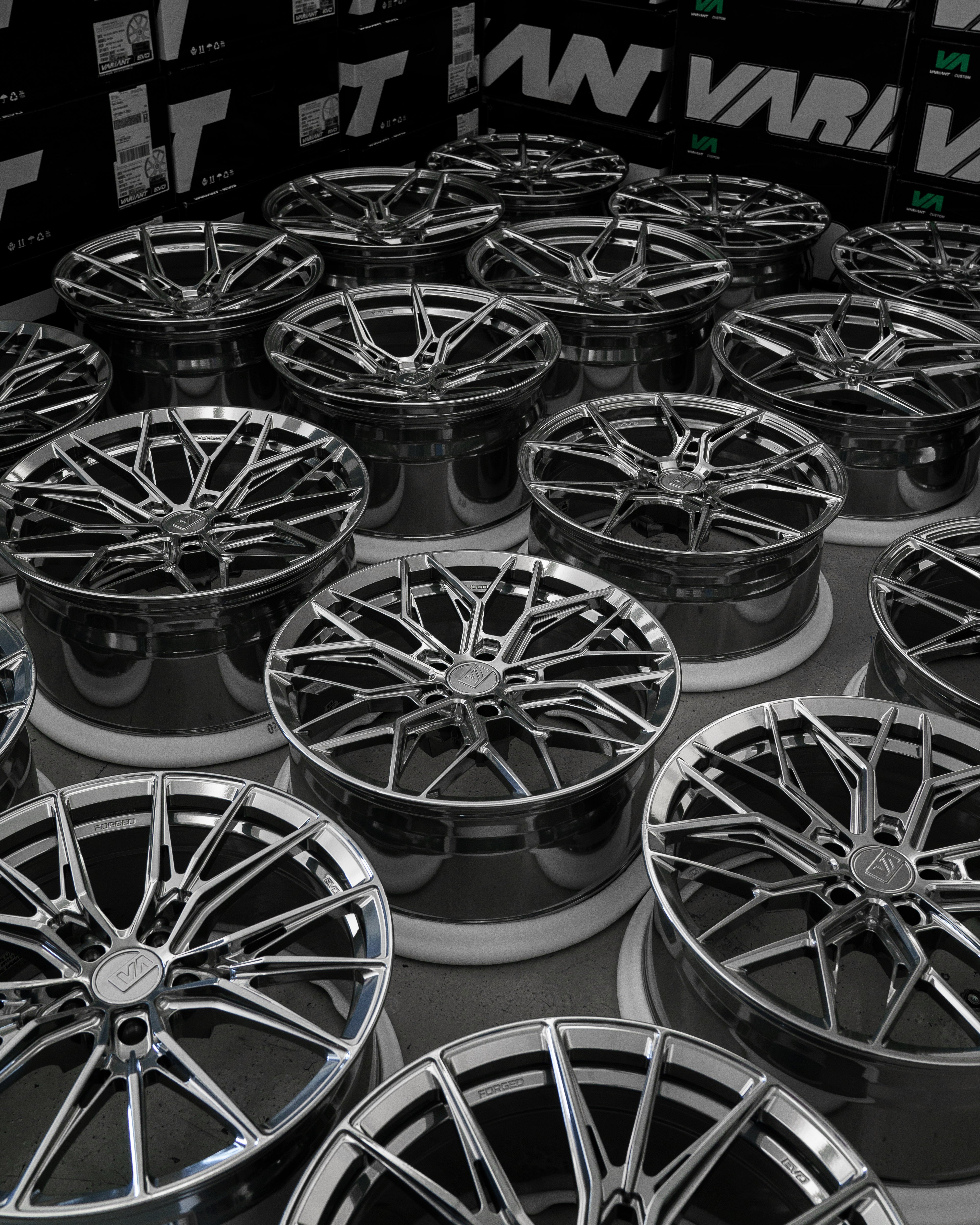
Forging compresses the aluminum's grain structure, which makes the metal stronger by volume. That lets engineers remove material—thinner spokes, slimmer barrels—without sacrificing strength, producing a wheel that is both lighter and tougher. Variant builds exclusively true forged wheels from aerospace-grade 6061-T6 aluminum for exactly this reason. If you want the full breakdown, see our guide to forged vs. flow-formed vs. cast wheels.
You can explore lightweight forged options across our monoblock EVO and Strada collections, the multi-piece Corsa lineup, or browse the full forged wheel catalog. Getting the size and offset right is just as important as weight—our wheel offset guide covers that.
Frequently asked questions
Is unsprung weight really noticeable on the street?
Yes, within reason. Most drivers feel a clear difference once they remove about 5 or more pounds per corner. Smaller reductions matter more on rough roads and during hard cornering or braking than on smooth highway cruising.
How much lighter is a forged wheel than a cast wheel?
It depends on size and design, but a forged wheel is commonly several pounds lighter than a comparable cast wheel of the same diameter and load rating, because forged aluminum is stronger by volume and needs less material.
Does a bigger wheel always increase unsprung weight?
Larger diameters generally add mass, but construction matters more than size alone. A well-engineered 20-inch forged wheel can weigh less than a heavy 19-inch cast wheel. Pairing a larger forged wheel with a lighter, lower-profile tire can keep total rotating mass in check.
Is unsprung weight or rotating weight more important?
Wheels are both, which is why they're the best place to save weight. The unsprung benefit helps grip and ride; the rotational benefit helps acceleration and braking. You get both improvements from one upgrade.
Written by Taylor Smith, co-founder of Variant Alloy Wheels, who has spent nearly two decades in the automotive aftermarket.
Share:
What Are the Best Wheels for the BMW M3 and M4?
Best Wheels for the Tesla Model S Plaid: A Forged Buyer's Guide