


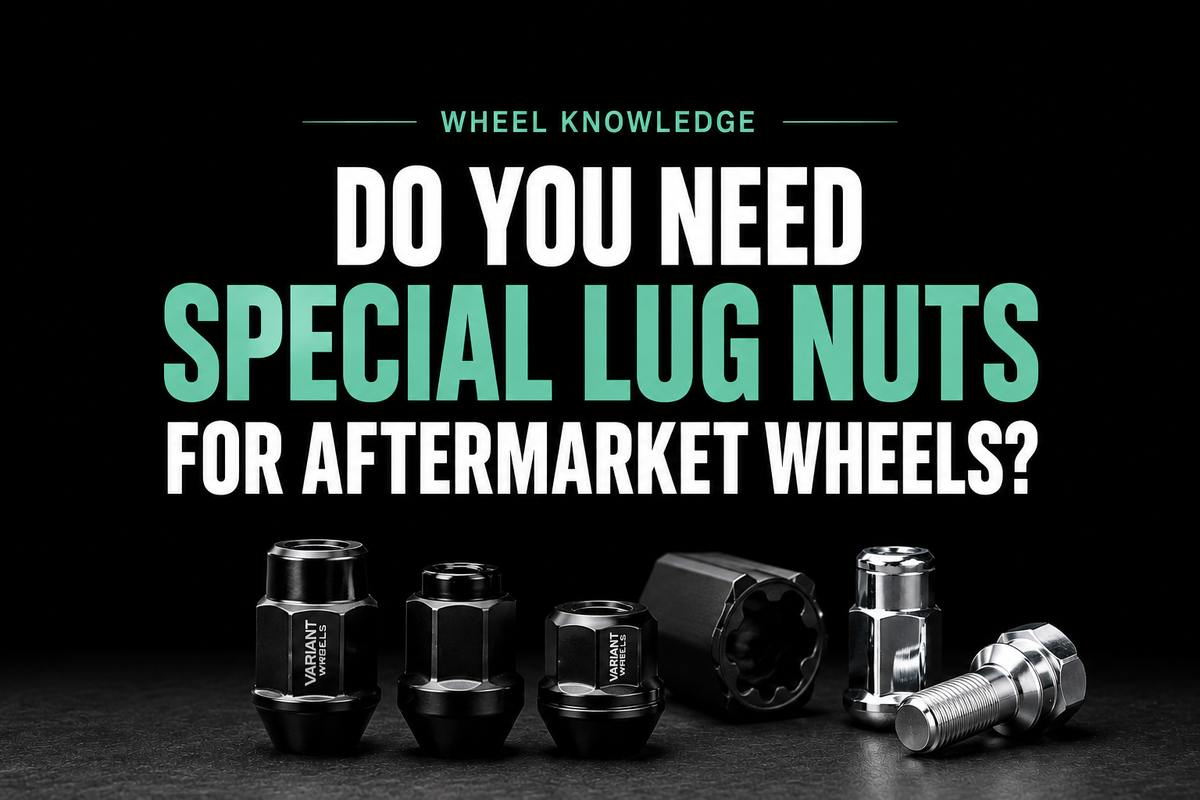
Key takeaways: Often, yes. You need special lug nuts for aftermarket wheels whenever the wheel's lug seat shape differs from your factory hardware, or when a thicker wheel face leaves too little thread engagement for your original lug bolts. The three seat types (conical, ball, and mag) are not interchangeable, and using the wrong one contacts on an edge instead of a surface, loses clamp load, and eventually wallows out the lug holes. Match the seat type, the thread pitch, and the length, and re-torque after 50 to 100 miles.
Choosing lug nuts for aftermarket wheels is the step most people skip. You spend weeks picking a design and a finish, then reuse whatever hardware came off the car. Sometimes that's fine. Sometimes it quietly destroys a set of wheels. The difference comes down to three measurements, and none of them are hard to check.
What does a lug nut actually do?
A lug nut does not hold the wheel on by acting as a peg. It stretches the stud slightly and creates clamping force, which presses the back of the wheel flat against the hub face. Friction between those two surfaces is what carries the load. The nut's job is to generate and hold that clamp.
That matters because everything that goes wrong with mismatched hardware traces back to the same root cause: the nut can't generate proper clamp load. The wheel then moves microscopically against the hub, the movement works the hardware loose, and it accelerates from there.
What are the three lug nut seat types?
The "seat" is the shaped surface where the nut meets the wheel. There are three, and they are not cross-compatible.
| Seat type | Shape | Typically found on |
|---|---|---|
| Conical (tapered, acorn) | 60-degree cone | Most aftermarket wheels; many domestic and Asian OEM wheels |
| Ball (radius) | Rounded curve, commonly R12, R13, or R14 | European OEM wheels: Volkswagen, Audi, some BMW and Mercedes |
| Mag (flat, shank) | Flat washer on a straight extended shank | Older Toyota, Honda, and Lexus OEM wheels |
A conical nut dropped into a ball seat touches only at a thin ring. A ball nut in a conical seat does the same in reverse. In both cases the contact patch is a line rather than a cone, so the load concentrates, the aluminum deforms, and the nut sinks deeper into the wheel every heat cycle. Tire Rack's explanation of proper lug nuts and lug bolts covers the same ground from the installer's side.
The conical seat has one useful property beyond clamping: it self-centers. As the taper pulls in, it nudges the wheel into concentric alignment with the stud pattern. That is helpful, but it is not a substitute for hub-centric mounting, which we covered in our guide to center bore and hub-centric rings.
How do you know if you need new lug nuts?
Run through these four checks before your wheels arrive:
- Seat type. Compare the shape machined into the new wheel's lug holes against your existing hardware. If your car came with ball-seat or mag-seat hardware and the new wheels are conical, you need new nuts. This is the most common mismatch on European cars.
- Thread pitch and diameter. This is dictated by your car, not the wheel. Ford Mustangs use M14x1.5. Many Toyota and Honda models use M12x1.5. Nissan and Subaru commonly use M12x1.25. Newer BMWs use M14x1.25. Get this wrong and the nut will either not thread or will cross-thread and ruin the stud.
- Length and thread engagement. Aftermarket wheels are often thicker at the mounting face than the OEM wheel. On stud-and-nut cars this is rarely a problem. On bolt cars (BMW, Audi, Volkswagen, Porsche, Mercedes) the bolt threads directly into the hub, so a thicker wheel means the bolt reaches less far in. A common rule of thumb is to keep at least as much thread engagement as the bolt's diameter, so roughly 14mm of engagement on a 14mm bolt. If you're short, you need longer bolts.
- Lug hole diameter and cap clearance. Some wheels use narrow lug pockets that only accept small-diameter tuner or spline-drive nuts. Others have shallow pockets where a tall closed-end nut will interfere with the center cap.
Can you reuse your factory lug nuts on aftermarket wheels?
Yes, if all four checks above pass. Plenty of cars with conical-seat factory hardware bolt straight onto conical-seat aftermarket wheels with no changes. There is nothing inherently better about buying new hardware.
What you should not do is assume. Two-piece factory nuts with a captured washer are especially worth inspecting, because the washer can spin freely and mask the fact that the underlying seat geometry is flat rather than tapered.
What happens if you use the wrong lug nuts?
The failure is gradual, which is exactly what makes it dangerous. It usually goes in this order:
- Clamp load comes up short even at correct torque, because the contact area is too small.
- The wheel shifts slightly under cornering and braking loads.
- You feel a vibration or a shimmy that shows up under braking and gets blamed on warped rotors.
- The nuts loosen. Torque checks come back low repeatedly.
- The lug seats deform, the holes elongate, and the wheel is no longer safely usable.
By the time there's a visible problem, the wheel is usually finished. This is a structural component carrying the entire vehicle, so it's worth ten minutes of verification.
How should you install and torque them?
Install on clean, dry threads. Do not use anti-seize, oil, or thread locker on lug hardware unless your manufacturer specifically calls for it. A lubricated thread reaches a given torque reading with far more actual clamp load than a dry one, which means a normal torque wrench setting can overstretch or snap the stud.
Snug the hardware by hand in a star pattern, lower the car so the wheel is loaded, then torque to your vehicle's specification with a proper torque wrench rather than an impact gun. Re-torque after 50 to 100 miles, since clamp loads shift as the assembly settles and heat-cycles. We go deeper on this in how much you should torque aftermarket wheels. If you're still working out fitment basics, start with bolt patterns and how to measure them, and the general background on lug nut design is worth a skim.
When you order a set from our vehicle-specific fitments, the spec sheet lists the seat type for that wheel. If anything is ambiguous, ask before you install. You can browse the full forged range in the wheel catalog or start with the Corsa collection.
Frequently asked questions
Are all aftermarket wheels conical seat?
Most are, but not all. The 60-degree conical seat is the aftermarket standard because it self-centers and suits a wide range of vehicles. Always confirm the seat type on the specific wheel's spec sheet rather than assuming.
Do I need longer lug bolts for aftermarket wheels?
Often yes, on cars that use bolts instead of studs. If the aftermarket wheel is thicker at the mounting face than your OEM wheel, the bolt threads less far into the hub. Aim to keep thread engagement at least equal to the bolt diameter.
Can I mix ball seat and conical seat lug nuts?
No. The seat shapes do not mate, so contact happens on an edge instead of across a surface. The result is reduced clamping force, loosening hardware, and permanent damage to the wheel's lug holes.
Should I put anti-seize on my lug nuts?
Generally no. Lubricating the threads means a given torque wrench reading produces significantly more clamp load than intended, which can overstretch or break the stud. Install on clean, dry threads unless your vehicle manufacturer states otherwise.
How often should I re-torque after installing new wheels?
Re-torque after the first 50 to 100 miles of driving. Clamp loads change as the wheel seats against the hub and the assembly goes through heat cycles. After that, checking periodically, such as at each tire rotation, is good practice.
Written by Taylor Smith, co-founder of Variant Alloy Wheels, who has spent nearly two decades in the automotive aftermarket.
Share:
What Are the Best Wheels for the BMW M3 (G80)?
What Are the Best Wheels for the Ford Mustang?