


If you've spent any time researching new wheels, you've run into the same three words over and over: cast, flow-formed, and forged. They get tossed around like price tiers—cheap, mid, and expensive—but that framing misses the point. These wheels are made in fundamentally different ways, and more importantly, they fail in fundamentally different ways. If you care about how your car handles and how it behaves when you hit a pothole at speed, the construction method matters more than almost any other spec on the page.
Here's a plain-English breakdown of how each type is made, what that means for strength and weight, and how to figure out which one actually belongs on your car.
How each wheel is made
Cast wheels
Casting is the oldest and cheapest method. Molten aluminum is poured into a mold, left to cool, and machined into a finished wheel. It's inexpensive and flexible for complex designs, which is why most factory wheels are cast. The downside is that pouring liquid metal leaves the grain structure relatively loose and porous, with tiny air pockets that become weak points under stress.
Flow-formed wheels
Flow forming (also called rotary forging or "flow-forged") starts with a cast center, then spins the barrel at high heat while rollers stretch and compress it into shape. That spinning step compacts the grain in the barrel, making it stronger and lighter than a plain cast wheel. It's a genuine improvement—but only the barrel is worked. The center is still cast.
Forged wheels
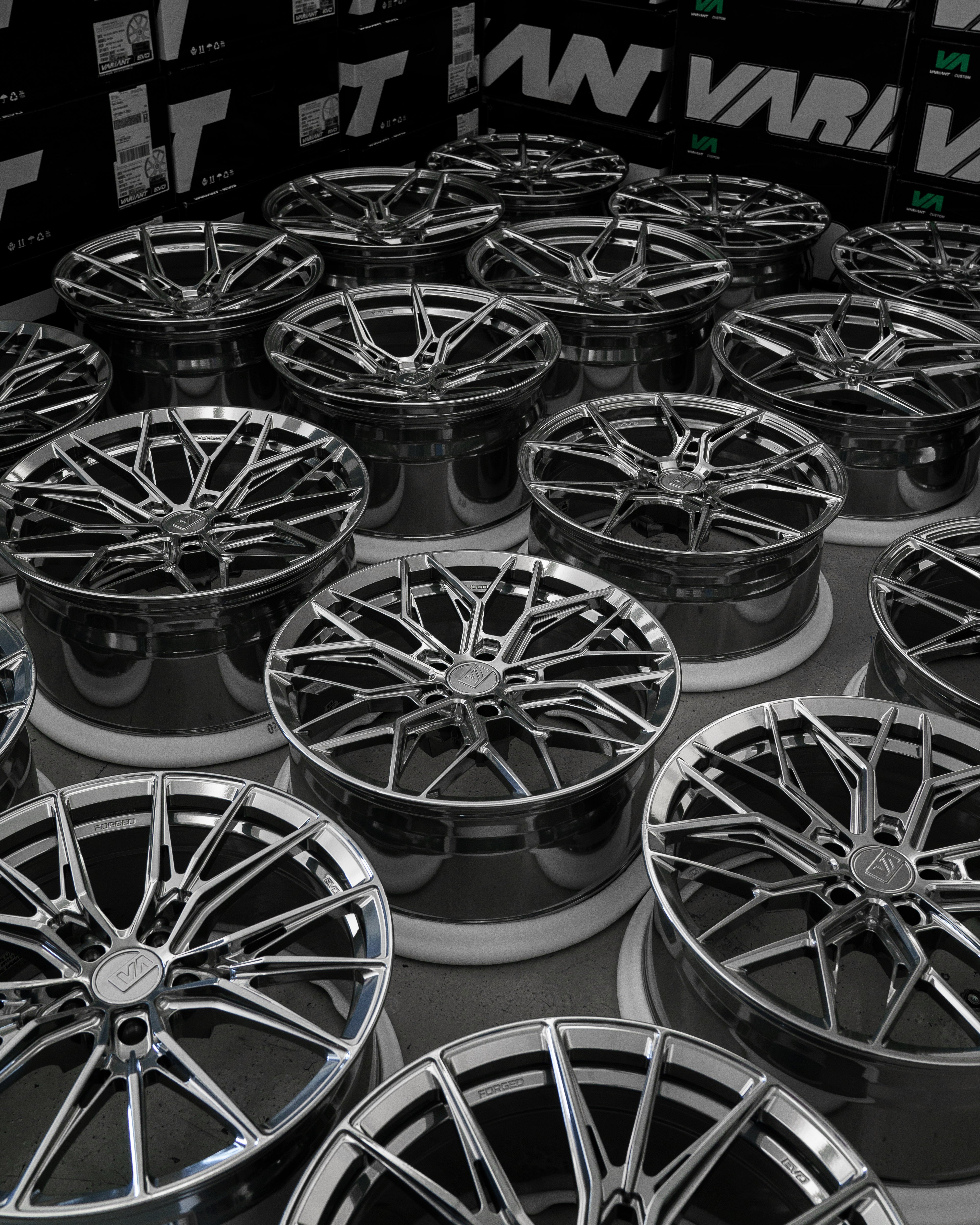
Forging skips molten metal entirely. A solid billet of aircraft-grade aluminum—typically 6061-T6—is squeezed into shape under thousands of pounds of pressure. That pressure aligns the metal's grain into a tight, continuous structure with no porosity. The result is the strongest wheel you can buy at the lightest possible weight. Every wheel Variant builds, from our multi-piece Corsa wheels to our EVO forged monoblocks, is fully forged—we don't sell cast or flow-formed product.
Strength: how they break tells the real story
This is the part most buying guides skip. When a cast or flow-formed wheel takes a hard enough hit, the granular aluminum tends to crack or shatter—a sudden, catastrophic failure that can let the tire go down instantly. A forged wheel behaves differently: because the grain is continuous, it tends to bend rather than break. Your tire stays seated and you limp to a shop instead of losing air—and possibly control—on the spot. For a part that's the only thing connecting your car to the road, that difference is worth understanding. For an independent primer on wheel construction, see the engineering overview of alloy wheels.
Weight: the number you actually feel
Wheels are unsprung weight—mass the suspension has to control that isn't supported by the springs. Shaving weight here improves ride quality, steering response, braking, and acceleration far more than removing the same weight from the body of the car. Cast wheels are heaviest, flow-formed sit in the middle, and forged are the lightest. On a typical setup, going forged can pull several pounds off each corner, and you feel it the first time you turn the wheel.
So which should you buy?
- Cast makes sense if you want the lowest price, drive gently, and don't care about performance. It's fine for a commuter that never sees a track or an aggressive backroad.
- Flow-formed is the value sweet spot for many enthusiasts—lighter and stronger than cast without full-forged pricing. A reasonable choice for spirited street driving on a budget.
- Forged is the answer when you want the strongest, lightest wheel and you're not willing to compromise on how the car drives or how the wheel behaves in a worst-case impact. It's also the only category that supports true custom sizing, finishes, and fitments built for your exact car.
If you've decided forged is right for you, the next step is fitment—getting the diameter, width, and offset dialed in for your specific vehicle. Learn the basics in our guide to wheel offset, browse options built for your car in our vehicle-specific fitments, or explore the full forged wheel lineup to see what's possible.
Frequently asked questions
Are forged wheels worth the extra money?
If performance, weight, and impact safety matter to you, yes. You're paying for a stronger, lighter wheel that bends instead of shattering and that can be built to your exact specs. For a car that never gets driven hard, a quality flow-formed wheel may be enough.
Is "flow-forged" the same as forged?
No. Flow forming works the barrel of an otherwise cast wheel. True forging presses a solid billet into shape, aligning the grain throughout the entire wheel. The names sound similar, but the construction—and the strength—are not the same.
Why are forged wheels lighter?
Because the forging process produces a denser, stronger grain structure, less material is needed to hit the same strength target. Less material means less weight, especially the unsprung and rotational weight that most affects how your car drives.
Can I get forged wheels in a custom size or finish?
Yes—custom sizing and finishes are one of the biggest advantages of forged construction. Because each wheel is made from a billet, width, offset, concavity, and finish can be tailored to your car rather than pulled from a fixed catalog of molds.
Written by Taylor Smith, co-founder of Variant Alloy Wheels, who has spent nearly two decades in the automotive aftermarket.
Share:
The 2 piece EVOlution: Introducing the EX2 Collection
Best Wheels for the Chevrolet Corvette C8: A Buyer's Guide