


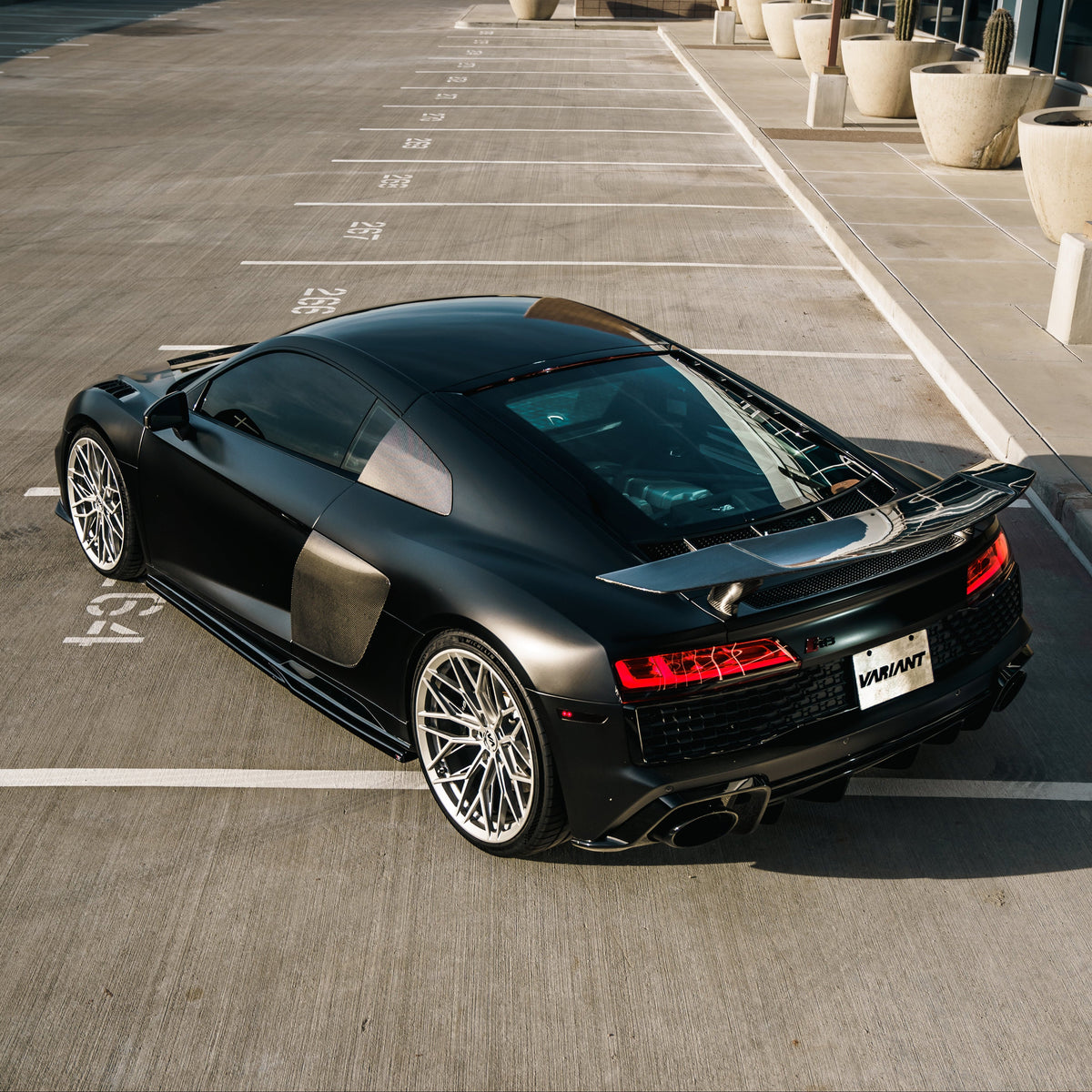
Key takeaways: The best wheels for the Audi R8 are lightweight true forged wheels in a staggered fitment, because the car is mid-engined, rear-biased, and carries a much wider rear tire than front. Both generations use a 5x112 bolt pattern with a 57.1 mm center bore, and factory setups run roughly 8.5 inches wide up front and 11 inches at the rear in 19 or 20 inch diameters. Brake clearance and load rating matter more here than on most cars, so verify both before you order.
Shopping for wheels for the Audi R8 is a narrower exercise than it looks. The car has an unusual footprint, a specific bolt pattern, and, on many examples, carbon-ceramic brakes that eat spoke clearance. Getting it right is mostly about respecting the geometry Audi already established and then improving on the weight.
What size wheels does the Audi R8 use from the factory?
Both the first-generation Type 42 (2007-2015) and the second-generation Type 4S (2016-2024) run a heavily staggered setup. Typical V10 factory specifications look like this:
| Position | 19-inch setup | 20-inch setup |
|---|---|---|
| Front width | 8.5J | 8.5J |
| Front tire | 245/35R19 | 245/30R20 |
| Rear width | 11J | 11J |
| Rear tire | 295/35R19 or 305/30R19 | 305/30R20 |
| Bolt pattern | 5x112 | 5x112 |
| Center bore | 57.1 mm | 57.1 mm |
Front offsets generally land in the ET40s and rears in the ET50s, but exact numbers vary by year, trim, and whether the car is a V8, V10, V10 Plus, or Performance model. Treat the table as the shape of the fitment, not gospel for your VIN. Check the sticker in the door jamb and measure before you commit. If offset numbers are unfamiliar territory, start with our guide to what wheel offset means.
Should you run a staggered or square setup on an R8?
Staggered, in almost every case. The R8 places its V8 or V10 behind the cabin, which puts roughly 60 percent of the car's mass over the rear axle. The wide rear tire is there to put that weight and the engine's torque to the ground. Narrowing it to match the front trades away traction and changes the handling balance toward oversteer in a way most owners will not enjoy.
The exception is dedicated track use with a spare set on a car where a driver wants rotatable tires and is prepared to re-learn the balance. Even then it is a deliberate compromise, not an upgrade. We laid out the full trade-off in staggered vs. square wheel setups.
Why does weight matter so much on this car?
An R8 V10 weighs somewhere around 3,600 pounds, which is not light for a mid-engined supercar, and a large share of the factory wheel and tire package sits at the corners as unsprung mass. Every pound removed from a wheel is a pound the suspension no longer has to control over a bump, and it is rotating mass the engine no longer has to accelerate.
An 11-inch-wide rear wheel is a large object. The difference between a heavy cast 20-inch rear and a well-designed forged one can be several pounds per corner, and on the rear axle it shows up in throttle response and in how settled the car feels over broken pavement. The mechanism is explained in our piece on unsprung weight.
This is the core argument for forged construction on a car like this. True forging produces a fully dense part with aligned grain flow, which lets an engineer thin sections down while keeping the load rating a 3,600-pound car with 600-plus horsepower actually needs. Cast and flow-formed wheels do not offer the same strength-to-weight headroom. The comparison is in forged vs. flow-formed wheels.
What should you check before buying R8 wheels?
- Brake clearance. R8s equipped with carbon-ceramic brakes use very large rotors and wide calipers. Spoke shape at the inner barrel is the limiting factor, not just diameter. Any wheel you consider should be confirmed against your specific brake package.
- Load rating. Do not buy a wheel rated below the axle load your car actually imposes. Load rating is a safety spec, not a marketing number. See how wheel load ratings work.
- Center bore. The R8 uses a 57.1 mm hub. A wheel bored larger needs hub-centric rings to carry the load on the hub rather than the studs. Details in our center bore guide.
- Tire availability. 305/30R20 and 245/30R20 are not sizes every manufacturer stocks in every compound. Confirm your preferred tire exists in the size before you order wheels around it.
- Ride height and camber. Lowered R8s change effective clearance at the fender and inner arch. If the car is on coilovers or an aftermarket setup, factor that in.
Which Variant wheels suit the Audi R8?
Variant builds true forged wheels only, in 6061-T6 aluminum, and the R8's staggered widths are exactly the kind of application that benefits. Our Audi R8 collection lists the fitments we support for the platform, and the Corsa and Evo lines are the usual starting points for a car that is expected to see spirited road use and occasional track days. If you want to see the broader platform coverage first, our vehicle-specific fitments index is the fastest route.
One honest caveat: the R8 is now out of production, which means aftermarket support is stable rather than growing. Buying a wheel from a manufacturer that keeps the fitment in the catalog matters if you ever need to replace a single corner.
For background on the two generations and their mechanical differences, Wikipedia's entries on the Audi R8 (Type 4S) and the earlier Audi R8 (Type 42) are well-sourced references.
Frequently asked questions
What is the Audi R8 bolt pattern?
The Audi R8 uses a 5x112 bolt pattern, meaning five lugs on a 112 mm circle, with a 57.1 mm center bore. This applies to both the Type 42 and Type 4S generations. Always confirm against your own car before ordering.
What size wheels come on an Audi R8?
Factory setups are staggered: roughly 8.5 inches wide at the front and 11 inches at the rear, in 19 or 20 inch diameters. Common tire sizes are 245/35R19 or 245/30R20 front and 295/35R19, 305/30R19, or 305/30R20 rear, depending on year and trim.
Can you run a square wheel setup on an Audi R8?
Physically it can be done, but it is not recommended for street use. The R8 is mid-engined with roughly 60 percent rear weight bias, and the wide rear tire exists to handle that. Going square costs rear traction and pushes the handling balance toward oversteer.
Do Audi R8 aftermarket wheels need hub-centric rings?
Only if the wheel's center bore is larger than the R8's 57.1 mm hub. Wheels bored to fit the hub exactly do not need rings. If the bore is oversized, rings center the wheel and let the hub carry the vertical load instead of the studs.
Are forged wheels worth it on an R8?
On a car with 11-inch-wide rear wheels and a 3,600-pound curb weight, the strength-to-weight advantage of forging translates into real reductions in unsprung and rotating mass at each corner. Forged wheels cost more, and that is a fair trade-off to weigh, but this is a platform where the benefit is easy to feel.
Written by Taylor Smith, co-founder of Variant Alloy Wheels, who has spent nearly two decades in the automotive aftermarket.
Share:
What Are the Best Wheels for the BMW M3 (G80)?
Do You Need Special Lug Nuts for Aftermarket Wheels?