


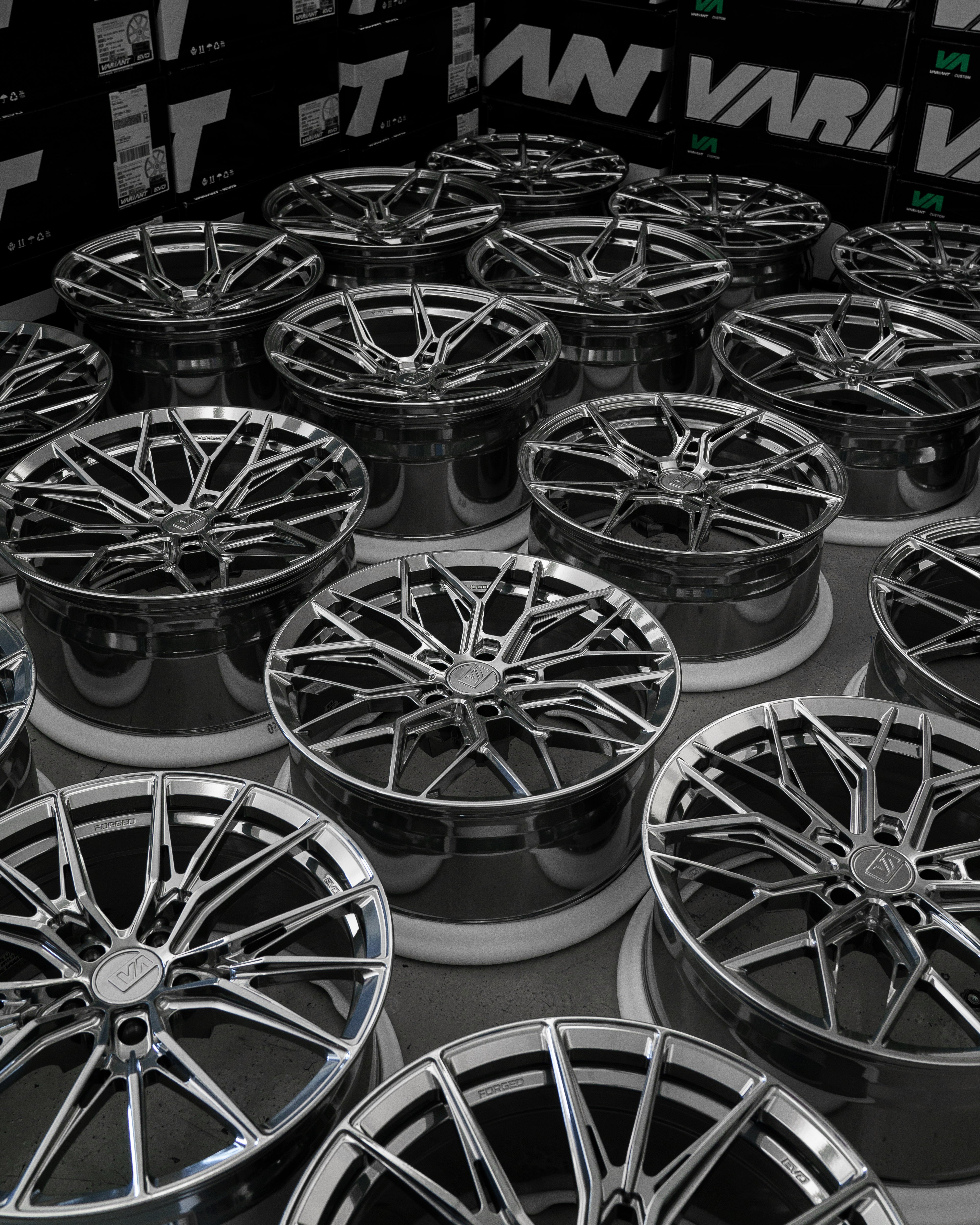

Key takeaways: Forged wheels typically cost between roughly $2,000 and $6,000 per set of four, with most quality monoblock sets landing in the $2,000 to $3,500 range and multi-piece or fully custom builds climbing well past that. The price is driven by four things: construction type, diameter and width, finish, and how much custom engineering your fitment requires. The single biggest cost jump is not size, it is going from one-piece monoblock to a two- or three-piece build.
What do forged wheels cost in 2026?
Across the market, a set of four forged wheels generally falls into these bands. Treat them as orientation, not quotes, because size and finish move the number substantially.
| Construction | Typical per wheel | Typical set of four |
|---|---|---|
| Forged monoblock (one-piece) | $450 to $900 | $1,800 to $3,600 |
| Forged two-piece | $700 to $1,200 | $2,800 to $4,800 |
| Forged three-piece | $900 to $1,600+ | $3,600 to $6,400+ |
| Fully bespoke / exotic finishes | $1,500+ | $6,000 and up |
For comparison, a cast wheel set often sits between $800 and $1,600, and flow-formed sets typically land between $1,400 and $2,400. If you want to understand what you are actually buying at each of those tiers, our breakdown of forged vs. flow-formed vs. cast wheels is the place to start.
Why are forged wheels more expensive than cast wheels?
The short answer is that forging is a slower, more material-intensive process with far more machining involved.
A cast wheel starts as molten aluminum poured into a mold. It comes out close to its final shape, which means minimal machining and very high throughput. A forged wheel starts as a solid billet of 6061-T6 aluminum that is compressed under thousands of tons of pressure, then heat-treated, then CNC-machined down to its finished form. A large share of that billet ends up as chips on the shop floor. You are paying for the raw material you keep and a meaningful amount of the material you do not.
What you get for it is a denser part with a grain structure that follows the shape of the wheel, which means higher strength per pound. That is why a forged wheel can hit a target strength at lower weight, and why unsprung weight is the argument people actually care about. Background on aluminum wheel construction generally is covered well in the overview of alloy wheels.
What drives the price up or down?
1. Construction: monoblock vs. multi-piece
This is the biggest single lever. A monoblock wheel is machined from one forged piece. A two-piece adds a separately forged barrel bolted to the face; a three-piece uses a face plus inner and outer barrel halves. Each additional piece means more forgings, more machining operations, hardware, sealing, and assembly labor. Expect roughly a 40 to 80 percent premium moving from monoblock to three-piece. Our guide to monoblock vs. 2-piece vs. 3-piece construction explains what you gain for that money, and the EX2 two-piece collection and EVO monoblock collection show the two ends in practice.
2. Diameter and width
Bigger wheels need bigger billets. Each step up in diameter typically adds $50 to $150 per wheel, and extra width does the same. A 22-inch wheel measuring 12 inches wide can cost meaningfully more than a 19-inch, 9-inch-wide wheel of the same design purely on material and machining time.
3. Finish
A standard gloss or satin powder coat is the baseline. Brushed finishes, polished lips, two-tone treatments, chrome, and custom colors all add process steps and hand labor. Budget a few hundred dollars per set for premium finishes, more for anything requiring hand polishing. Variant offers these through additional finishes.
4. Fitment complexity
An off-the-shelf fitment for a common application costs less than a bespoke offset, custom bolt pattern, or a wheel engineered around a carbon ceramic brake package. Cars like the Corvette C8, Tesla Model S Plaid, and BMW M3 often need application-specific engineering to clear factory calipers, which is part of why vehicle-specific fitments exist rather than a single universal part number.
What else should you budget for?
The wheels are not the whole invoice. Plan for:
- Tires: $800 to $2,000+ for a performance set, more for staggered high-performance sizes.
- TPMS sensors: roughly $50 to $100 per wheel if your car requires them and you are not transferring existing sensors. See TPMS sensors.
- Mount, balance, and installation: $150 to $400 depending on shop and whether road-force balancing is used.
- Hardware: lug bolts or nuts in the correct seat type and length, and hub-centric rings if needed.
- Protection: a ceramic coating is optional but makes brake dust removal far easier over the life of the wheel.
Add it up and a $2,800 wheel set can realistically become a $4,200 project. Better to know that going in.
Are forged wheels worth the extra cost?
It depends entirely on what you are optimizing for, and we have written an honest answer to that in are forged wheels worth it. The short version: if you want a specific look at a specific size and you drive the car normally, a good cast or flow-formed wheel will serve you fine and cost less. If you care about unsprung weight, want a fitment that does not exist off the shelf, or are running enough power and grip that wheel strength genuinely matters, forged is the answer and the premium buys something real.
Worth noting on resale: forged wheels from established brands hold value noticeably better than cast wheels, often recovering 50 to 65 percent of purchase price on the used market versus 25 to 40 percent for cast. That narrows the true cost gap more than most buyers expect. You can browse the full range across the Variant wheel lineup, all of which is true forged.
Frequently asked questions
How much does a set of forged wheels cost?
Most forged sets of four run between roughly $2,000 and $6,000. Monoblock sets typically fall in the $1,800 to $3,600 range, while three-piece and fully custom builds commonly exceed $4,000 and can pass $6,000 with premium finishes and large diameters.
Why are three-piece forged wheels so much more expensive?
A three-piece wheel requires separate forgings for the face and both barrel halves, plus assembly hardware, sealing, and significantly more machining and labor. That typically adds 40 to 80 percent over an equivalent monoblock.
Do bigger forged wheels cost more?
Yes. Larger diameters and widths require larger billets and longer machining cycles. Each inch of diameter generally adds around $50 to $150 per wheel, with extra width adding a similar amount.
Are cheap forged wheels a bad idea?
Not automatically, but be skeptical of unusually low pricing. Verify the manufacturer publishes load ratings and testing standards, and confirm the wheel is genuinely forged rather than flow-formed and marketed loosely. On a safety-critical component, unexplained discounts deserve questions.
Do forged wheels hold their value?
Generally yes, better than cast wheels. Established forged brands often resell for around 50 to 65 percent of original price in good condition, compared with roughly 25 to 40 percent for cast wheels, which reduces the effective cost of ownership.
Written by Taylor Smith, co-founder of Variant Alloy Wheels, who has spent nearly two decades in the automotive aftermarket.
Share:
What Are the Lightest Forged Wheels for Your Car?
What Are the Best Wheels for the BMW 3 Series (G20)?