


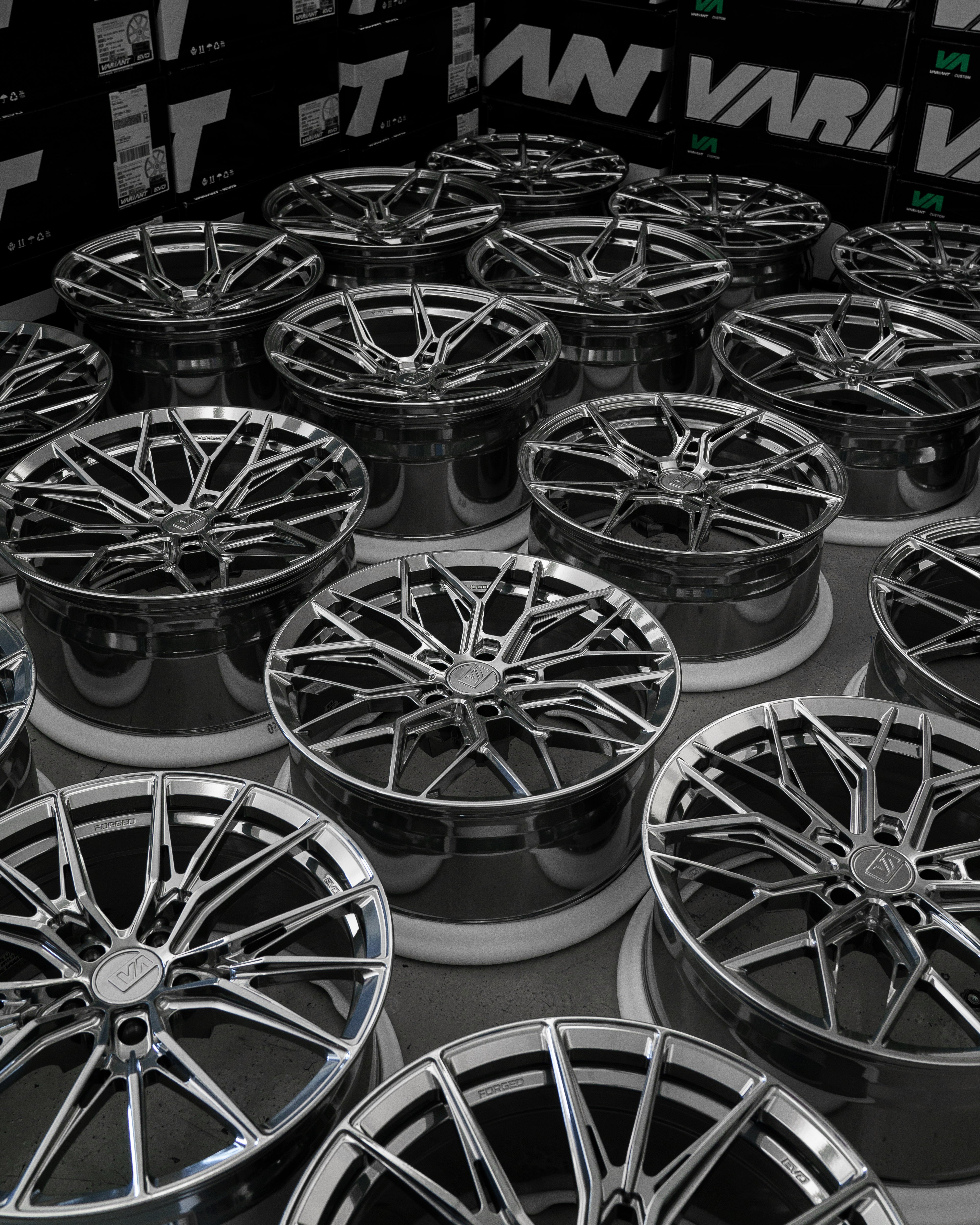
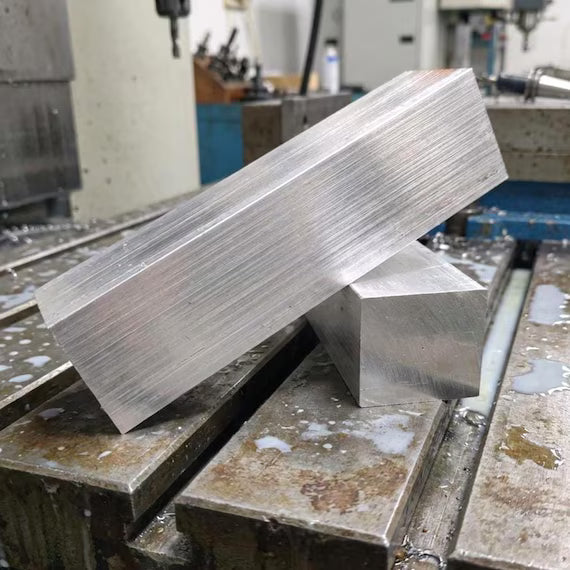
Key takeaways: Forged wheels are made from a single billet of 6061-T6 aluminum that is squeezed under thousands of tons of pressure, which aligns the metal's internal grain structure for far more strength than poured (cast) aluminum. In the name, "6061" is the alloy (aluminum mixed mainly with magnesium and silicon) and "T6" is the heat treatment that hardens it. The payoff is a wheel that is lighter, denser, and more impact-resistant for a given strength than a cast or flow-formed wheel.
What Are Forged Wheels Made Of? 6061-T6 Aluminum Explained
If you have shopped for performance wheels, you have seen the phrases "forged" and "6061-T6" everywhere, usually without much explanation. So what are forged wheels made of, and why does the material matter? The short answer: a true forged wheel starts as a solid block of 6061-T6 aluminum and is shaped under enormous pressure rather than poured into a mold. That single difference in how the metal is made is the reason forged wheels can be both lighter and stronger than the alternatives.
At Variant, every wheel we build is a true forged wheel, so this is the alloy and process behind our entire lineup. Here is what that actually means.
What is forging, and how is it different from casting?
Forging is the process of shaping metal under compressive force. In wheel manufacturing, a billet (a solid cylinder of aluminum) is heated and pressed with thousands of tons of force until it takes the rough shape of a wheel, which is then precision-machined. Forging has been used for centuries on high-stress parts precisely because it makes metal tougher.
Casting, by contrast, means pouring molten aluminum into a mold and letting it cool. It is cheaper and faster, but molten metal that simply cools in a mold leaves tiny air pockets (porosity) and a random, less organized grain structure. Flow forming (sometimes called rotary forging) is a middle ground: a cast barrel is spun and rolled to compress just the outer rim. It improves the barrel but the wheel still begins as a casting. We break this down in detail in our guide to forged vs. flow-formed vs. cast wheels.
What does "6061-T6" actually mean?
6061-T6 is the specific aluminum alloy and temper used in quality forged wheels. Breaking the name apart makes it easy to understand.
The "6061" alloy
6061 is an aluminum alloy whose main added ingredients are magnesium and silicon. It is one of the most widely used structural alloys in the world, found in aircraft components, bike frames, and aerospace fittings. The reason it is popular is balance: it offers a strong combination of strength, toughness, machinability, and corrosion resistance. You can read the full metallurgical profile on 6061 aluminium alloy.
The "T6" temper
"T6" describes the heat treatment. The metal is solution heat-treated and then artificially aged, a controlled heating and cooling cycle that dramatically increases hardness and strength. Forged 6061 in the T6 temper has a tensile strength of roughly 45,000 psi and a yield strength near 40,000 psi. Without the T6 treatment, the same alloy would be far softer.
Why use 6061-T6 instead of stronger 7075 aluminum?
This is the question that trips up a lot of enthusiasts. On paper, 7075 aluminum is much stronger than 6061: roughly 83,000 psi tensile and 73,000 psi yield, nearly double the numbers above. So why is 6061-T6 the industry standard for wheels?
Because raw strength is not the only thing that matters in a part that hits potholes. 7075 is far less ductile, meaning that under a sharp impact it tends to crack rather than bend. 6061-T6 sits at the sweet spot between strength and toughness: hard enough to hold precise forged geometry, but flexible enough to absorb a curb strike or a pothole without fracturing. It also resists corrosion better. For a safety-critical part that has to survive years of road abuse, that toughness wins.
| Property | 6061-T6 aluminum | 7075-T6 aluminum |
|---|---|---|
| Tensile strength | ~45,000 psi | ~83,000 psi |
| Yield strength | ~40,000 psi | ~73,000 psi |
| Ductility / impact toughness | High (tends to bend) | Low (tends to crack) |
| Corrosion resistance | Excellent | Good |
| Best use in wheels | Road and track wheels | Niche racing hardware |
Does the forged material make a real-world difference?
Yes, in two ways you can feel. First, strength-to-weight: because forged 6061-T6 is so dense and strong, manufacturers can remove material and still meet load ratings, producing a lighter wheel. Lighter wheels reduce unsprung weight, which sharpens steering response, braking, and ride quality, as we explain in our breakdown of unsprung weight. Second, durability: the aligned grain flow makes a forged wheel more resistant to bending and cracking on impact than a comparable cast wheel.
That material advantage is the foundation of our forged collections, from the monoblock designs in the Corsa Collection to the customizable forged options in the EVO Collection and the multi-piece builds in the Strada Collection. Whether a wheel is one piece or three, the construction choice still rides on top of the forged-vs-cast decision, which we cover in our monoblock vs. 2-piece vs. 3-piece guide.
Frequently asked questions
Are forged wheels stronger than cast wheels?
Yes. Forging compresses and aligns the aluminum's grain structure and eliminates the porosity left by casting, so a forged wheel is denser and more resistant to bending and cracking than a cast wheel of the same weight. That is why forged wheels can be made lighter while still meeting load ratings.
Is 6061-T6 aluminum the same as aircraft-grade aluminum?
Effectively, yes. 6061 is one of the alloys commonly described as "aircraft-grade" because it is used in aerospace structural components. The T6 temper is the heat treatment that gives it its working strength.
Are 7075 wheels better than 6061-T6 wheels?
Not for street and most track use. 7075 is stronger on paper but much more brittle, so it can crack on a hard impact instead of bending. 6061-T6 offers a better balance of strength, impact toughness, and corrosion resistance for a wheel that lives on real roads.
Do forged wheels crack or bend?
Any wheel can be damaged by a severe enough impact, but forged 6061-T6 wheels are more likely to bend than shatter, and they resist damage better than cast wheels. Their ductility is a safety feature, giving you warning and often a repairable wheel rather than a sudden failure.
Written by Taylor Smith, co-founder of Variant Alloy Wheels, who has spent nearly two decades in the automotive aftermarket.
Share:
What Are the Best Wheels for the BMW M5 (F90)?
Are Forged Wheels Worth It? An Honest Breakdown