



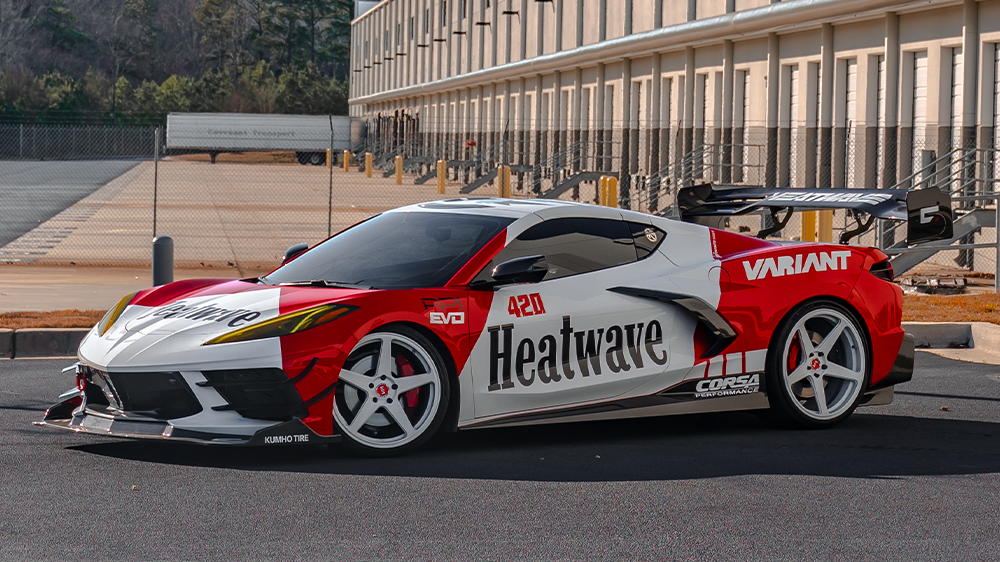
Yes, forged wheels are a good choice for track days. Forged 6061-T6 aluminum is strong, tolerates the heat cycles of repeated hard braking, and the lower unsprung weight helps the suspension and tires work better. They are not magic, though: you still need the right load rating, correct fitment for your brakes, and a disciplined torque and inspection routine between sessions.
Are forged wheels good for track days? For most track-day drivers who care about grip, braking, and durability, they are hard to beat, because a track exposes every weakness a wheel has. Here is why, what to watch for, and how to set one up properly. If you want a wheel designed for this, start with our Track Spec range.
Why are forged wheels better for the track?
Forged wheels suit the track because they combine strength and low weight. A forged wheel starts as a solid aluminum billet that is pressed under extreme force, which aligns the metal's grain structure and produces a dense part with no casting porosity. Our guide to 6061-T6 aluminum covers the alloy itself.
On track, that matters in three ways:
- Lower unsprung weight. Unsprung mass is everything not supported by the springs, including wheels, tires, and brakes. Reducing it lets the suspension keep the tire in contact with the pavement over bumps and curbs. Our guide to unsprung weight covers the physics.
- Less rotational inertia. A lighter wheel is easier to accelerate and to slow down, which helps both acceleration and braking, especially with weight at the outer edge of the wheel.
- Better impact behavior. A hard hit on a curb or rumble strip is more likely to bend a forged wheel than to crack it, which is a safer failure mode. Our article on whether forged wheels bend or crack goes deeper.
Can forged wheels handle brake heat?
Forged wheels handle track-day brake heat well, but heat is the factor to respect. Rotors and calipers glow at the end of a long braking zone, and that heat soaks into the wheel, the valve stem, the TPMS sensor, and the tire. 6061-T6 holds up well to the heat most wheels see on a track day, but sustained extreme heat (a dragging brake, for example) is a different story, and well before that point heat can damage the finish, harden the valve stem rubber, and cook a sensor.
Practical steps help:
- Run a cool-down lap before you park, and avoid holding the brakes on with hot rotors.
- Use a finish rated for heat; a quality powder coat or clear coat is designed for this, and a ceramic coating can help shed brake dust.
- Replace valve stems and check sensor condition at tire changes.
- Check that your wheel clears the caliper before you buy. Our guide to brake clearance with aftermarket wheels shows how.
What should you check before and after each track session?
Treat the wheel as a safety-critical part, because it is. A short routine catches most problems:
- Torque the lug nuts cold to your vehicle's spec with a calibrated torque wrench, in a star pattern. Re-check after the first session. We explain the numbers in our guide to torquing aftermarket wheels.
- Set tire pressure cold, then adjust hot. Pressures climb during a session, often by several PSI, so start lower than your target and bleed down if needed.
- Inspect the wheel for curb marks, bends, or cracks around the lug seats and spokes. Retire any wheel with a crack or a bend that affects roundness.
- Check balance and runout if you feel a vibration after a hard session.
How do forged wheel types compare for track use?
| Option | Weight | Track strengths | Trade-offs |
|---|---|---|---|
| Forged monoblock | Lowest for a given size | One piece, no joint, strong and simple | Higher cost than cast; damaged wheel replaced as a whole |
| Forged multi-piece (2- or 3-piece) | Low, slightly more than a comparable monoblock | Wider widths, rebuildable barrel | Assembly joints and seals need inspection |
| Cast (generic, for comparison) | Heaviest | Cheapest | Heavier, more brittle in a hard impact |
Every Variant wheel is a true forged wheel, so the practical choice is between a monoblock like the EVO collection and a multi-piece design like the 2-piece EX2 collection or the three-piece Corsa collection.
What load rating and fitment do you need on track?
The wheel's load rating has to suit your car's weight with margin to spare, because cornering and curb loads on a track are far higher than on the street. Our guide to wheel load ratings explains how to read the number. Offset, width, and bolt pattern also have to be right for your car so the tire does not rub when the suspension compresses. Tell our fitment experts your car, brakes, and tire size, and we'll spec the fitment.
If you drive a track-oriented car such as a C8 Corvette, you can start with the EVO fitments on our Corvette C8 wheels page, or check vehicle-specific fitments to find your model. Those pages list EVO, one of our lines; EX2 two-piece and three-piece (Corsa, Strada) builds are specced per car, so their sizes and offsets can differ. If the size you want isn't listed, our EVO Custom program builds EVO designs from 17 to 24 inches. For anything else, the full wheel lineup is the place to start.
Are forged wheels worth it for track days?
For regular track drivers, yes. The weight savings help the car brake, turn, and accelerate, and the strength gives you margin. For an occasional driver doing one event a year, the benefit is real but smaller, and a forged wheel is still a long-term investment. Whatever you choose, the discipline of torque, pressure, and inspection matters more than the wheel itself. When you are ready, browse the Track Spec and EVO collections, or let our fitment experts spec a set for your car.
Frequently asked questions
Are forged wheels good for track days?
Yes. Forged wheels are strong and light, which improves braking, handling, and tire contact. They still need the correct load rating, brake clearance, and a routine of torque and inspection checks between sessions.
Can forged wheels crack on a race track?
Any wheel can fail from a severe impact, but a hard curb or rumble strip hit is more likely to bend a forged wheel than to crack it. Inspect the wheel after any hard hit and retire it if you find a crack or a bend that affects roundness.
Do you need special wheels for track days?
You do not need a special track-only wheel, but you do need one with a load rating well above your car's corner weight and fitment that clears your brakes. A quality forged wheel meets both requirements for most cars.
How often should you torque lug nuts on track days?
Torque the lug nuts cold to the vehicle's spec before the first session and re-check after it. Re-check again whenever the wheels have been removed or after any hard impact.
Does brake heat damage forged wheels?
Normal track-day brake heat is rarely what hurts a forged 6061-T6 wheel, but it can damage finishes, valve stems, and TPMS sensors, and sustained extreme heat from a dragging brake should be checked out. A cool-down lap and a quality heat-rated finish reduce the risk.
Written by Taylor Smith, co-founder of Variant Alloy Wheels, who has spent nearly two decades in the automotive aftermarket.
Share:
Should You Buy Used Forged Wheels?
Do You Need a Second Set of Wheels for Winter Tires?