


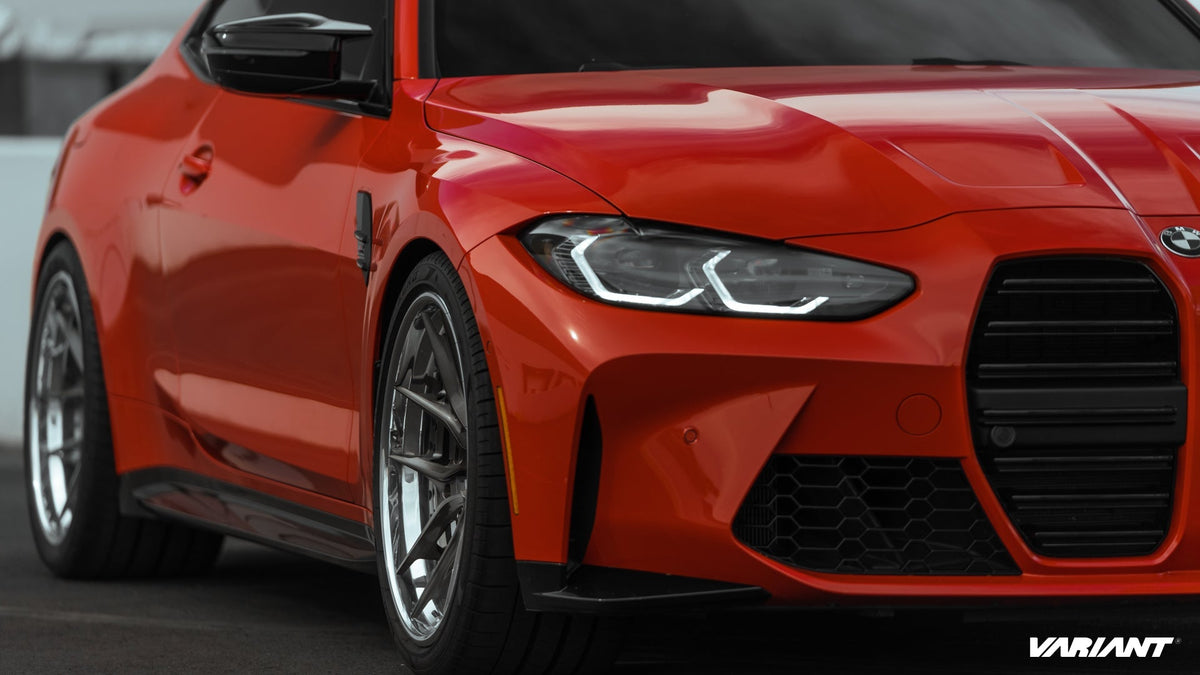
Key takeaways: The best wheels for the BMW M4 (G82) are lightweight forged wheels in a staggered setup that respect the chassis's 5x112 bolt pattern and 66.6 mm center bore. Factory Competition cars run 19x9.5 ET22 front and 20x10.5 ET21 rear. The most common aftermarket upgrade is a square-diameter 20x10 front and 20x11 rear staggered fitment, which cleans up the look and adds rear tire width without touching the suspension.
The G82 M4 is a heavy car that hides it well. Between the wide track, the enormous factory brakes, and over 500 horsepower going through either the rear wheels or all four, it asks a lot of whatever is bolted to the hubs. That is why wheel choice on this chassis is less about style and more about not undoing what BMW's M division spent years engineering.
What wheels come on the BMW M4 G82 from the factory?
Competition-spec G82 coupes leave the factory on a staggered 19/20 setup: 19x9.5 with ET22 offset at the front and 20x10.5 with ET21 at the rear. The chassis uses a 5x112 bolt pattern with a 66.6 mm center bore, shared with the G80 M3 sedan and the wider G8x family.
Those are good wheels. They are also cast, and on a car this heavy that means you are carrying more unsprung mass than you need to. Trims and model years vary (the LCI cars and the CS shuffle things again), so confirm what is actually on your car before ordering rather than trusting a spec table for "an M4."
What size wheels fit the BMW M4 G82?
| Setup | Front | Rear | Notes |
|---|---|---|---|
| Factory Competition | 19x9.5 ET22 | 20x10.5 ET21 | Baseline; staggered diameters |
| Square 20" upgrade | 20x10 | 20x11 | Most popular aftermarket fitment; matched diameters, wider rear |
| Bolt pattern | 5x112 | Shared with G80 M3 | |
| Center bore | 66.6 mm | Wheels should be machined to match | |
The move most G82 owners make is going to 20 inches at both corners with a wider rear. You gain rear contact patch and lose the visual mismatch of a 19/20 stagger, without needing spacers or fender work on a stock-height car. If you want the deeper background on why front and rear differ at all, we covered staggered vs. square setups in detail.
Two dimensions do the heavy lifting here: width and offset. Width sets your tire options, and offset sets where the wheel sits in the arch. Our guide to wheel offset explains the direction the number moves the wheel, which is the single most misread spec in aftermarket fitment.
Why forged wheels on an M4?
A forged wheel is machined from a solid billet of aluminum that has been compressed under enormous pressure, aligning the grain structure of the metal along the load paths. The result is a wheel that can hit a target strength with less material than a cast wheel needs. Less material means less weight at the corner of the car.
That weight sits in the worst possible place. Unsprung mass has to be accelerated, decelerated, and moved vertically by the suspension every time the road changes, and reducing it improves ride compliance, steering response, and how quickly the damper can control a wheel over a bump. We broke the physics down in what unsprung weight actually is.
On an M4 specifically, the payoff shows up in two places you notice daily: turn-in feels sharper because there is less rotational inertia to overcome, and the car settles faster over expansion joints because the dampers are fighting less mass. Neither is a lap-time headline. Both are things you feel on the drive home.
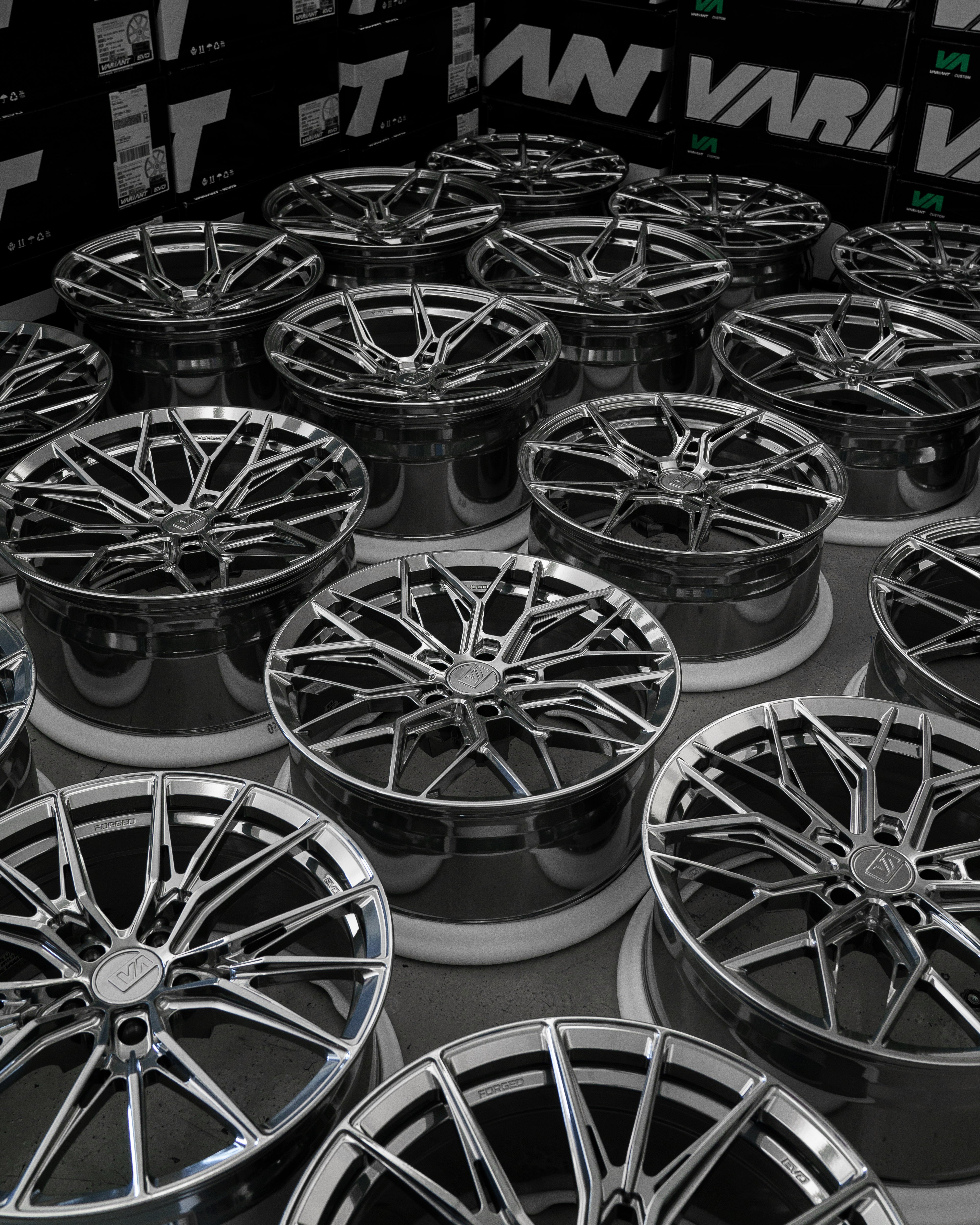
Variant builds true forged wheels only. There is no cast or flow-formed product in the lineup, which means the comparison you are making is between our forged wheels and someone else's, not between forging and a cheaper process wearing the same name.
Which Variant wheels fit the G82 M4?
Our BMW M4 collection covers 2021–2025 G82 cars in a 20x10 front and 20x11 rear staggered fitment, plus 2015–2020 F82 applications. Three designs anchor the range:
- Zeno, the broadest finish selection for the G82, from Gloss Black and Satin Gunmetal to Raw Milled and both Gloss and Satin Bronze. A safe first pick if you want the car to look factory-plus rather than modified.
- Sena, available in Gloss Black, Satin Black, Raw Milled, and Chrome Powder. A more graphic spoke pattern that reads well against the G82's wide rear haunches.
- Rian, offered in Satin Gunmetal and Chrome Powder for owners who want something less common.
Finish is not a trivial choice on a car this size, since a 20-inch face shows every decision. If you are torn, our comparison of gloss vs. matte vs. brushed finishes covers how each ages and what each demands in upkeep. You can also browse the wider Corsa and EVO families, or start from your car in vehicle-specific fitments.
What should you watch out for on a G82 fitment?
- TPMS. The G82 will throw a warning without functioning sensors in the new wheels. Plan for them rather than discovering the problem in the shop. See whether you need new TPMS sensors.
- Brake clearance. M4s with the carbon ceramic brake option have different caliper geometry than the standard iron setup. Confirm clearance for your specific brake package.
- Tire sizing. A 20x11 rear wants an appropriate tire width; stretching or over-stuffing a tire changes the sidewall profile and undoes some of what the wider wheel bought you.
- Torque. Aluminum wheels need correct torque and a re-check after roughly 50 to 100 miles. Overtightening is as bad as undertightening.
- Model-year drift. BMW revised the G82 mid-cycle. Match the year, not just the chassis code.
If you are cross-shopping the sedan, most of this transfers directly. The platforms share hardware. Our best wheels for the BMW M3 (G80) guide covers that side. Broader chassis history is well documented on the BMW M4 reference page.
Frequently asked questions
What is the bolt pattern on a BMW M4 G82?
The G82 M4 uses a 5x112 bolt pattern with a 66.6 mm center bore. This is shared with the G80 M3 and much of the current BMW range, but it is different from the 5x120 pattern used on older BMW chassis such as the F82 M4's predecessors in the 3 and 4 Series line.
Will 20-inch wheels fit an M4 G82 all around?
Yes. A 20x10 front and 20x11 rear staggered setup is the most common aftermarket fitment on the G82 and fits a stock-height car without spacers or fender modification, provided tire sizing is chosen appropriately.
How much weight can you save with forged wheels on an M4?
It depends on the specific design, size, and finish, so treat any blanket number with suspicion. The general principle holds: forging lets a wheel reach a given strength target with less aluminum than casting, so a comparable forged wheel is typically lighter. Ask for the actual weight of the exact size you are buying.
Do aftermarket wheels void the M4's warranty?
Fitting aftermarket wheels does not automatically void a vehicle warranty in the United States, though a manufacturer can deny a claim if it can show the part caused the failure. We covered the details in our guide to whether aftermarket wheels void your warranty.
Are the factory M4 Competition wheels forged?
The standard Competition wheels are cast aluminum. That is normal for a factory fitment at this price point and they are perfectly safe, but cast construction is why they carry more weight than an equivalent forged wheel in the same size.
Written by Taylor Smith, co-founder of Variant Alloy Wheels, who has spent nearly two decades in the automotive aftermarket.
Share:
How Much Should You Torque Aftermarket Wheels?
Are Wheel Spacers Safe? What to Know Before You Run Them