


Key takeaways: Forged and billet wheels both start as a solid piece of aluminum, but they are shaped in fundamentally different ways. A forged wheel is squeezed into shape under thousands of tons of pressure, which makes the metal's internal grain flow around the wheel and pack tighter. A billet wheel is cut entirely from a solid block on a CNC machine, so the grain stays as-is. The practical result: true forged wheels deliver the best strength-to-weight ratio, which is why they are the standard for lightweight performance. Billet wheels can be just as strong, but usually need more aluminum (and weight) to get there, so they are mostly reserved for ultra-custom, low-volume designs.
What is a forged wheel?
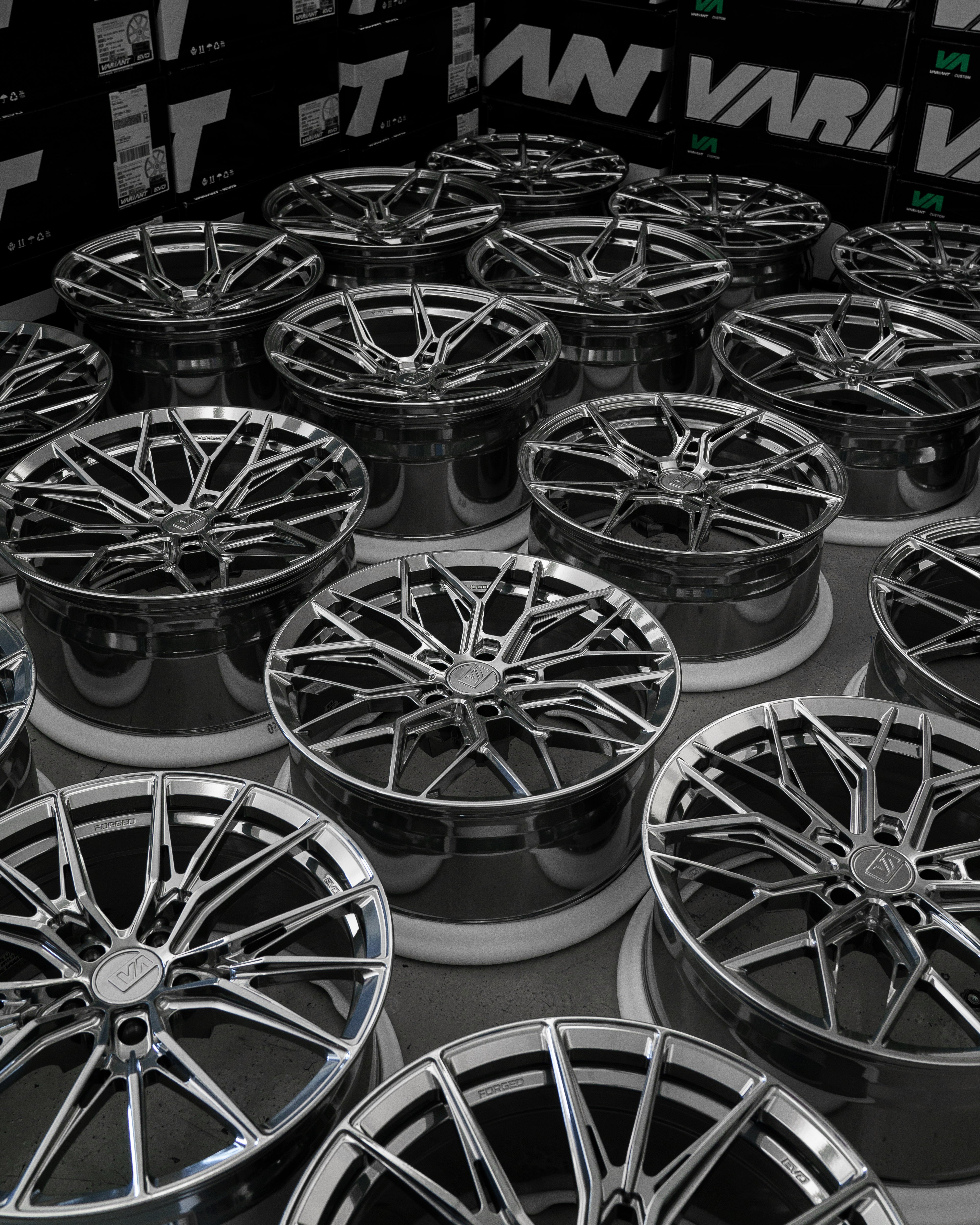
A forged wheel is made by taking a solid cylinder of aluminum, called a billet, heating it, and compressing it under enormous force, often 8,000 to 12,000 tons or more, so the metal is pressed close to its final shape before it is machined. That pressing step is what defines forging. As the aluminum deforms, its grain structure realigns and follows the contours of the wheel, a phenomenon known as grain flow. The denser, directional grain is what gives a forged wheel its strength. At Variant, every wheel we build is a true forged wheel, cut from aerospace-grade 6061-T6 aluminum, not cast or flow-formed. If you want the full sequence, we broke it down in how forged wheels are made.
What is a billet wheel?
A billet wheel is machined entirely from a solid block, or billet, of aluminum. Instead of pressing the metal into a near-net shape first, a CNC mill simply carves the finished wheel out of the raw block, removing everything that is not part of the design. Nothing about the process reshapes or realigns the metal's grain the way forging does; the wheel keeps the grain structure the block started with. Billet machining excels at intricate, one-off designs because the entire shape is defined by tool paths in software, so a shop can produce a truly custom face without the tooling a forging press requires.
Forged vs. billet wheels: how do they actually differ?
The short version: forging changes the metal, billet machining does not. Forging refines and aligns the grain under pressure; billet cutting leaves it untouched. Here is a side-by-side comparison.
| Attribute | Forged wheel | Billet wheel |
|---|---|---|
| Starting material | Solid aluminum billet | Solid aluminum block |
| Key process step | Pressed under thousands of tons, then CNC machined | CNC machined only |
| Grain structure | Realigned to flow around the shape (grain flow) | Unchanged from the raw block |
| Strength-to-weight | Excellent; more strength per pound | Good, but often needs more material to match |
| Design flexibility | Very high, especially in multi-piece builds | Extremely high for one-off custom faces |
| Typical use | Lightweight performance and OE-plus upgrades | Show builds, low-volume and specialty applications |
Are forged wheels stronger than billet wheels?
For a given weight, forged wheels are generally stronger. The reason is grain flow. When aluminum is forged, the pressing process stretches and aligns the metal's grain so it wraps continuously around the spokes and barrel, much like the grain in a piece of wood follows the branch rather than being cut across it. That continuous, directional structure resists fatigue and cracking better than a grain pattern that has been machined straight through. A billet wheel starts from a block whose grain is not optimized for the loads a wheel sees, so to reach the same strength it typically has to carry more aluminum in the critical areas, which adds weight. You can read more about the mechanics of forging and grain flow on Wikipedia.
It is worth being precise here: billet is not weak. A well-engineered billet wheel can be extremely strong. The trade-off is efficiency. Forging simply gets you more strength out of every pound of metal, and on a wheel, weight is the whole game.
Which is lighter, forged or billet?
Forged wheels usually win on weight for the same strength target. Because grain flow lets a forged wheel do more with less material, designers can shave mass out of the spokes and barrel while keeping the load rating where it needs to be. That matters because wheels are unsprung weight, the mass that is not supported by the suspension. Reducing unsprung weight improves ride quality, steering response, and how well the tire stays planted over bumps. We explain why in what is unsprung weight, and outlets like Car and Driver have measured the handling benefits of lighter wheels directly.
Which should you buy?
For the vast majority of drivers, a true forged wheel is the better call. It gives you the best balance of strength, weight, and design, and it is available in monoblock and multi-piece constructions to suit almost any car. If you are weighing your options, our guide on forged vs. flow-formed vs. cast covers where each construction fits, and monoblock vs. 2-piece vs. 3-piece explains the different forged builds.
Billet makes the most sense when you want a genuinely one-off face, a specialty size, or an artistic design that would be impractical to forge in low volume. It is a craft process, and it shines in that niche. But if your priorities are lightweight, strength, and value on a street or track car, forged is the proven path. Browse our forged lineups in the Corsa, EVO, and Designer collections, or start at the full wheels hub.
Frequently asked questions
Is a billet wheel the same as a forged wheel?
No. A billet wheel is CNC-machined from a solid block of aluminum without any pressing step, so its grain structure is unchanged. A forged wheel is pressed under thousands of tons before machining, which realigns the grain and improves strength-to-weight.
Are billet wheels stronger than forged wheels?
Not for a given weight. Billet wheels can be very strong, but because forging aligns the metal's grain flow, a forged wheel typically achieves the same strength with less material and therefore less weight.
Why are forged wheels more expensive to develop than billet?
Forging requires dedicated tooling and a massive press, which favors it once a design is being produced in volume. Billet needs only a CNC mill and software, which is why it is popular for true one-off or very low-volume designs, though machining time per wheel can be significant.
Does Variant make cast or billet wheels?
No. Variant builds only true forged wheels from 6061-T6 aluminum. We do not sell cast, flow-formed, or billet-machined wheels.
Written by Taylor Smith, co-founder of Variant Alloy Wheels, who has spent nearly two decades in the automotive aftermarket.
Share:
What Is Wheel Offset? Positive, Negative, and Zero Offset Explained
Do Forged Wheels Hold Their Value?