


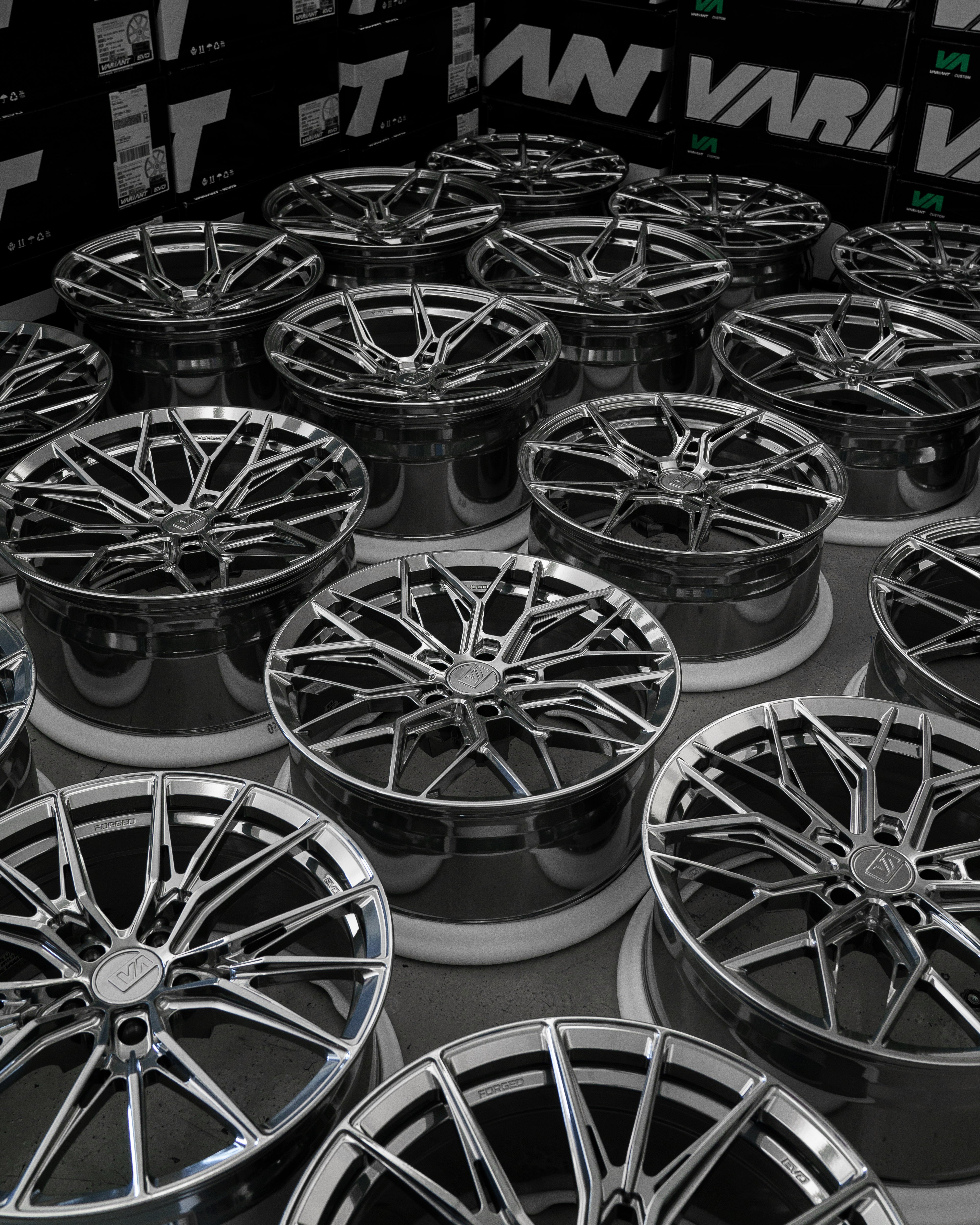

Key takeaways: Yes, forged wheels are lighter than cast wheels. At the same size and design, a true forged wheel is typically 20-30% lighter than a comparable cast wheel because forging makes the aluminum denser and stronger, so less material is needed. On an 18-inch wheel that can mean 3-5 lbs saved per corner, which lowers unsprung weight and rotational mass for sharper handling and a better ride.
If you are comparing wheels, the short answer to whether forged wheels are lighter than cast wheels is a clear yes, but the "how much" depends on size, width, and design. Below we break down the real numbers, why forging saves weight, and where that weight actually helps. Variant builds only true forged wheels, so this is a trade-off we live with every day.
Why are forged wheels lighter than cast wheels?
Forged wheels are lighter because forging produces a denser, stronger aluminum structure that needs less material to carry the same load. A cast wheel is made by pouring molten aluminum into a mold, which can leave microscopic porosity (tiny air pockets). To stay strong, cast designs compensate with thicker spokes and barrels, and that extra material adds weight.
A forged wheel starts as a solid billet of 6061-T6 aluminum that is squeezed under thousands of tons of pressure. Forging aligns the metal's grain structure and eliminates porosity, so engineers can machine away material and still meet load ratings. Less material at the same strength equals a lighter wheel. For the full process, see our guide on how forged wheels are made.
How much lighter are forged wheels than cast wheels?
Most true forged wheels come in 20-30% lighter than a cast wheel of the same diameter, width, and offset. The savings scale with size: the bigger and wider the wheel, the more weight forging tends to save. Here is a representative comparison for common sizes (actual weights vary by design and finish).
| Wheel size | Typical cast weight | Typical forged weight | Weight saved per wheel |
|---|---|---|---|
| 18 x 8.5 | ~24 lbs (10.9 kg) | ~19 lbs (8.6 kg) | ~5 lbs (2.3 kg) |
| 19 x 9.5 | ~29 lbs (13.2 kg) | ~22 lbs (10.0 kg) | ~7 lbs (3.2 kg) |
| 20 x 10 | ~34 lbs (15.4 kg) | ~25 lbs (11.3 kg) | ~9 lbs (4.1 kg) |
Across a full set, that is often 15-30 lbs removed from the car. Just as important, much of that saved weight sits at the outer barrel and spokes, where it does the most good.
Does the weight savings actually matter?
Yes, wheel weight matters more than almost any other bolt-on because it is both unsprung and rotational. Unsprung mass is the weight not supported by the suspension springs (wheels, tires, and brakes). Lowering it lets the suspension react faster to bumps, which improves grip and ride comfort. Wheels also spin, so lighter wheels reduce rotational inertia, helping acceleration, braking, and steering response. We cover this in depth in what is unsprung weight.
The rule of thumb enthusiasts cite is that unsprung weight feels several times heavier than an equivalent amount of sprung weight, because the springs and dampers have to control it. You will not turn a family sedan into a race car, but shaving 20-plus pounds of unsprung, rotating mass is genuinely noticeable in steering feel and bump absorption.
Do lighter forged wheels improve fuel economy or EV range?
Marginally, yes. Reducing rotating mass lowers the energy needed to accelerate the wheels, so lighter wheels can nudge fuel economy and electric-vehicle range in the right direction, especially in stop-and-go driving. The effect is small next to tire choice, aerodynamics, and driving style, so treat it as a bonus rather than the reason to buy. On heavy performance cars and EVs, the handling benefit of dropping unsprung weight is usually the bigger prize.
Are all lightweight wheels forged?
No. Flow-formed wheels (also called rotary-forged) sit between cast and forged: they start as a cast center and are then spun and stretched to work-harden the barrel, so they are lighter than a plain cast wheel but generally still heavier than a true forged wheel of the same size. If outright weight and strength are the priority, true forged remains the benchmark. For the full breakdown, read forged vs. flow-formed vs. cast wheels.
Variant builds only true forged wheels. You can see lightweight monoblock options in the Corsa and EVO collections, or browse everything in our forged wheels lineup. If you want the lightest options by application, see our guide to the lightest forged wheels.
Is a lighter wheel always the better choice?
Not automatically. A wheel still has to meet the load rating for your vehicle, survive potholes, and match how you drive. Chasing the absolute lightest wheel with too little material can hurt real-world durability. A well-engineered forged wheel gives you most of the weight savings while keeping the strength margin you want on the street. Weight is one input; load rating, width, offset, and construction all matter too.
Frequently asked questions
Are forged wheels lighter than cast wheels?
Yes. At the same diameter, width, and offset, a true forged wheel is usually 20-30% lighter than a cast wheel because forging creates a denser, stronger structure that needs less aluminum.
How much weight do forged wheels save?
Roughly 3-9 lbs per wheel depending on size, or about 15-30 lbs across a full set. Larger and wider wheels tend to show the biggest savings.
Are forged wheels lighter than flow-formed wheels?
Usually yes. Flow-formed wheels are lighter than plain cast wheels but generally still heavier than a true forged wheel of the same size, because they start from a cast center.
Does a lighter wheel improve performance?
It helps. Lighter wheels reduce unsprung and rotational mass, which sharpens acceleration, braking, steering response, and ride quality. It will not replace power or tires, but it is one of the most effective handling upgrades.
Written by Taylor Smith, co-founder of Variant Alloy Wheels, who has spent nearly two decades in the automotive aftermarket.
Share:
What Is Wheel Offset? Positive, Negative, and Zero Offset Explained
Do Forged Wheels Hold Their Value?