


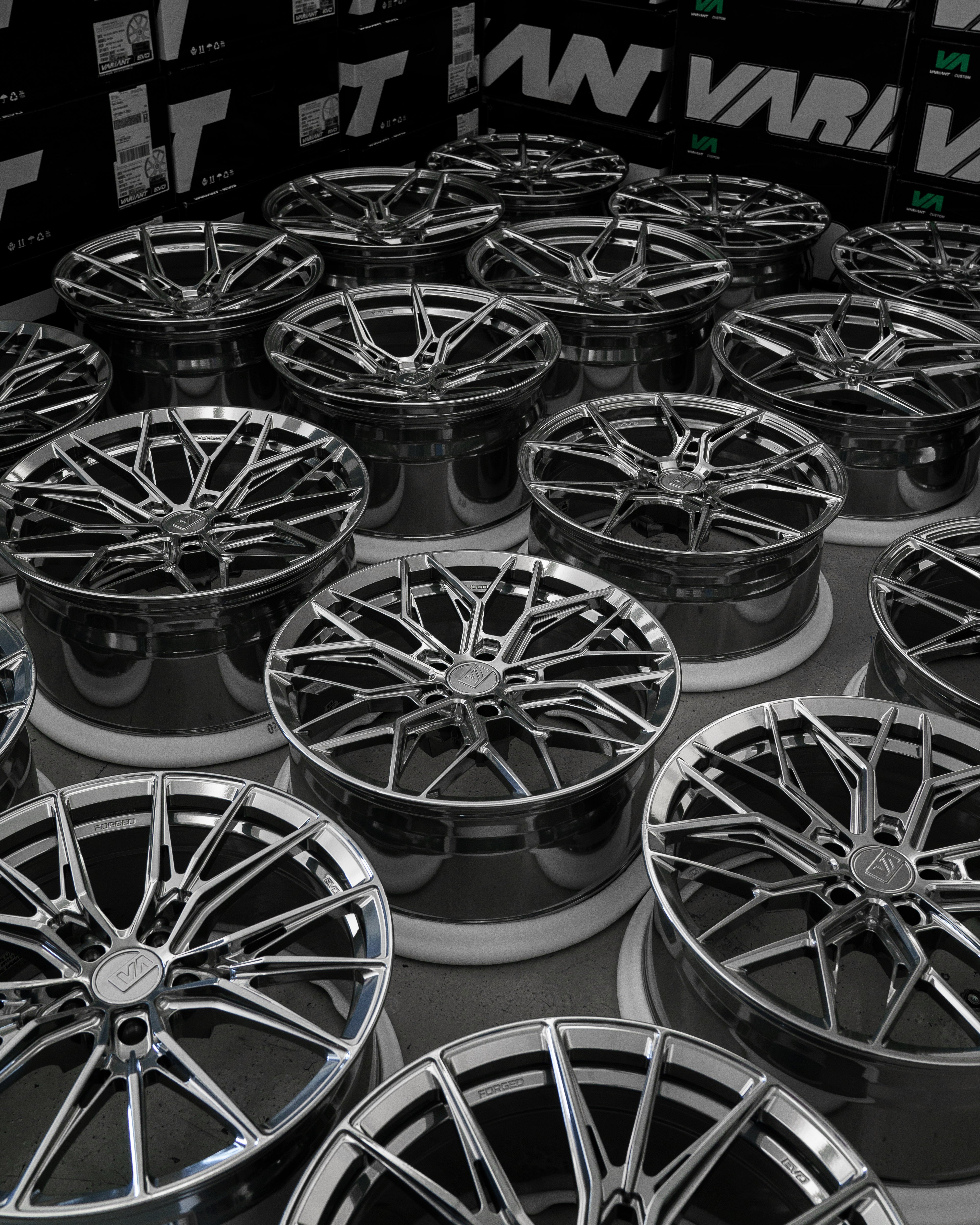
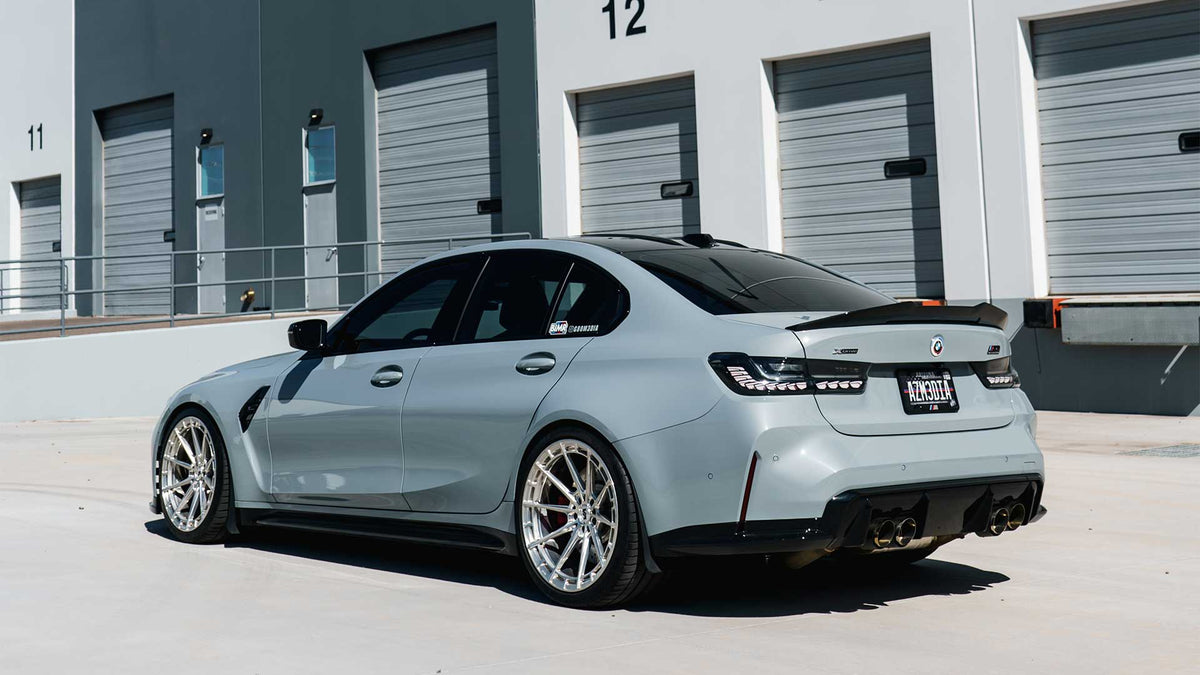
Key takeaways: The best wheels for the BMW M3 (G80) and M4 (G82) are true forged wheels that cut unsprung weight while keeping the factory 5x112 mm bolt pattern and 66.6 mm center bore. Most owners run a staggered 19- or 20-inch setup that mirrors BMW's factory sizing, with widths around 9.5 inches front and 10.5 inches rear. Forged construction is the priority: it is typically 20–25% lighter than cast at the same strength, which sharpens steering, ride, and braking on a car this fast.
What wheel specs do the BMW M3 and M4 use?
The G80 M3 and G82 M4 share the same wheel mounting specs, so wheels are cross-compatible between them:
- Bolt pattern: 5x112 mm
- Center bore: 66.6 mm (hub-centric)
- OEM diameters: 19-inch front, 20-inch rear on Competition models (staggered)
- Typical widths: ~9.5 in front, ~10.5 in rear
- Drivetrain: rear-wheel drive, or xDrive all-wheel drive on Competition xDrive
Because these are rear-wheel-drive (or rear-biased AWD) cars, BMW ships them staggered from the factory. You can keep that staggered look or move to a square setup for track use — see our guide to wheel offset and fitment to get the numbers right.
Why are forged wheels the best choice for the M3 and M4?
Forged wheels are the best wheels for the BMW M3 and M4 because they reduce unsprung weight without sacrificing strength. Forging compresses a single billet of aircraft-grade 6061-T6 aluminum under enormous pressure, creating a denser grain structure than cast wheels, where molten aluminum is poured into a mold. The result is a wheel that is usually 20–25% lighter at equal strength.
Lighter wheels mean less unsprung weight — the mass not supported by the suspension. On a 473–543 hp M3 or M4, dropping that weight improves acceleration, braking, steering response, and ride quality all at once. If you want the full construction breakdown, read forged vs. flow-formed vs. cast wheels.
What size wheels are best for the BMW M3 and M4?
| Use case | Front | Rear | Notes |
|---|---|---|---|
| OEM-style street (staggered) | 19x9.5 | 20x10.5 | Balanced ride and looks |
| Aggressive street (staggered) | 20x9.5 | 20x10.5 | Bigger face, lower profile |
| Track / square | 19x10.5 | 19x10.5 | Tire rotation, max grip |
Exact offset depends on tire choice and whether you run coilovers or factory suspension. Variant builds forged wheels to custom widths and offsets, so the fitment is dialed in for your specific M3 or M4 rather than a one-size-fits-all rim. Not sure whether to go wider in the rear? Our breakdown of a staggered vs. square setup covers the trade-offs.
Where can you find forged wheels for your M3 or M4?
Variant offers true forged, application-engineered wheels for both cars. Start with our dedicated BMW M3 forged wheels and BMW M4 forged wheels collections, or browse all vehicle-specific fitments to confirm sizing. Every wheel is monoblock or multi-piece forged — no cast or flow-formed construction.
For factory reference specs, BMW's official site and Car and Driver publish the M3 and M4's dimensions and performance figures.
Frequently asked questions
What is the bolt pattern for the BMW M3 G80 and M4 G82?
Both use a 5x112 mm bolt pattern with a 66.6 mm hub-centric center bore, so wheels are interchangeable between the G80 M3 and G82 M4.
Are forged wheels worth it on an M3 or M4?
Yes. Forged wheels are typically 20–25% lighter than cast wheels at the same strength, reducing unsprung weight to improve acceleration, braking, steering, and ride on a high-output M car.
Should I run a staggered or square setup on my M3?
Staggered (wider rear) mirrors BMW's factory setup and looks aggressive on the street. A square setup lets you rotate tires and is popular for track days. Both work — it comes down to how you drive.
What size wheels fit the BMW M3 and M4?
Most owners run 19- or 20-inch wheels, often staggered around 9.5 inches front and 10.5 inches rear, matching BMW's factory dimensions. Custom forged widths and offsets let you fine-tune the fit.
Written by Taylor Smith, co-founder of Variant Alloy Wheels, who has spent nearly two decades in the automotive aftermarket.
Share:
Staggered vs. Square Wheel Setup: Which Is Better?
What Is Unsprung Weight, and Why Do Lighter Wheels Matter?