


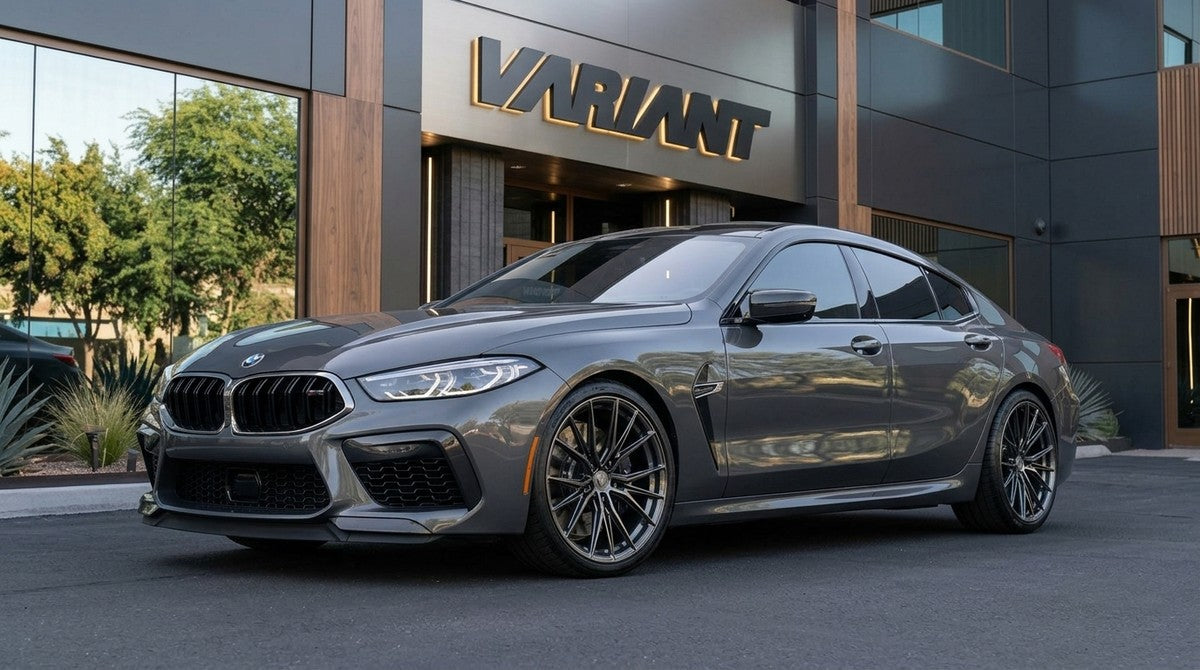
Key takeaways: The best wheels for the BMW M8 are true forged wheels in the factory-style 20-inch staggered sizing, with an offset that fills the arches without rubbing. Because the M8 weighs well over 4,000 pounds and makes more than 600 horsepower, weight and strength both matter, so a forged wheel that trims unsprung weight while keeping a high load rating is the smart pick. Stick with the 5x112 bolt pattern and 66.6 mm center bore, and match the staggered front-to-rear concept the car was designed around.
What are the best wheels for the BMW M8?
The best wheels for the BMW M8 are lightweight true forged wheels sized to the car's factory 20-inch staggered layout. The M8 (built as the F91 convertible, F92 coupe, and F93 Gran Coupe) is a heavy, powerful grand tourer, so the wheel has to do two jobs at once: cut rotational weight for sharper response, and carry serious load without flexing. Forged construction is the cleanest way to get both, which is why it is the default choice on cars in this class.
What size wheels does the BMW M8 use from the factory?
From the factory the M8 runs a staggered 20-inch setup, meaning the rear wheels and tires are wider than the fronts. Typical factory tire sizing is around a 275-width front and a 285-width rear, both on 20-inch wheels. The car uses a 5x112 mm bolt pattern and a 66.6 mm center bore, and factory rubber is usually run-flat. Most owners keep the 20-inch diameter when they upgrade, because it preserves the ride and speedometer accuracy while opening up finish and fitment choices. Confirm your exact trim's numbers against BMW's specifications and a reference like the BMW M8 overview.
BMW M8 wheel specs at a glance
| Spec | Typical M8 figure |
|---|---|
| Wheel diameter | 20 inches, staggered front to rear |
| Bolt pattern | 5x112 mm |
| Center bore | 66.6 mm (hub-centric) |
| Front tire (approx.) | 275/35 ZR20 |
| Rear tire (approx.) | 285/35 ZR20 |
| Curb weight | Roughly 4,300 to 4,500 lb depending on body |
Why do forged wheels make sense on a car as heavy as the M8?
Forged wheels make sense on the M8 precisely because it is heavy and fast. The S63 twin-turbo V8 makes more than 600 horsepower in Competition trim, and the car tips the scales well past 4,000 pounds. That combination puts real load through the wheels under braking, cornering, and hard launches. A forged wheel is made from a single billet of 6061-T6 aluminum compressed under enormous pressure, which aligns the grain of the metal and produces a part that is stronger for its weight than a cast wheel. That means you can shed unsprung weight, which the M8's suspension will thank you for, without giving up the load capacity a car this heavy needs. We explain the trade-offs in our guide to unsprung weight. Variant builds only true forged wheels, so there is no cast or flow-formed compromise in the lineup.
What offset and fitment should you run on an M8?
Offset (the distance between the wheel's mounting face and its centerline) is what makes an aftermarket wheel sit flush instead of poking or tucking. On the M8, a factory-style fitment lives in a moderate positive-offset window, and the safe path is to match a proven M8 or 8-series specification rather than guess. Because the hub bore is 66.6 mm, your wheels should be hub-centric to that size, or use hub-centric rings, so the wheel is centered by the hub and not by the lug bolts. If offset is new to you, start with our wheel offset guide. Variant's vehicle-specific fitments are engineered to the car so you are not left doing the math alone.
Should you run a staggered or square setup on the M8?
Staggered is the natural setup for the M8. The car was designed around wider rear wheels to put its power down, and both the rear-biased feel and the look benefit from that extra rear width. A square setup (the same size at all four corners) is something a few track-focused owners choose so they can rotate tires and carry one spare size, but for street driving the staggered concept is what suits the car. If you are weighing the two approaches, our breakdown of staggered vs. square setups walks through the trade-offs.
Where should M8 owners start?
Start with true forged wheels sized to the factory 20-inch staggered layout, in an offset proven for the chassis, and choose a finish that suits the car. Because the M8 shares its 8-series bones with the M850i, those fitments are a useful reference point, and the same forged approach that works on an M5 applies here. Browse Variant's 8-series and M5 fitments as a starting point, and see the related writeups best wheels for the BMW M850i and best wheels for the BMW M5 (F90). For a deeper look at the car itself, Car and Driver's BMW M8 coverage is a good outside reference.
Frequently asked questions
What size wheels does the BMW M8 come with?
From the factory the M8 runs a staggered 20-inch setup, typically around a 275-width front tire and a 285-width rear, on a 5x112 bolt pattern with a 66.6 mm center bore. Most owners stay at 20 inches when they upgrade.
What bolt pattern and center bore does the BMW M8 use?
The M8 (F91, F92, F93) uses a 5x112 mm bolt pattern and a 66.6 mm center bore. Wheels should be hub-centric to that bore, or use hub-centric rings, so the wheel is centered on the hub rather than on the lug bolts.
Are forged wheels worth it on the M8?
For a car that weighs well over 4,000 pounds and makes north of 600 horsepower, yes. Forged wheels are stronger for their weight than cast, so you can cut unsprung weight without giving up the load capacity a heavy, fast grand tourer needs.
Can you run a square setup on the M8?
You can, and some track-focused owners do it to rotate tires and simplify spares, but the M8 is designed around a staggered setup with a wider rear. For street driving, matching the factory staggered concept usually looks and drives best.
Written by Taylor Smith, co-founder of Variant Alloy Wheels, who has spent nearly two decades in the automotive aftermarket.
Share:
What Is Wheel Offset? Positive, Negative, and Zero Offset Explained
Do Forged Wheels Hold Their Value?