


Key takeaways: Are replica wheels safe? Not in the way most buyers assume. They are not illegal to own, but they are an unknown quantity. Most replicas are gravity-cast A356 aluminum copying the look of a forged design, with none of the grain structure, material density, or destructive testing behind the original. The certification marks stamped on them are frequently meaningless in the US market, where no federal agency verifies aftermarket wheel claims. If a wheel copies a known design, carries no serial or date stamp, and costs a fraction of the real thing, treat it as untested.
The question "are replica wheels safe" comes up constantly, and the honest answer is more complicated than yes or no. A wheel is the only structural component between your suspension and the road, and it sees fatigue loading every single rotation. So it is worth understanding exactly what you are buying.
What is a replica wheel?
A replica wheel is an aftermarket wheel that copies the visual design of an OEM or a well-known aftermarket wheel, sold under a generic name. You will see them listed as "replica," "reps," "style," or "inspired by." The design is copied. The engineering behind it is not.
This matters because a wheel design is not just a shape. The original was engineered around a specific spoke cross-section, hub thickness, and material spec, then validated by destructive testing. A replica manufacturer measures the outside of the wheel and reproduces the silhouette in a cheaper process. The load path inside the spoke is a guess.
How are replica wheels made differently from forged wheels?
Nearly all replicas are gravity cast: molten aluminum, usually A356 alloy, is poured into a mold and allowed to cool. It is fast and cheap. It also leaves the metal with a random grain structure and microscopic porosity, which is why cast wheels need more material to reach the same strength.
A true forged wheel starts as a solid billet of 6061-T6 aluminum that is squeezed under thousands of tons of pressure. Forging compresses the metal and aligns its grain flow to follow the shape of the part, which raises density and fatigue strength. That is the whole reason a forged spoke can be thinner and lighter than a cast spoke while carrying more load.
| Cast replica | True forged | |
|---|---|---|
| Process | Molten alloy poured into a mold | Solid billet pressed under extreme tonnage |
| Typical alloy | A356 casting alloy | 6061-T6 |
| Grain structure | Random, some porosity | Aligned grain flow, dense |
| Material needed for strength | More, so thicker spokes | Less, so lighter at equal strength |
| Design origin | Copied from another wheel | Engineered for a specific load case |
| Typical failure mode | Cracking, sudden fracture | Bending before cracking |
If you want the full breakdown of construction methods, we covered it in forged vs. flow-formed vs. cast wheels and how forged wheels are made, step by step.
Are replica wheels safe?
The direct answer: a replica wheel is an unknown. Some are adequate for a stock, lightly driven car. Many are not. The problem is that you cannot tell which one you have, because the thing that makes a wheel safe is testing you cannot see.
Cast aluminum does not fail the way forged aluminum does. Forged wheels tend to deform before they break, which gives you a bent rim, a vibration, and a drive home. Cast replicas are more likely to crack at the spoke-to-hub junction or fracture outright, especially after a pothole strike or a season of track heat cycles. Hagerty's reporting on counterfeit wheels documents exactly this pattern.
The risk scales with the car. A 4,000-pound sedan on 305-section rear tires puts loads through a wheel that a light hatchback never will. The heavier, faster, and grippier the car, the less margin a copied design has.
Do JWL, VIA, and TUV marks mean the wheel was actually tested?
Not necessarily, and this is the part most buyers get wrong.
- JWL is a Japanese government standard. The mark is required on wheels sold in Japan, but the stamp itself is cast or machined into the wheel by the manufacturer.
- VIA is third-party verification of a JWL claim, registered in Japan.
- TUV is German third-party approval, tied to specific vehicle applications.
- SAE J2530 is the North American performance standard for aftermarket passenger car wheels, covering cornering fatigue, radial fatigue, and impact.
Here is the catch: in the United States, no federal agency certifies aftermarket wheels or polices those markings. NHTSA regulates vehicles and some equipment, but it does not approve aftermarket wheel designs. A counterfeiter can put "JWL VIA" on a mold and nothing stops the wheel from shipping. The mark is only as good as the company standing behind it. We went deeper on this in are aftermarket wheels safe: testing standards explained.
How do you spot a fake forged wheel?
- Check the price against physics. Forging requires a billet, a press, and CNC machining time. A "forged" wheel at cast-wheel money is not forged.
- Look inside the barrel. Real manufacturers stamp or laser-etch a part number, size, offset, load rating, and often a date code or serial. Blank barrels are a red flag.
- Feel the unmachined surfaces. Cast wheels have a slightly grainy, pebbled texture on the inside of the barrel and around the spoke backs. Forged surfaces are smoother and show machining marks.
- Weigh it. If a seller claims forged 19x10 and the wheel lands well over 30 pounds, the claim does not hold up.
- Ask for documentation. A legitimate manufacturer can tell you the alloy, the heat treat, and what testing the design passed. Vague answers are an answer.
- Watch the naming. "Style," "replica," and "inspired by" in a product title means the seller is telling you it is a copy.
- Buy from the brand or an authorized dealer. This eliminates most of the problem outright.
What should you do if you already own replicas?
Do not panic, but do inspect them. Pull each wheel, clean the inside of the barrel, and look carefully at the spoke-to-hub transitions and the inner lip for hairline cracks. Any crack, anywhere, means the wheel comes off the car permanently, because welding a cast wheel does not restore it. If you get a persistent vibration that balancing will not fix, suspect runout from a bent or out-of-true wheel.
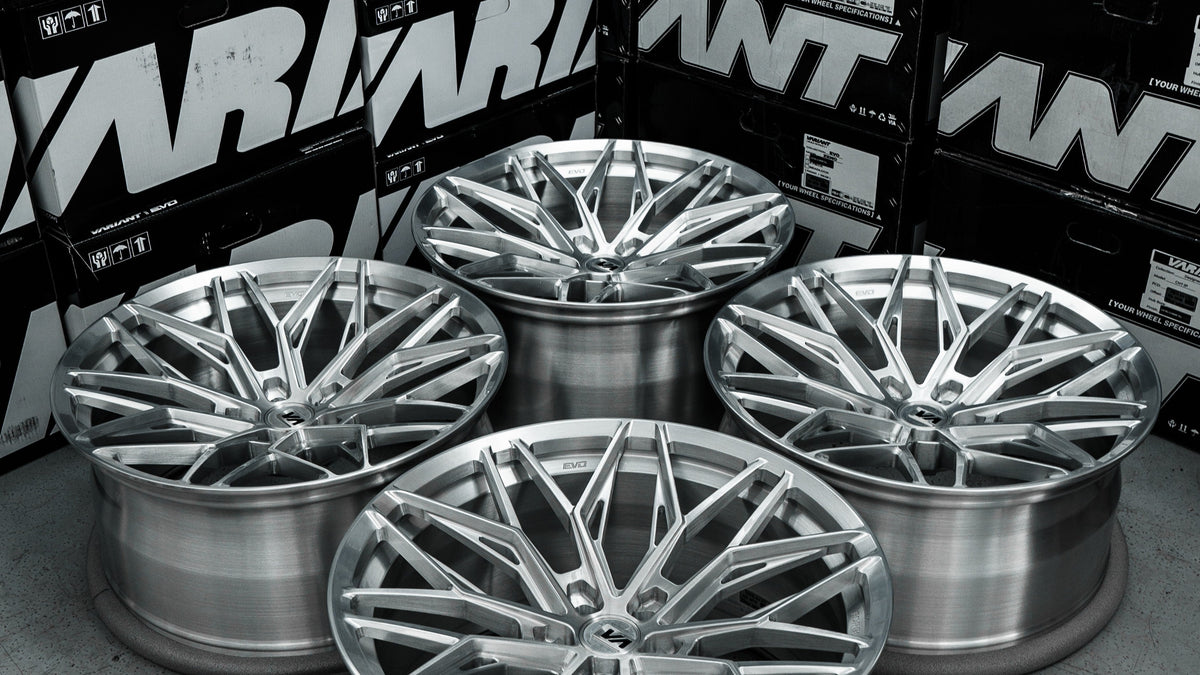
If you are replacing them, buy on engineering rather than looks. Variant builds only true forged wheels, made to order in the size and offset your car needs, across the Corsa, EVO, and broader forged wheel lineups. It costs more than a replica, and it is worth understanding why before you decide: are forged wheels worth it?
Frequently asked questions
Are replica wheels illegal?
Selling a wheel that copies a protected design can raise trademark and design-patent issues for the seller, but owning or driving on replicas is not itself illegal in the US. Legality is not the same as safety, and the safety question is the one that matters.
Can a replica wheel be forged?
A wheel can be forged and still be a design copy, but it is rare, because forging costs far too much to justify undercutting the original on price. In practice, the overwhelming majority of replicas are gravity cast, and "forged replica" listings should be verified with documentation before you believe them.
Do replica wheels pass inspection?
In most US states, wheels are not inspected beyond obvious damage and tire coverage, so replicas typically pass. That is a gap in inspection scope, not evidence that a wheel is structurally sound.
Are OEM takeoff wheels a better option than replicas?
Usually yes. A genuine factory wheel was engineered and validated for your car, and used takeoffs often cost less than new replicas. Inspect them for cracks, curb damage, and runout before buying, the same way you would with any used wheel.
How can I tell if my current wheels are cast or forged?
Check the barrel for markings, then look at the surface texture on unmachined areas. Cast wheels show a grainy, slightly porous texture; forged wheels are denser and smoother. Weight is the other tell, since a forged wheel is typically several pounds lighter than a cast wheel in the same size.
Written by Taylor Smith, co-founder of Variant Alloy Wheels, who has spent nearly two decades in the automotive aftermarket.
Share:
What Wheel Size Should You Run on a Corvette C8? 19/20 vs. 20/21 Explained